Three-day hypertrophy training: splits, volume and examples
Choose between full body, hybrid splits and PPL, distribute volume without endless sessions and adjust when your routine changes.


If you want to progress in the gym without depending on a five- or six-day routine, a 3-day workout split can be a very useful structure for building muscle consistently. The point here is not training less. It is training at a frequency you can actually sustain.
Many people go wrong precisely by following a split that looks great on paper but does not survive a real week. And when frequency breaks, training loses power fast. That is why a well-built 3-day split usually works better than a more complete plan that lasts two weeks. If you are still deciding between different types of split, pair this article with Full body vs. split training.
In SelfShapeAI, that logic gets even stronger because the plan is not born as a generic sheet. It is born from your real frequency, your goal, your limitations and your routine. And after it is created, it stays adjustable — the thinking behind AI training.
Contents
- 1. What is a 3-day workout split?
- 2. Who the 3-day split works really well for
- 3. Does a 3-day split deliver muscle gains?
- 4. How to build a 3-day workout split
- 5. Option 1: Push / Pull / Legs
- 6. Option 2: Upper / Lower / Full Body
- 7. Option 3: Chest and back / Legs / Shoulders and arms
- 8. How many exercises, sets and reps to use?
- 9. How to progress on a 3-day split
- 10. Common mistakes in a 3-day split
- 11. How SelfShapeAI makes this process smarter
- 12. Weekly schedule examples for a 3-day split
- 13. Missed one of the three days? Continue the sequence
- 14. Is a 3-day split worth it?
- 15. Frequently asked questions
- 16. A 3-day split makes sense when it keeps working when the week gets busy
What is a 3-day workout split?
A 3-day split is a routine where your week is organized into three sessions with clear roles. Instead of trying to do everything on any given day, you distribute the stimulus more logically to train with more focus, control per-muscle volume better, recover better between sessions and fit the gym more realistically into your schedule.
In practice, that can mean training Monday, Wednesday and Friday, or Tuesday, Thursday and Saturday. What matters most is not the name of the split. It is how the week's volume is distributed and how well that structure holds up when life gets busy.
Turn understanding into a workout you can follow
SelfShapeAI uses your routine and goal to build an explained plan, log every session and guide the next adjustment.




Download for free. Annual: R$ 299,90/year, equivalent to about R$ 25/month; monthly: R$ 39,90/month. See how AI training works.
Who the 3-day split works really well for
- Beginners who need a simple, efficient routine.
- Intermediates who want hypertrophy without depending on five sessions per week.
- People with a tight schedule.
- Anyone who wants to train with good recovery.
- Anyone chasing consistency without constantly rebuilding the plan.
It also works for people who have understood something important: training more often does not always mean training better. In many cases, three good, consistent, progressive workouts deliver more than five mediocre ones.
Does a 3-day split deliver muscle gains?
Yes. Training 3 times per week can produce excellent hypertrophy results when the plan is well built. What defines the result is not just the number of days. It is the whole picture: exercise selection, weekly volume, intensity, proximity to failure, recovery, nutrition, progression and consistency.
Frequency primarily distributes work. Volume-matched reviews find similar results between full-body and split routines and between higher and lower frequencies. Three days are useful when they let you accumulate quality sets, progress and recover. Explore How many sets to build muscle, How to build more muscle and the Practical RPE and RIR guide.
How to build a 3-day workout split
There is no single perfect split for everyone. The best choice depends on your level, your goal, your recovery and how well you can sustain the week. In practice, three models tend to work very well.
| Model | Distribution | Strength | Watch for |
|---|---|---|---|
| Full body three times weekly | Whole body in all three sessions | Repeats movements and distributes volume | Manage compound-exercise fatigue and session length |
| Full body plus upper/lower | One general, one upper and one lower workout | Combines frequency with focused sessions | Full body should complement rather than duplicate all other-day volume |
| Three-day PPL | Push, pull and legs once per cycle | Clear, themed sessions | Concentrated volume; one missed session can leave a group untrained for many days |
Option 1: Push / Pull / Legs
This familiar three-day split trains chest, shoulders and triceps on day 1; back, biceps and rear deltoids on day 2; quadriceps, hamstrings, glutes and calves on day 3. It suits themed-session preferences, but three-day PPL usually gives each group direct work only once weekly. That concentrates volume and makes missed sessions more costly. Full body or a hybrid may distribute opportunities better. See the Complete Push Pull Legs guide and Full body or split comparison.
- Day 1: bench press, incline dumbbell press, military press, lateral raises, cable triceps pushdown, overhead triceps extension.
- Day 2: lat pulldown, bent-over row, seated cable row, barbell curl, alternating dumbbell curl, shrugs.
- Day 3: back squat, leg press, leg extension, stiff-leg deadlift, lying leg curl, standing calf raise.
Option 2: Upper / Lower / Full Body
This structure is very useful for anyone who wants to mix focus with frequency. The first day works the upper body, the second the lower body, and the third reinforces the whole body with focus on the most important patterns. It works especially well when you want to repeat key stimuli across the week without leaving too large a gap between them.
- Day 1: incline bench press, single-arm row, dumbbell shoulder press, wide-grip pulldown, barbell curl, rope triceps pushdown.
- Day 2: squat, stiff-leg deadlift, leg press, lying leg curl, leg extension, seated calf raise.
- Day 3: Romanian deadlift, dumbbell bench press, seated cable row, lunge, lateral raises, abs.
If your focus is gaining muscle without making training hostage to a perfect routine, this is usually a very useful choice. To see how SelfShapeAI helps create this kind of structure, visit AI training.
Option 3: Chest and back / Legs / Shoulders and arms
This split tends to please people who like giving extra aesthetic attention to the torso and arms without giving up a strong leg day. It can deliver a lot when you already know you want more upper-body attention. The caution is not turning the plan into something visually seductive but badly distributed. Back and legs cannot become an afterthought.
- Day 1: bench press, incline press, machine fly, lat pulldown, bent-over row, chest-supported row.
- Day 2: back squat, leg press, stiff-leg deadlift, seated leg curl, leg extension, calves.
- Day 3: military press, lateral raises, reverse fly, barbell curl, hammer curl, skull crushers, cable triceps pushdown.
How many exercises, sets and reps to use?
A successful three-day plan does not require a magic exercise count. Start with tolerable weekly volume, distribute it and check whether later sets maintain effort and technique comparable to early sets. Four to seven exercises with two to four working sets can be a practical reference, not a requirement. If sessions exceed available time or execution deteriorates, reduce redundancy or change the split.
- Compounds can use lower or moderate reps while technique and joints remain stable.
- Machines and isolation exercises can use moderate or higher reps sufficiently close to failure.
- Hypertrophy does not require staying within 8–12 reps; load, effort, range and progression must work together.
Three training days do not mean doing everything every day. Inflated sessions often reduce quality and prolong recovery. Combine Weekly volume, Rest between sets, Range of motion, Training to failure and Warm-up sets.
How to progress on a 3-day split
Three weekly sessions can produce progress when progression is observable. Add reps within the planned range, increase load once sets are stable, improve range and technique, or add volume only when performance and recovery justify it. Shorter rests are not progress if they reduce the next exercise's reps.
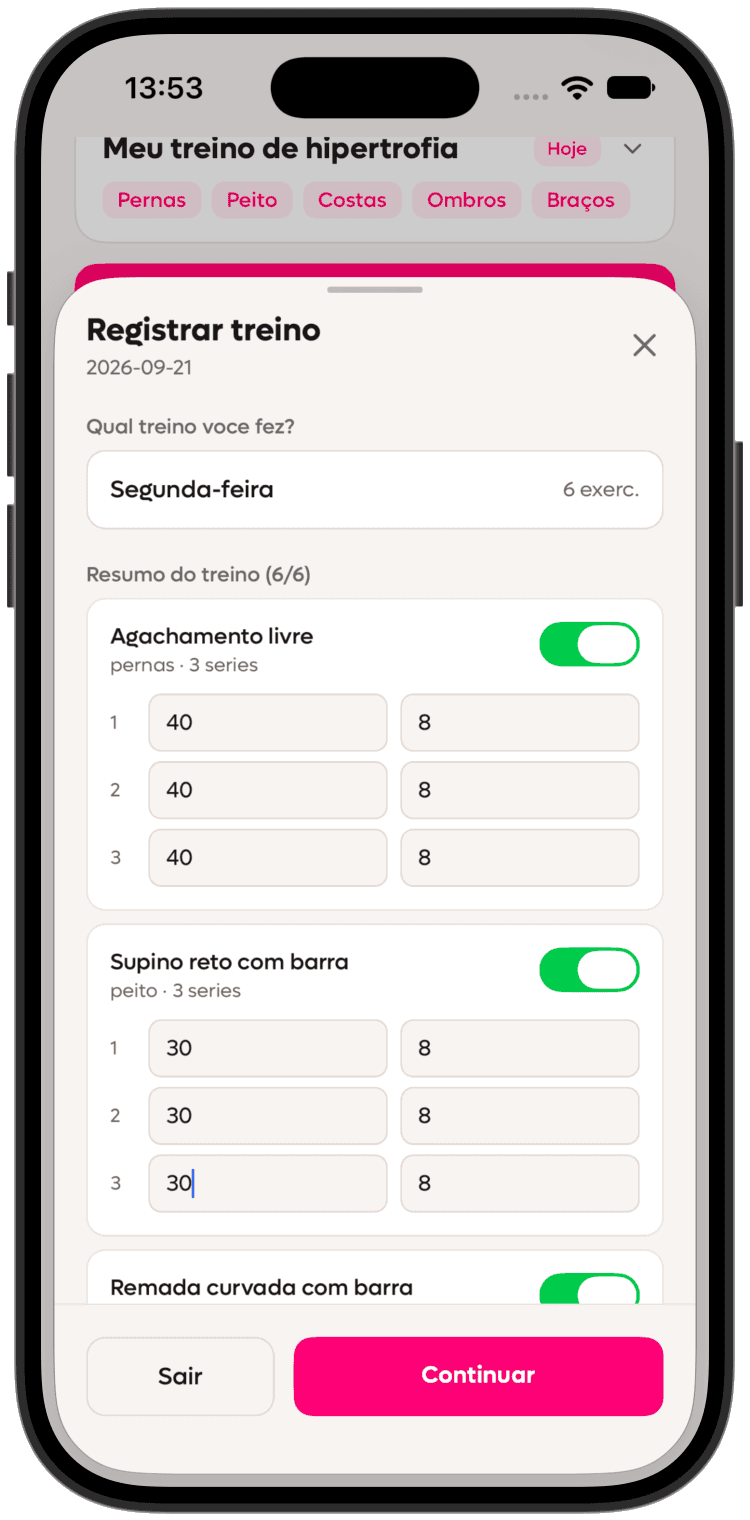
In practice, training only stops working when it becomes repetition without reading. That is why logging load, reps, check-ins and history makes sense. To go deeper into progression logic, the best complements are progressive overload and the RPE effort scale.
Common mistakes in a 3-day split
- Trying to compensate by training everything at once and turning every session into a marathon.
- Ignoring progression and repeating week after week without criteria.
- Picking random exercises with no clear split logic.
- Underestimating legs or back while over-focusing on chest and arms.
- Disrespecting recovery, sleep, nutrition and accumulated fatigue.
These mistakes get even worse when you have no system showing what was planned versus what was actually executed. That is where training analysis makes the difference.
How SelfShapeAI makes this process smarter
In the real world, the problem is not just knowing that 3-day splits exist. The challenge is deciding which split suits you, how much volume to use, how to adjust the plan when the week changes, how to track progress and when to keep, swap or progress. That is exactly where SelfShapeAI comes in.
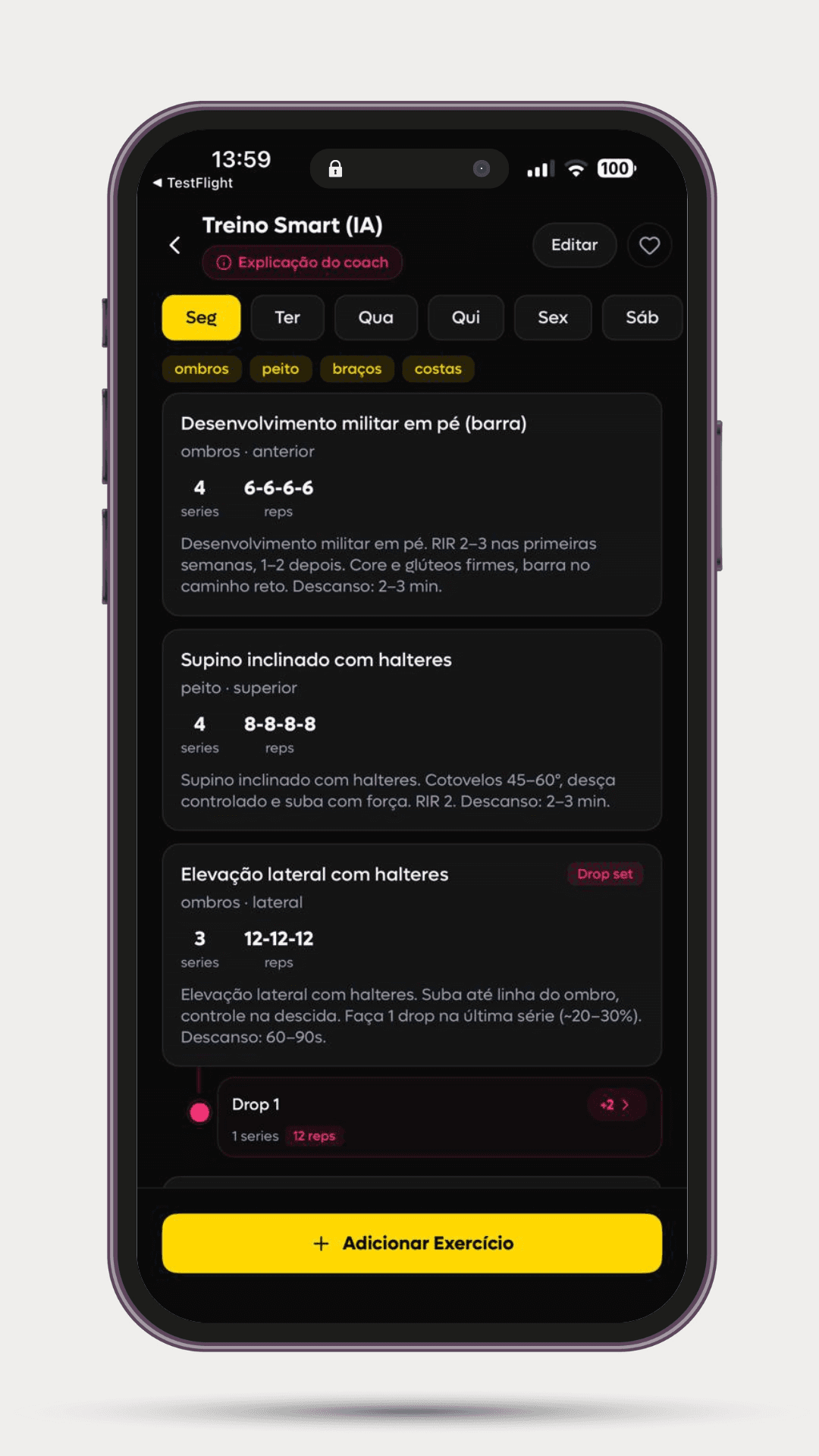
At the start of the process, your weekly frequency enters as real context, with training days that fit your routine. From there, the plan can be created with AI, adjusted, or built more manually. And that generation is not vague: it can consider extra context, preferred methodology and weekly scope.
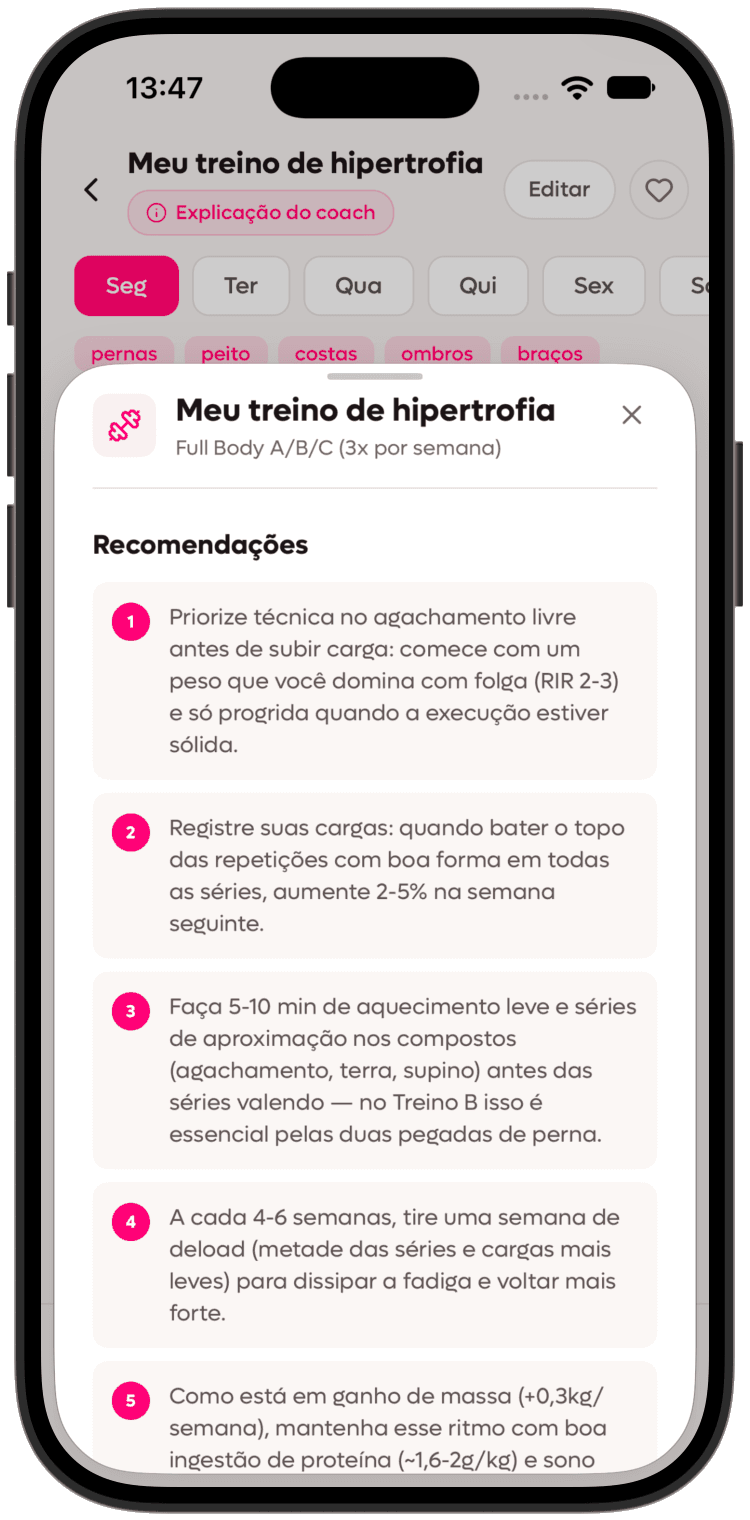
Once the plan is born, you are not stuck with a mute sheet. The plan explanation shows the chosen split, the training logic and the recommendations. That helps you understand why your 3-day split was built that way before you simply start executing.
There is also the part missing from most routines: adjustment. If the plan feels too heavy, an exercise does not fit or you missed one of the week's three sessions, the AI Coach helps reorganize without dismantling everything. Instead of starting over, you adjust the structure with criteria.
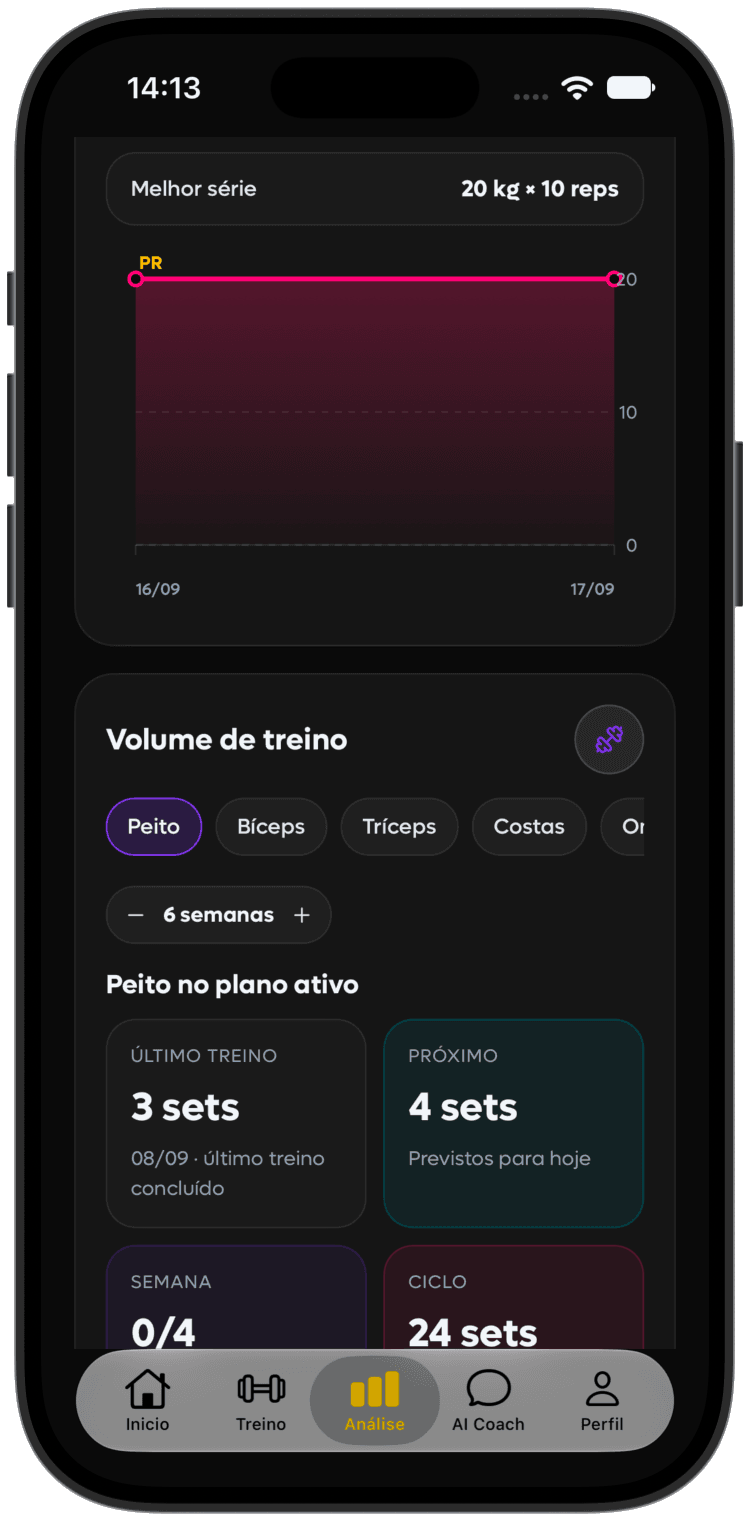
Finally, training analysis closes the loop. It is where you cross the plan with execution and track planned versus performed volume. That answers a decisive question for anyone training 3 days: is the problem the split itself or the way the week was executed? If the plan called for a certain volume and you delivered far less, the reading changes completely. See everything that supports this in features.
Weekly schedule examples for a 3-day split
- Monday / Wednesday / Friday.
- Tuesday / Thursday / Saturday.
What matters most is leaving enough room for recovery between sessions, especially when training is heavier or weekly volume has grown. And if your routine changes phase, there is no problem keeping different versions of the same plan. SelfShapeAI's plan library helps exactly with that: you can sustain different structures for different phases without losing organization.
Missed one of the three days? Continue the sequence
Treat workouts as A, B and C, not sessions that expire on Sunday. If you miss B, do B next, then C. This usually preserves balance better than combining days, skipping legs or always restarting your favorite workout. Missing full body tends to have less impact because all groups appear again; continuing the sequence is especially important in three-day PPL.
Is a 3-day split worth it?
It can make a lot of sense when that is the frequency you can actually keep. A 3-day plan can work very well for hypertrophy, strength and body recomposition. What it needs is not glamour. It needs structure, well-distributed volume, progression and adaptation. In the end, a strategy you can repeat for months almost always beats a perfect plan that cannot survive your schedule.
Frequently asked questions
- Does training 3 times a week deliver results?Yes. With structure, progression and consistency, 3 workouts per week can produce excellent results.
- Can beginners follow a 3-day split?Yes. This frequency is often excellent for starting with more organization and regularity.
- Which 3-day split is best for hypertrophy?It depends on your context. Push/Pull/Legs and Upper/Lower/Full Body tend to work very well, but the best choice is the one that matches your recovery, your routine and your goal.
- Can you grow training only Monday, Wednesday and Friday?Yes. That is actually one of the most common and practical distributions for gaining muscle with good adherence.
- Do I need to change the plan frequently?Not necessarily. It usually pays more to progress well inside a solid structure before swapping everything. When something really needs to change, adjust with criteria, not on impulse.
A 3-day split makes sense when it keeps working when the week gets busy
In the end, a 3-day split is not a lesser plan. It is a very strong strategy for anyone who wants results with more adherence, good recovery and less improvisation. When weekly volume is well distributed and the structure matches your real life, three sessions a week can deliver a lot.
A system that helps generate, explain, adjust and track the plan makes execution clearer. That is where SelfShapeAI fits. Explore AI training, see the features, compare Pricing and open SelfShapeAI to build or adjust your three-day routine.
Sources and references
- Source: Schoenfeld BJ, Grgic J, Krieger J. How many times per week should a muscle be trained to maximize muscle hypertrophy? A systematic review and meta-analysis. J Sports Sci, 2019. — Journal of Sports Sciences (PubMed)
- Source: Schoenfeld BJ, Ogborn D, Krieger JW. Dose-response relationship between weekly resistance training volume and increases in muscle mass: a systematic review and meta-analysis. J Sports Sci, 2017. — Journal of Sports Sciences (PubMed)
- Source: Ramos-Campo DJ et al. Efficacy of Split Versus Full-Body Resistance Training on Strength and Muscle Growth: A Systematic Review With Meta-Analysis. J Strength Cond Res, 2024. — Journal of Strength and Conditioning Research (PubMed)
- Source: Currier BS et al. ACSM Position Stand: Resistance Training Prescription for Muscle Function, Hypertrophy, and Physical Performance in Healthy Adults. Med Sci Sports Exerc, 2026. — American College of Sports Medicine (PubMed)
- Source: Lopez P et al. Resistance Training Load Effects on Muscle Hypertrophy and Strength Gain: Systematic Review and Network Meta-analysis. Med Sci Sports Exerc, 2021. — Medicine & Science in Sports & Exercise (PubMed)
Reviewed by the SelfShapeAI research team using strength-training guidelines and studies.
Take this method to the app

Create your plan with AI, log check-ins and use the AI Coach to adjust training with context.
Share
SelfShapeAI Team
SelfShapeAI technical and editorial team.
Keep learning

Recommended next article
Upper/lower split: what it is, how to build it and when this split makes sense
Build an upper/lower split for hypertrophy by matching volume, recovery and progression to your routine.
Continue →