Back and biceps training: build a complete, balanced pull day
Understand why back and biceps usually work well together, which exercises really matter and how to organize a pull day that makes sense in your routine.


Some workouts change how a physique reads almost without needing explanation. Back is very much in that group. It adds more presence, more width, more density and more structure to the torso as a whole. And when back training goes along with good biceps work, the session usually gets even more coherent.
But this is also where many people get lost. They do a pulldown, a row, add two more machines, finish with a bunch of curls and leave with the forearm burning, but without knowing whether they actually trained back or just tired the arms. The problem is usually not lack of exercise. It is lack of logic.
Back and biceps on the same day usually work well because they share pulling patterns. This shows up clearly in a push/pull/legs, but it does not have to be locked to that split. The same logic can enter an upper/lower split, a full body workout or even a leaner week like a 3-day workout split. What matters is not the name of the split. It is the coherence of the session.
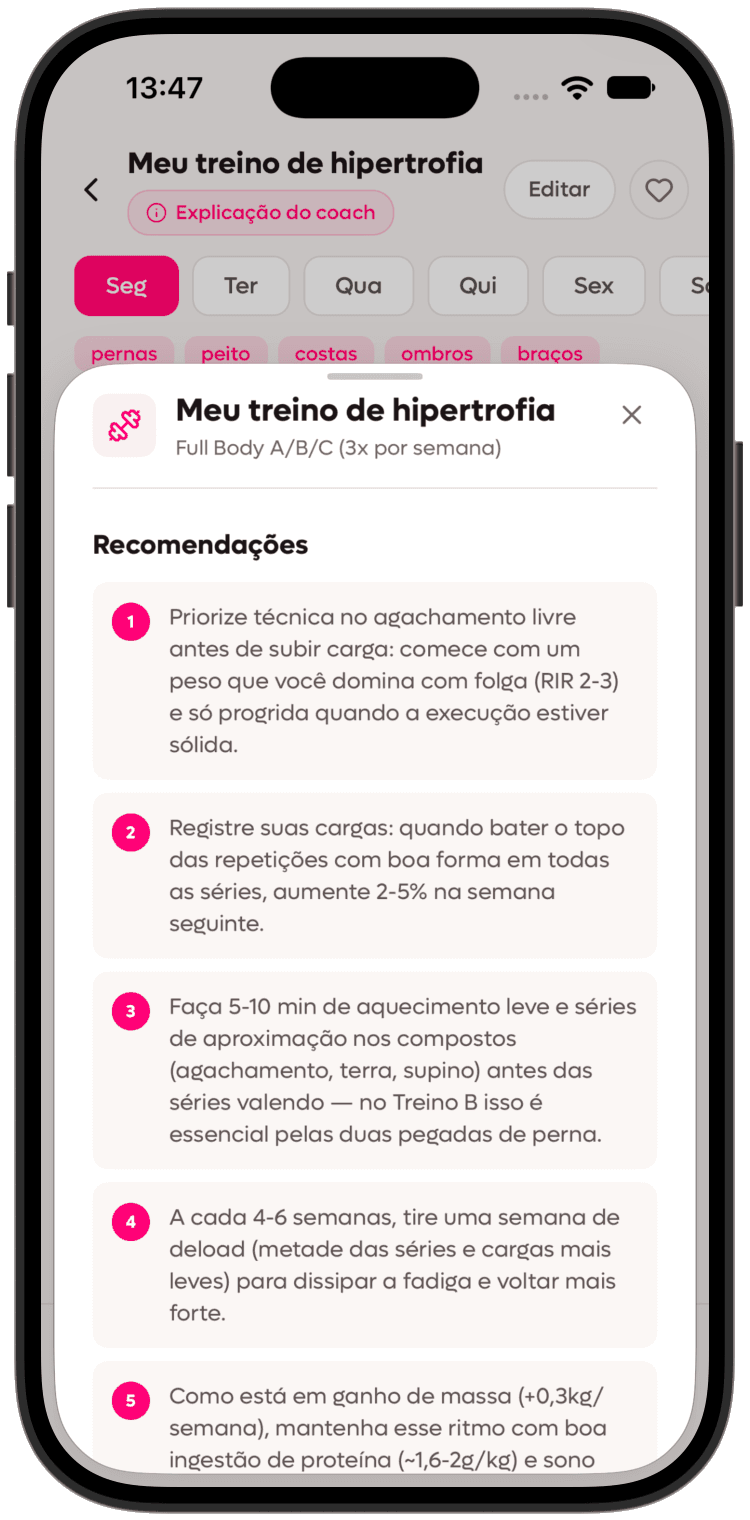
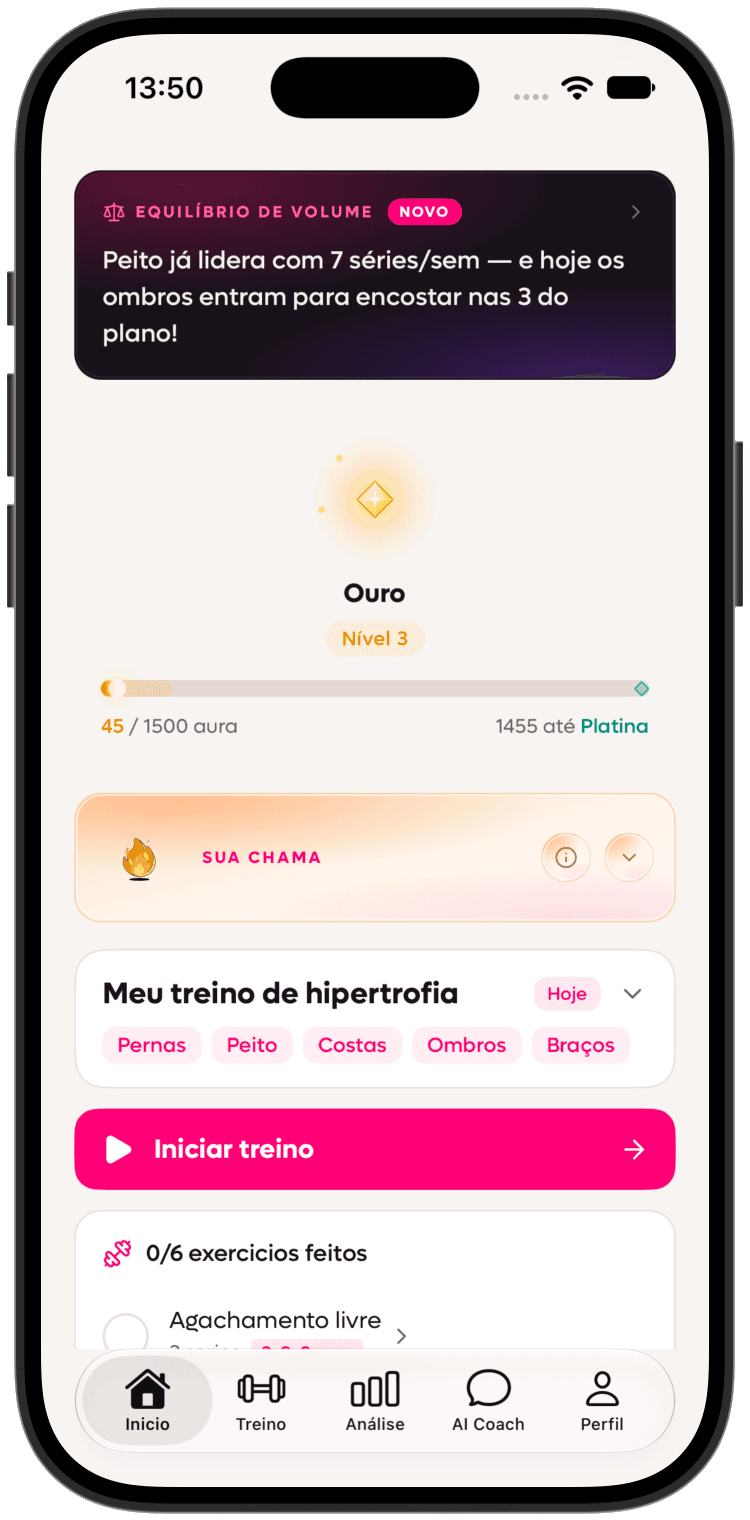
In SelfShapeAI, this kind of workout gets easier to sustain because the pull day is not born as a random list of pulls. It is born with context, real frequency, an explanation of the plan's logic and room to adjust over time. To understand this proposal better, also open Intelligent AI-powered training, What is SelfShapeAI and How to use SelfShapeAI.
Contents
- 1. Why train back and biceps together
- 2. What you are actually training
- 3. Lats
- 4. Mid and upper back
- 5. Rear delt and scapular control
- 6. Biceps, brachialis and forearm
- 7. The logic of a pull day that actually works
- 8. Exercises that actually make sense
- 9. 1. Pull-up or lat pulldown
- 10. 2. Bent-over, supported or machine row
- 11. 3. Seated cable row
- 12. 4. Straight-arm pulldown or face pull
- 13. 5. Barbell curl
- 14. 6. Incline or alternating curl
- 15. 7. Hammer curl
- 16. How to build a pull day in practice
- 17. The mistakes that most stall this workout
- 18. 1. Feeling only the biceps in the pulls
- 19. 2. Doing only one type of stimulus for the back
- 20. 3. Letting the lower back limit everything
- 21. 4. Turning the workout into an endless session
- 22. 5. Not progressing anything for weeks
- 23. How to fit back and biceps into the week
- 24. Where SelfShapeAI comes into this
- 25. Frequently asked questions
Why train back and biceps together
Back and biceps are usually trained together for a very simple reason: when you pull, your back does the main work and the biceps helps out through a good part of the movement. That applies to pull-ups, front pulldowns, rows and many other variations.
- Organizes the session by movement pattern.
- Avoids separating muscles that already work together.
- Makes recovery more predictable.
- Helps build a workout with a beginning, middle and end.
But an important nuance: this does not mean back and biceps always need to be on the same day. In an upper body session, for example, the biceps can share space with chest, shoulders and triceps within an upper-body workout. In a full body or split, it can show up diluted across the week. The pull day is a useful structure. It is not a universal rule.
Turn understanding into a workout you can follow
SelfShapeAI uses your routine and goal to build an explained plan, log every session and guide the next adjustment.




Download for free. Annual: R$ 299,90/year, equivalent to about R$ 25/month; monthly: R$ 39,90/month. See how AI training works.
What you are actually training
Talking about back as if it were a single thing usually leaves training shallow. A well-built pull day gets better when you understand the role of each block.
Lats
The lats are usually associated with the sense of width. They show up a lot in vertical pulls, like pull-ups and lat pulldowns, and also in some rows when execution favors that path.
Mid and upper back
Here come the rhomboids, mid traps and other muscles that help add more thickness, more scapular stability and more consistency to rows. If your workout only has vertical pulls, it tends to stay incomplete.
Rear delt and scapular control
Not every back workout needs to become a shoulder workout, but rear deltoids participate in many rows and can receive direct work when prioritized. Face pulls and reverse flyes are options, not compulsory posture or shoulder-health exercises.
Biceps, brachialis and forearm
In the arm, the biceps draws the most attention, but it does not work alone. The brachialis and forearm also come into play. That is why a good pull day usually finishes with well-chosen curls, not ten variations because there was no criteria at the start of the session.
If you want to read this kind of organization with more foundation, cross this section with How many sets to build muscle and the practical RPE and RIR guide.
The logic of a pull day that actually works
Back and biceps training can follow a simple structure adapted to the cycle's priority:
- Put the exercise where performance and progression matter most first.
- Combine a vertical pull and horizontal row without repeating equivalent variations.
- Add a third movement only if it covers a missing function or priority.
- Dose direct biceps work to fit weekly volume and elbow recovery.
- Rest enough that grip or breathing does not limit the back before the target muscles.
Exercises performed early tend to receive more reps and gain more strength. Compounds need not always come first: if biceps are the priority, a curl can open the session. For hypertrophy, order seems less important than completing planned volume with appropriate effort.
Another important point: the back does not need an infinite amount of exercises to deliver. What it needs is coherent stimulus, good execution and readable progression. If the session becomes a tour of every machine in the gym, you lose quality before gaining results.
Exercises that actually make sense
1. Pull-up or lat pulldown
Pull-ups and pulldowns train a vertical pattern involving lats, upper back, biceps and grip. Pull-ups suit those who can control bodyweight reps; pulldowns simplify resistance and rep-range adjustment. Neither is universally required.
- Use a repeatable range without changing torso position each rep.
- Adjust grip and path for comfort and execution, rather than a perfect-width rule.
- Avoid increasing load by progressively shortening the movement.
- Record load, reps and RIR; muscle sensation may help but cannot replace these data.
If the pull-up does not fit yet, that does not disqualify the workout. It just means the front pulldown may be the best tool for the moment.
2. Bent-over, supported or machine row
Rows train a horizontal pattern involving lats, trapezius, rhomboids, rear deltoids and elbow flexors. Arm position and path alter emphasis, but no row isolates only one region. Not every row needs to be a bent-over barbell row.
- A supported row reduces the noise on the lower back.
- A machine makes technique more stable.
- Variations with chest support help focus more on the back.
- The bent-over row is still great, but it does not have to be the only good answer.
If the lower back becomes a bottleneck early, it is worth choosing a more stable variation. That usually improves the quality of the set instead of worsening the workout.
3. Seated cable row
The seated cable row fits very well as a second or third back block because it allows good range, a more controlled tempo and great connection with the mid back.
- Pull with the elbow.
- Hold the contraction for a moment.
- Do not turn the return into total relaxation.
- Keep the trunk stable.
This exercise also helps avoid a common mistake: doing only vertical pulls and forgetting that a strong back also needs consistent rows.
4. Straight-arm pulldown or face pull
Not every pull day needs both, but at least one of them usually enriches the session a lot. The straight-arm pulldown can help those who want more attention on the lats without so much biceps involvement. The face pull, in turn, fits very well when the focus is the rear delt, the scapula and the overall quality of the upper back.
This is the kind of block that does not need ego. It needs control.
5. Barbell curl
The barbell curl is still a classic for a good reason: it delivers consistent tension and makes progression easy to track.
The problem is when it becomes a lower-back, hip and momentum movement. Then the exercise leaves the biceps and turns into anything. Better less weight and more control than a bar jerking up.
6. Incline or alternating curl
After the main curl, this one usually fits very well to complement with more range, more control and cleaner work on each side.
- Helps correct differences between the arms.
- Improves the reading of the eccentric phase.
- Gives more attention to the biceps without depending only on the bar.
7. Hammer curl
The hammer curl usually closes the workout well because it talks to the brachialis and forearm, helping add more density to the arm as a whole.
It does not necessarily replace the barbell curl. In most cases, it complements. It is this kind of combination that usually makes the biceps block more complete without becoming excessive.
How to build a pull day in practice
A coherent example of a back and biceps workout might look like this:
- Pulldown or pull-up: two to three working sets in a range supporting stable execution.
- Supported, cable or machine row: two to three working sets.
- Straight-arm pulldown, another row or rear deltoids: two sets only if they address a real priority.
- Barbell, incline or cable curl: two to three sets.
- Hammer curl or another variation: two optional sets based on indirect volume and recovery.
This example provides six to eight direct back sets and two to five biceps sets per session. It is not a universal dose: add work from other sessions and adjust to your response using how many sets to build muscle.
This does not need to be copied to the letter. The point is the logic. In some cases, three back exercises already solve it very well. In others, it is worth adding one more block for the rear delt or lats. What rules is context, not attachment to a fixed spreadsheet. If you like comparing week structures, cross this with 4-day workout split, 5-day workout split and Push/pull/legs.
The mistakes that most stall this workout
1. Feeling only the biceps in the pulls
This is one of the most common mistakes. People do pulldowns, rows and pull-ups and everything seems to become an arm workout. This usually happens due to load that is too heavy, little scapular reading, bad range or rushing to finish the set.
2. Doing only one type of stimulus for the back
One pattern can leave functions unaddressed, but many variations are unnecessary. A well-chosen pull and row cover substantial work; a third exercise should have a clear reason.
3. Letting the lower back limit everything
If every heavy row ends up stalling because the lower back tired first, maybe the problem is not lack of back strength. Maybe the exercise choice is bad for that moment. For many people, a supported row delivers better than insisting on a free variation the whole time.
4. Turning the workout into an endless session
A pull day does not need ten exercises to work. A session that is too long usually dilutes quality, increases improvisation and makes progression harder.
5. Not progressing anything for weeks
Progress can mean more load or reps with comparable exercise, range and effort. Improving inconsistent technique makes comparisons better, without necessarily constituting overload by itself.
If none of that changes, the workout may tire you but does not necessarily get better. If this point is still unclear, review Simple progression: when to add weight, How to get stronger with SelfShapeAI and Warm-up sets: how to do them and when to use them.
How to fit back and biceps into the week
This kind of session can enter very different contexts. In a push/pull/legs, it shows up more directly as a pull day. In an upper/lower split, back and biceps can share space with chest, shoulders and triceps within the upper days. In a full body workout, part of the back work can be distributed across two or three weekly sessions.
In other words: back and biceps together make sense in many contexts, but they are not a universal obligation. What defines the best fit for you is routine, real frequency, recovery and adherence. This is exactly where SelfShapeAI gets more useful, because it helps choose and adjust the structure based on your current moment, not on an idealized model.
Where SelfShapeAI comes into this
First, it helps build the workout with more context. Instead of stacking pulls and curls in the dark, you can create a plan based on goal, weekly frequency, current level and available equipment. That already avoids much of random training.
Then comes the explanation of the plan's logic. This point matters because many people execute the workout without understanding why the vertical pull comes first, why the supported row was chosen or why the biceps block ended up smaller than they imagined. When the logic is clear, the session becomes easier to follow consistently.
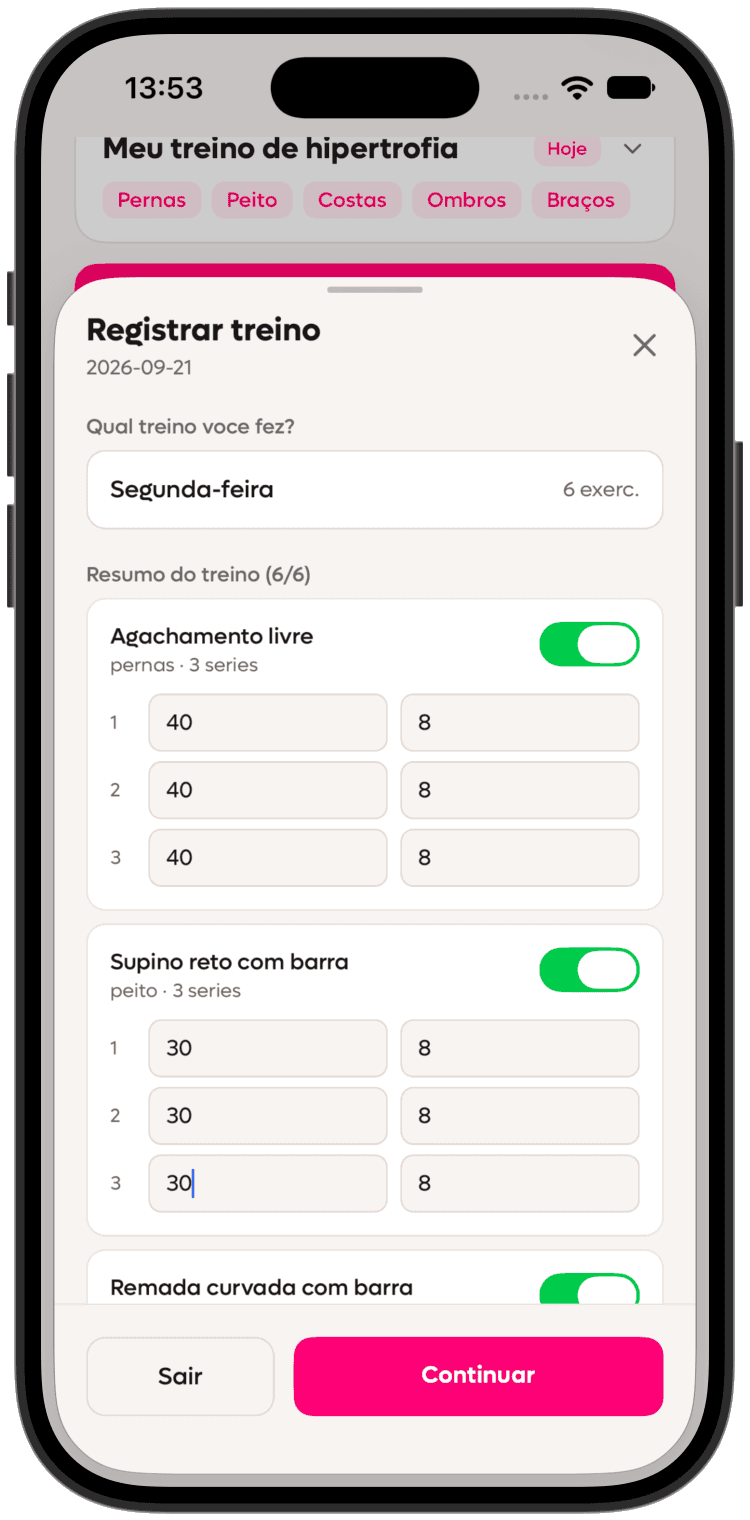
During execution, SelfShapeAI also helps log weight, reps, sets and notes. In a back and biceps workout, this is especially useful for notes like feeling more biceps than lats, noticing the bent-over row tired the lower back too much, spotting that the neutral pulldown fit better or understanding when the barbell curl lost form early.
Those notes, combined with check-ins, make the adjustment smarter. Instead of switching exercises on a guess, you start understanding what is working and what needs to change.
SelfShapeAI shows volume, muscle groups, records and load per exercise. For pull days, check whether rows and pulls progress and the biceps block fits the week.
AI Coach discusses alternatives in the active plan, such as replacing pull-ups with adjustable pulldowns or free rows with supported versions. Persistent or intense pain needs professional assessment, not app diagnosis. Explore AI training, features and pricing.
Frequently asked questions
- Do back and biceps always need to be on the same day?No. This combination usually works well because both groups show up in pulling patterns, but it is not mandatory in every routine.
- Do I need pull-ups to have a good pull day?No. Pulldowns, neutral-grip pulls and assisted versions are viable when they allow a more suitable rep range and execution.
- How many back exercises are enough in a session?Two or three complementary choices cover many contexts: one pull, one row and an optional third block. Dose depends on weekly volume, effort and recovery.
- If I only feel the biceps, what could be wrong?Usually load that is too heavy, little scapular reading, bad range, rushed technique or an exercise choice that is a bad fit for your moment.
- Does the hammer curl replace the barbell curl?In most cases, no. It usually complements the session well, especially through the brachialis and forearm work.
- Does SelfShapeAI help build this kind of workout?It does, because this kind of session depends on context. The app helps build, explain, adjust, log and track the workout without letting the pull day become improvisation.
A good back and biceps workout combines pulls and rows logically, uses biceps work thoughtfully and remains coherent week after week. Explore AI training, features, pricing and SelfShapeAI to put it into practice.
Sources and references
- Source: Nunes JP et al. What influence does resistance exercise order have on muscular strength gains and muscle hypertrophy? A systematic review and meta-analysis. Eur J Sport Sci, 2021. — European Journal of Sport Science (PubMed)
- Source: Currier BS et al. American College of Sports Medicine Position Stand. Resistance Training Prescription for Muscle Function, Hypertrophy, and Physical Performance in Healthy Adults. Med Sci Sports Exerc, 2026. — ACSM (PubMed)
- Source: Pelland JC et al. The Resistance Training Dose-Response: Meta-Regressions Exploring the Effects of Weekly Volume and Frequency on Muscle Hypertrophy and Strength Gain. Sports Med, 2025. — Sports Medicine (PubMed)
Reviewed by the SelfShapeAI research team using strength-training guidelines and studies.
Take this method to the app

Create your plan with AI, log check-ins and use the AI Coach to adjust training with context.
Share
SelfShapeAI Team
SelfShapeAI technical and editorial team.
Keep learning

Recommended next article
Full body vs. split training: which routine makes more sense for your goal?
Find out when full body or a split makes more sense for hypertrophy, a busy schedule and muscle focus.
Continue →