Four-day hypertrophy training: splits and volume
Compare upper/lower, full body and hybrid splits to distribute weekly work without turning the fourth day into volume you cannot recover from.


Training 4 times a week is often a very useful balance point for anyone who wants to gain muscle with more structure, without depending on an extreme five- or six-day routine. The gain is not just training more. It is spreading the week's volume better, shrinking giant sessions and raising training quality.
The problem is that many people go from 3 to 4 days the wrong way. Instead of redistributing what already worked, they simply add one more packed workout. The result is predictable: more fatigue, worse recovery, falling performance and the false feeling that frequency is the problem. In practice, the problem is almost always how the volume was organized. If you are still consolidating the previous frequency, compare this article with the 3-day workout split and Full body vs. split training.
In SelfShapeAI, this kind of adjustment makes much more sense because the plan does not have to be born as a fixed sheet. It can be generated, explained, adjusted and tracked with more clarity — the approach behind AI training.
Contents
- 1. What is a 4-day workout split?
- 2. Main advantages of a 4-day split
- 3. Is 4 days enough to gain muscle?
- 4. The main 4-day training splits
- 5. 1. Upper / Lower over 4 days
- 6. 2. Push / Pull / Legs + 1
- 7. 3. Bro split adapted to 4 days
- 8. 4. Full body over 4 days
- 9. 5. PHUL over 4 days
- 10. How to know which 4-day split suits you
- 11. The most common mistake when moving from 3 to 4 days
- 12. How SelfShapeAI makes this process smarter
- 13. How to know you are gaining muscle with this split
- 14. Frequently asked questions
- 15. Training 4 days works best when frequency rises but the mess does not
What is a 4-day workout split?
A 4-day split is a way of organizing weekly training into four sessions. Instead of concentrating everything in a few enormous workouts or spreading volume across five or six hard-to-keep days, you distribute muscle groups or movement patterns through the week with more control.
- Train with more focus per session.
- Distribute weekly volume better.
- Keep good recovery between stimuli.
- Raise frequency without stretching workout duration.
This format usually works very well for anyone who wants a more robust routine but still values sustainability.
Turn understanding into a workout you can follow
SelfShapeAI uses your routine and goal to build an explained plan, log every session and guide the next adjustment.




Download for free. Annual: R$ 299,90/year, equivalent to about R$ 25/month; monthly: R$ 39,90/month. See how AI training works.
Main advantages of a 4-day split
- Raises weekly stimulus without demanding an extreme routine.
- Makes sessions more organized.
- Makes it easier to hit priority muscles more often.
- Improves the balance between training and recovery.
- Creates strong ground for tracked progression.
That last point matters a lot. When the week's structure improves, reading load, reps, adherence and real volume also gets easier. This connects directly with progressive overload and the RPE and reps in reserve rulers.
Is 4 days enough to gain muscle?
Yes. Four days can support hypertrophy, but that frequency has no automatic advantage. With similar volume, split and full-body routines tend to produce similar results. The fourth day's value is practical: shorter sessions, better set distribution and more consistent execution.
- Weekly volume.
- Exercise selection.
- Intensity.
- Technique.
- Recovery.
- Nutrition.
- Progression.
- Consistency.
Four days work when they help you accumulate more good weeks with better quality. Explore Weekly volume, Rest between sets, Proximity to failure and Warm-up sets.
The main 4-day training splits
There are several ways to organize 4 workouts per week. These tend to be the most useful.
| Split | Common schedule | When it helps | Main consideration |
|---|---|---|---|
| Upper/lower | Upper, lower, rest, upper, lower | Predictable distribution and two exposures per region | Upper or lower days can become long with redundant exercises |
| PPL plus one | Push, pull, legs and one rotating day | Temporary movement-pattern or muscle priority | A fixed fourth day can unbalance the week if the priority never changes |
| Full body four times weekly | Four sessions with low per-muscle volume | High frequency and fresher local sets | Avoid heavy compounds and failure for the same muscles on consecutive days |
| Adapted bro split | Groups or regions spread over four days | Preference for themed sessions | Manage overlap and avoid concentrating all of a muscle's volume into one session |
1. Upper / Lower over 4 days
Upper/lower is a straightforward four-day split: two upper and two lower sessions with clear recovery intervals. It is not superior in every context, but often simplifies progression and volume redistribution. A and B days can vary exercises, rep ranges or emphasis. See the Upper/lower guide and Full body or split comparison.
- Monday: upper 1.
- Tuesday: lower 1.
- Thursday: upper 2.
- Friday: lower 2.
2. Push / Pull / Legs + 1
Use one push, one pull and one legs session, then a strategic fourth day. Count overlap: a second push adds chest, shoulder and triceps work while legs still gets only one day. That can be intentional during a priority phase, but should not happen accidentally. Rotate the fourth day between push, pull and legs, or continue the sequence without resetting every Monday. See the Push Pull Legs guide and AI training.
- A second push day.
- A second pull day.
- A second leg day.
- An arms-and-abs day.
- A lighter full-body day.
- A workout focused on your weak point.
3. Bro split adapted to 4 days
The classic bro split separates muscle groups by day. In the 4-day version, you normally combine one or two groups per session. This model can deliver a lot for people who like themed workouts, aesthetic focus and localized attention to certain groups. The caution is frequency. For some people it will not be the most optimized weekly distribution. But consistency and personal preference matter too. A beautiful split with poor adherence loses to a split you actually execute.
- Monday: chest + shoulders.
- Tuesday: back.
- Thursday: legs.
- Friday: arms + abs.
4. Full body over 4 days
Full body can work with four weekly sessions as well as two or three. Each day needs low per-muscle volume and alternating emphasis. Do not simply repeat heavy squats, deadlifts and near-failure presses four times. The advantage comes from distributing work and keeping sets fresh; it disappears when the same fatigue stacks across consecutive days. Explore the Full-body training guide.
- You want high frequency per muscle.
- You do not like destroying one area per session.
- You prefer more balanced sessions.
- You want consistency without overly long workouts.
5. PHUL over 4 days
PHUL combines strength and hypertrophy emphasis within upper/lower. Two days use heavier exercises and lower reps; the others distribute work across moderate or high reps. Both approaches can support hypertrophy, while heavier loads practice maximal strength. Avoid turning heavy days into weekly tests or hypertrophy days into unlimited volume. See How to get stronger with SelfShapeAI.
- Monday: upper strength.
- Tuesday: lower strength.
- Thursday: upper hypertrophy.
- Friday: lower hypertrophy.
How to know which 4-day split suits you
- Your recovery.
- Your schedule.
- Your main goal.
- Your weak points.
- Your volume tolerance.
- Your ability to keep the routine for months.
In practical terms, upper/lower is very useful for overall balance. Push/pull/legs + 1 opens plenty of room for personalization. The bro split pleases people who like aesthetic focus and themed sessions. Full body 4x works well for high frequency with less local exhaustion. PHUL makes sense for anyone who wants strength and hypertrophy in the same week.
The most common mistake when moving from 3 to 4 days
This is the part that matters most in this article. The most common mistake is not picking the wrong split. It is raising frequency without reorganizing volume. Someone had 3 well-built workouts and, on moving to 4 days, simply adds another heavy session. The weekly total explodes. Recovery worsens. Performance drops. And they conclude that 4 days do not work.
Suppose chest already receives 12 working sets weekly. Start by testing 6 + 6 or 7 + 5, keeping the total, rather than retaining all 12 and adding another chest day. These numbers are examples: redistribute volume before increasing it. After several weeks, loads, reps, soreness, energy and adherence show whether there is room for more.
- First redistribute the volume you already tolerate well.
- Watch recovery.
- Watch performance.
- Check that adherence stays good.
- Only then add volume, if it makes sense.
Use the fourth day to improve distribution. Read How many sets to build muscle, Rest between sets and Supersets: how and when to use them.
How SelfShapeAI makes this process smarter
In the SelfShapeAI ecosystem, the value is not just knowing different splits exist. The value is turning that into practical decisions. At the start of the process, weekly frequency enters as real context, helping the plan be born aligned with your routine. From there, the plan can be created with AI, adjusted or built more manually — considering weekly scope, extra context and preferred methodology.
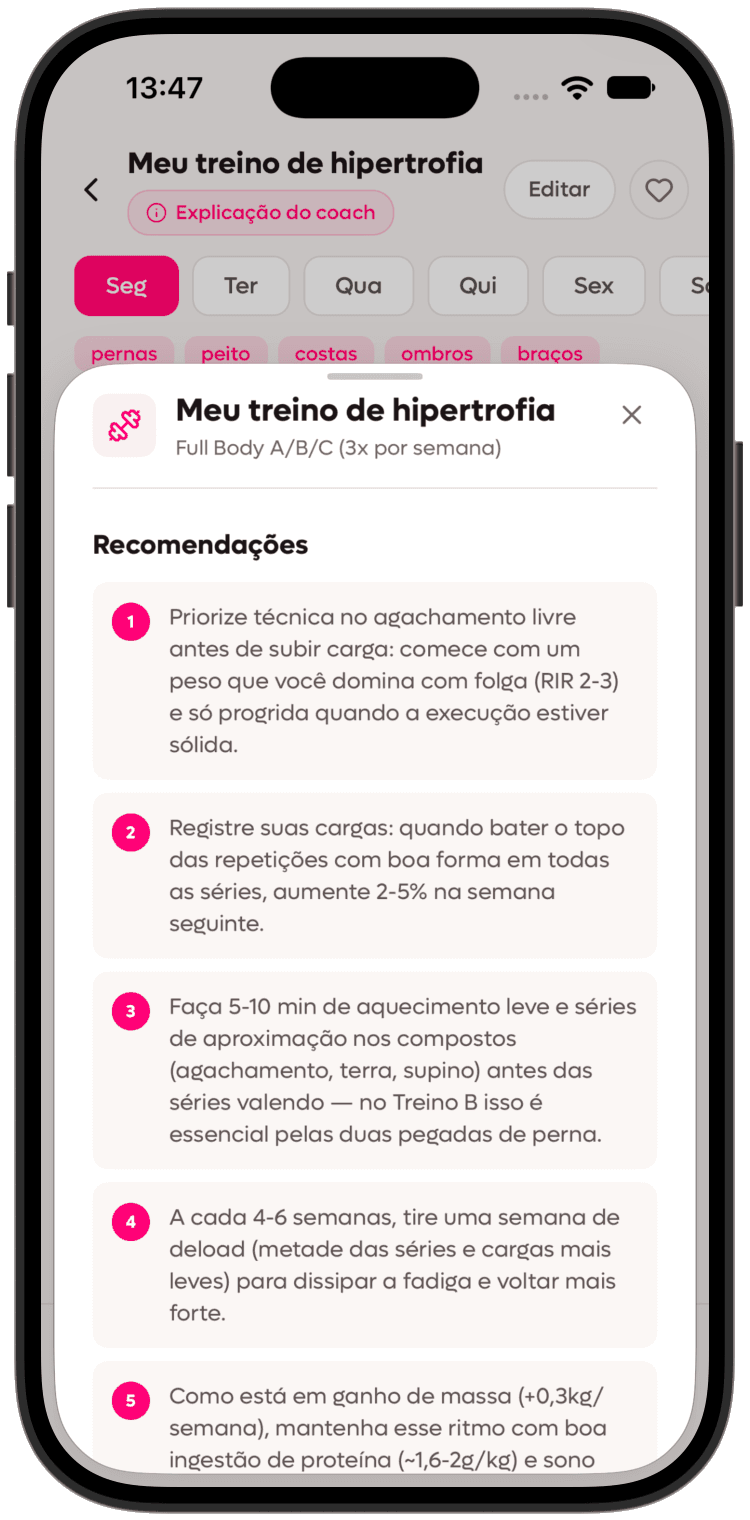
Once the plan is born, the plan explanation shows the chosen split, explains the training logic and delivers recommendations. That is especially useful on 4-day routines, because you start to understand where each session's identity lives and where the fourth workout fits most strategically.
The AI Coach steps in when the week leaves the paper. If a workout got too heavy, the fourth day is not fitting, or you missed a session, the idea is not to dismantle everything. The idea is to reorganize with criteria.
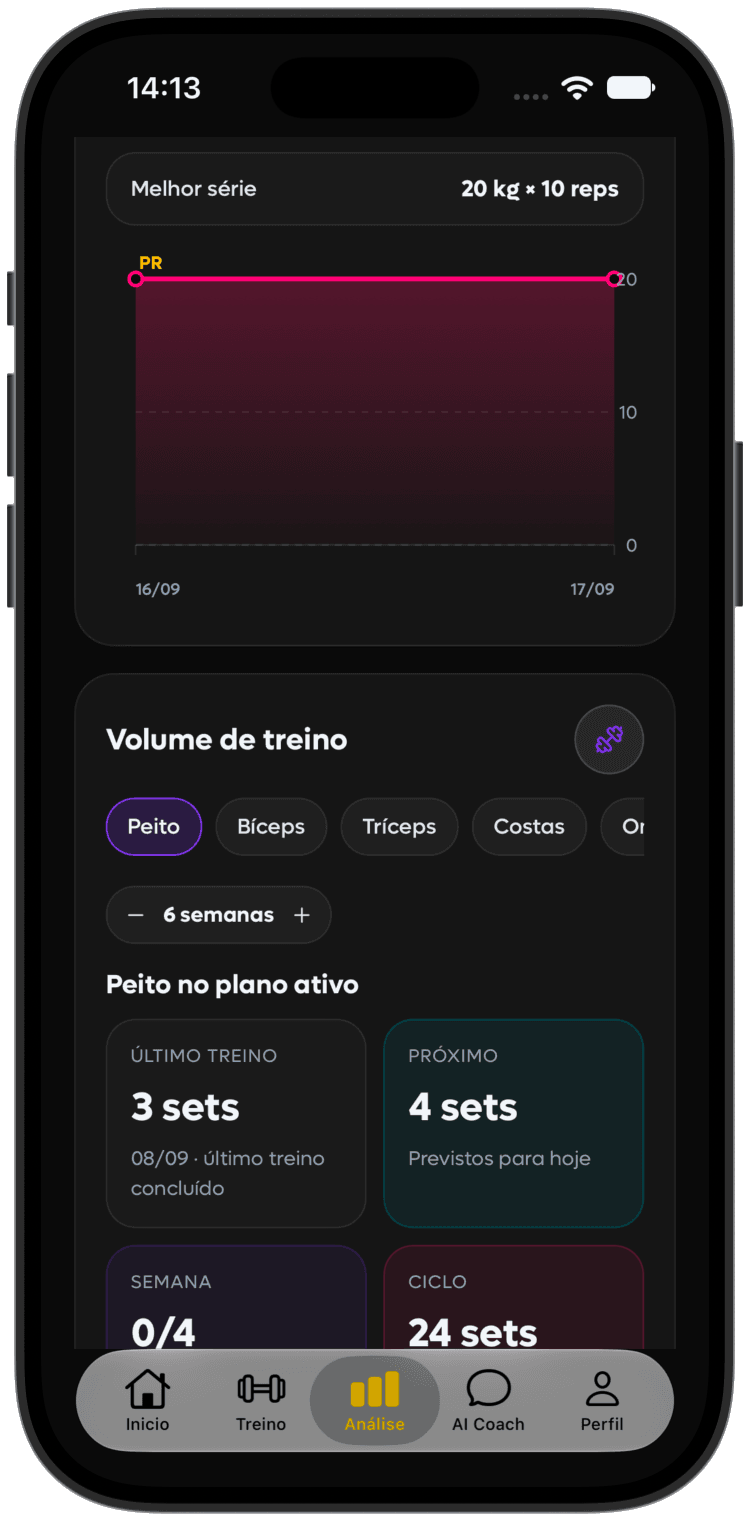
Training analysis closes the cycle. It compares planned volume with what was actually executed. And that is decisive when you move from 3 to 4 days: it becomes much easier to understand whether the problem was the split or your real capacity to sustain the new week. Everything that supports this lives in features.
Finally, the plan library helps you keep different phases of your routine. You can have a 3-day structure for busier weeks and a 4-day one for phases when you can train more. That avoids starting from zero every time your routine changes.
How to know you are gaining muscle with this split
- You are lifting more load with good technique.
- You do more reps with the same weight.
- Weekly volume is more solid.
- Execution stays good across the weeks.
- Your consistency is improving.
- Photos and measurements show real progress.
When these signals appear together, the split is making sense. When they do not, the best path is not swapping everything too early. It is first understanding whether what was missing was execution, recovery, volume adjustment or simply more time stacking good weeks.
Frequently asked questions
- How should rest days be distributed in a 4-day split?Good distributions include Monday, Tuesday, Thursday and Friday; Monday, Wednesday, Thursday and Saturday; or Monday, Tuesday, Thursday and Saturday. What matters is respecting recovery, especially on heavier plans.
- How do I know if 4 workouts per week is too much?If you are constantly tired, sore, unmotivated, start missing sessions and your performance is not rising, it may be a sign that frequency or volume is still above what you sustain well.
- Can beginners train 4 days?They can, but they do not always need to. In many cases, 2 or 3 well-executed workouts are still the most coherent base.
- Which 4-day split is best for hypertrophy?Upper/lower is usually easy to balance. PPL plus one works with a clear fourth-day priority or rotation. Four-day full body is also possible with low per-muscle volume each session. The best fit depends on schedule, recovery, preference and required volume.
- Can I use the 4th day to fix a weak point?Yes. That is a very useful strategy, especially in structures like push/pull/legs + 1.
Training 4 days works best when frequency rises but the mess does not
In the end, a 4-day training split can make a lot of sense for anyone who wants to gain muscle with more structure while keeping the routine sustainable. The central point is not simply adding one more day to the schedule. It is using that day to improve the week's distribution, not to inflate volume without criteria.
With context, execution tracking and thoughtful adjustments, higher frequency becomes useful. That is where SelfShapeAI fits. Explore AI training, see the features, compare Pricing and open SelfShapeAI to build or adjust your four-day routine.
Sources and references
- Source: Schoenfeld BJ, Grgic J, Krieger J. How many times per week should a muscle be trained to maximize muscle hypertrophy? A systematic review and meta-analysis. J Sports Sci, 2019. — Journal of Sports Sciences (PubMed)
- Source: Ramos-Campo DJ et al. Efficacy of Split Versus Full-Body Resistance Training on Strength and Muscle Growth: A Systematic Review With Meta-Analysis. J Strength Cond Res, 2024. — Journal of Strength and Conditioning Research (PubMed)
- Source: Currier BS et al. ACSM Position Stand: Resistance Training Prescription for Muscle Function, Hypertrophy, and Physical Performance in Healthy Adults. Med Sci Sports Exerc, 2026. — American College of Sports Medicine (PubMed)
- Source: Currier BS et al. Resistance training prescription for muscle strength and hypertrophy in healthy adults: a systematic review and Bayesian network meta-analysis. Br J Sports Med, 2023. — British Journal of Sports Medicine (PubMed)
Reviewed by the SelfShapeAI research team using strength-training guidelines and studies.
Take this method to the app

Create your plan with AI, log check-ins and use the AI Coach to adjust training with context.
Share
SelfShapeAI Team
SelfShapeAI technical and editorial team.
Keep learning

Recommended next article
Upper/lower split: what it is, how to build it and when this split makes sense
Build an upper/lower split for hypertrophy by matching volume, recovery and progression to your routine.
Continue →