Best workout tracking app in 2026: 7 options for lifting and cardio
Compare workout apps for lifting, cardio, guided classes and mobility — by the criterion that matters: which one you will still be using three months from now.

Everyone who decided to take training seriously goes through the same cycle: download a famous app, use it for two weeks, forget it exists. The problem is rarely laziness. It is that most comparisons mix different goals into the same pile — lifting, running, guided classes, mobility and wellness look like the same category when they are not.
In 2026, the right question is not which app has the most features. It is which app reduces friction in your routine, helps you keep training and turns information into practical decisions. A feature you do not use is dead weight; what changes results is what happens between one session and the next.
We gathered 7 options that make sense in different scenarios. SelfShapeAI leads when the focus is strength training with context, progression and consistency. The others come in as the main pick or a complement in specific niches — and we say exactly which ones.
Contents
- 1. The 7 apps in one table
- 2. What separates a good training app from a pretty one
- 3. 1. SelfShapeAI: best for lifting, intelligent training and personalized progress
- 4. 2. Strava: best for running, cycling and outdoor cardio
- 5. 3. BetterMe: best for beginners and a guided approach
- 6. 4. Nike Training Club: best free app for guided classes
- 7. 5. Zwift: best for indoor cycling and running with gamification
- 8. 6. StretchIt: best for mobility and flexibility
- 9. 7. Centr: best for those who want training, recipes and mindfulness together
- 10. How to choose: four questions before downloading
- 11. Features that really matter (and the ones that just decorate)
- 12. Frequently asked questions
- 13. The best app is the one that keeps your training alive
The 7 apps in one table
| App | Best for | Where it loses strength |
|---|---|---|
| SelfShapeAI | Lifting with a personalized plan, progression and progress reading | Outdoor cardio with GPS and routes |
| Strava | Running, cycling and outdoor cardio with community | Strength-training structure and progression |
| BetterMe | Beginners who want a ready-made plan and guided habits | Progression analysis and fine load adjustment |
| Nike Training Club | Free guided classes for training at home | Measurable progress over months |
| Zwift | Gamified indoor cycling and running | Everything that is not indoor cardio with equipment |
| StretchIt | Mobility and flexibility as support | Being the main app for someone who lifts |
| Centr | Lifestyle package: training, recipes and mindfulness | Depth in lifting and progression |
Turn understanding into a workout you can follow
SelfShapeAI uses your routine and goal to build an explained plan, log every session and guide the next adjustment.




Download for free. Annual: R$ 299,90/year, equivalent to about R$ 25/month; monthly: R$ 39,90/month. See how AI training works.
What separates a good training app from a pretty one
A training app needs to pass three tests no screenshot shows. First: can you log a set in seconds, with sweat in the way and the rest timer running? Second: does it answer what you did in recent weeks without requiring archaeology? Third: does it stay useful once the initial motivation fades — which is when most people quit?
There is also a criterion that training science puts above all others: progression. Strength-training guidelines are clear — progressing requires progressive overload, and progressive overload requires knowing what you did before. An app that only stacks numbers is a digital diary. An app that crosses load, reps and effort to point to the next step is a method tool. That difference becomes obvious in Simple progression: when to add weight and the practical RPE and RIR guide.
1. SelfShapeAI: best for lifting, intelligent training and personalized progress
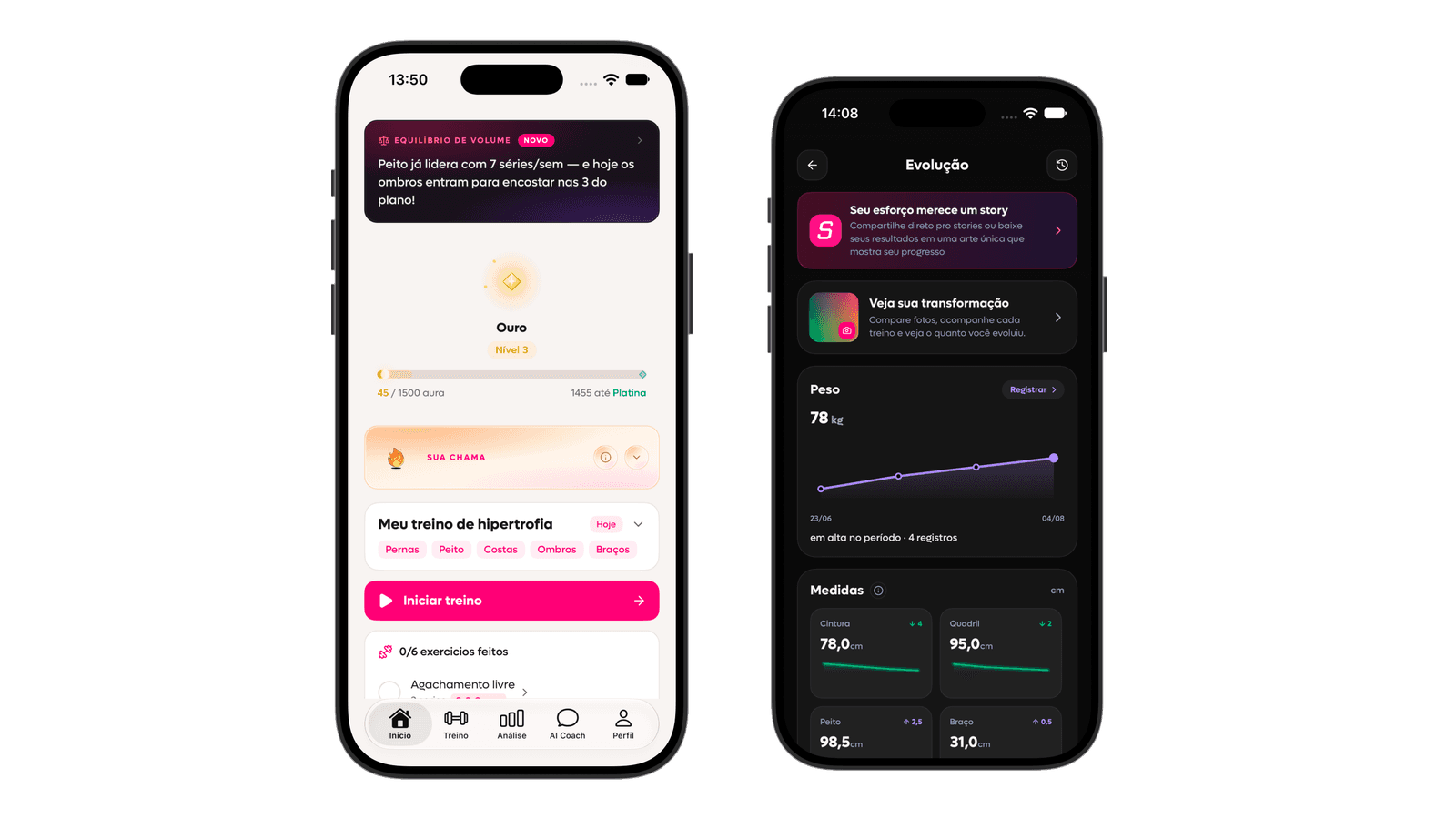
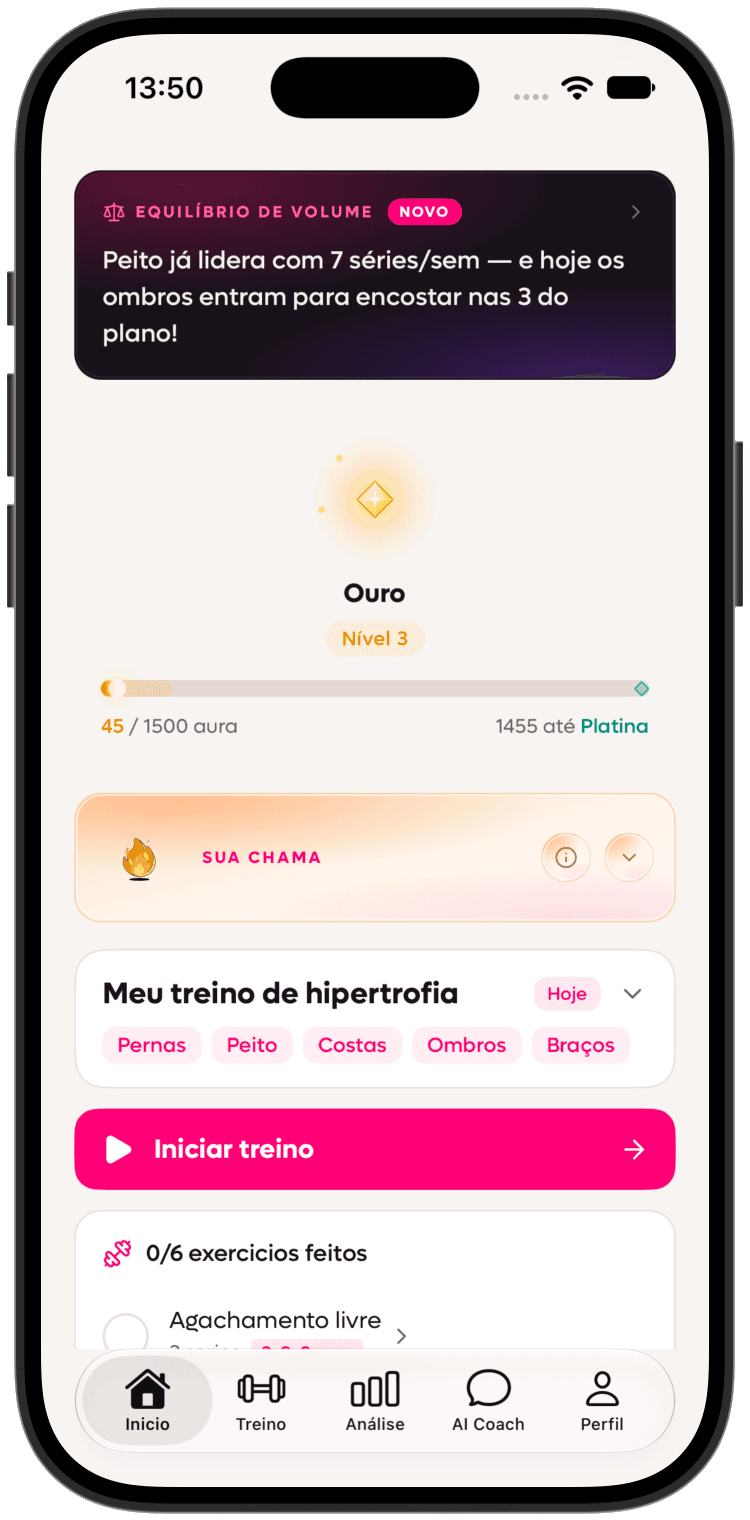
SelfShapeAI starts from a different premise: before suggesting any workout, it understands your context. An intelligent assessment collects goal, level, real frequency, equipment and routine — and the plan is born from that, explained, so you know why each exercise is there. It is the opposite of the generic template that treats everyone the same.
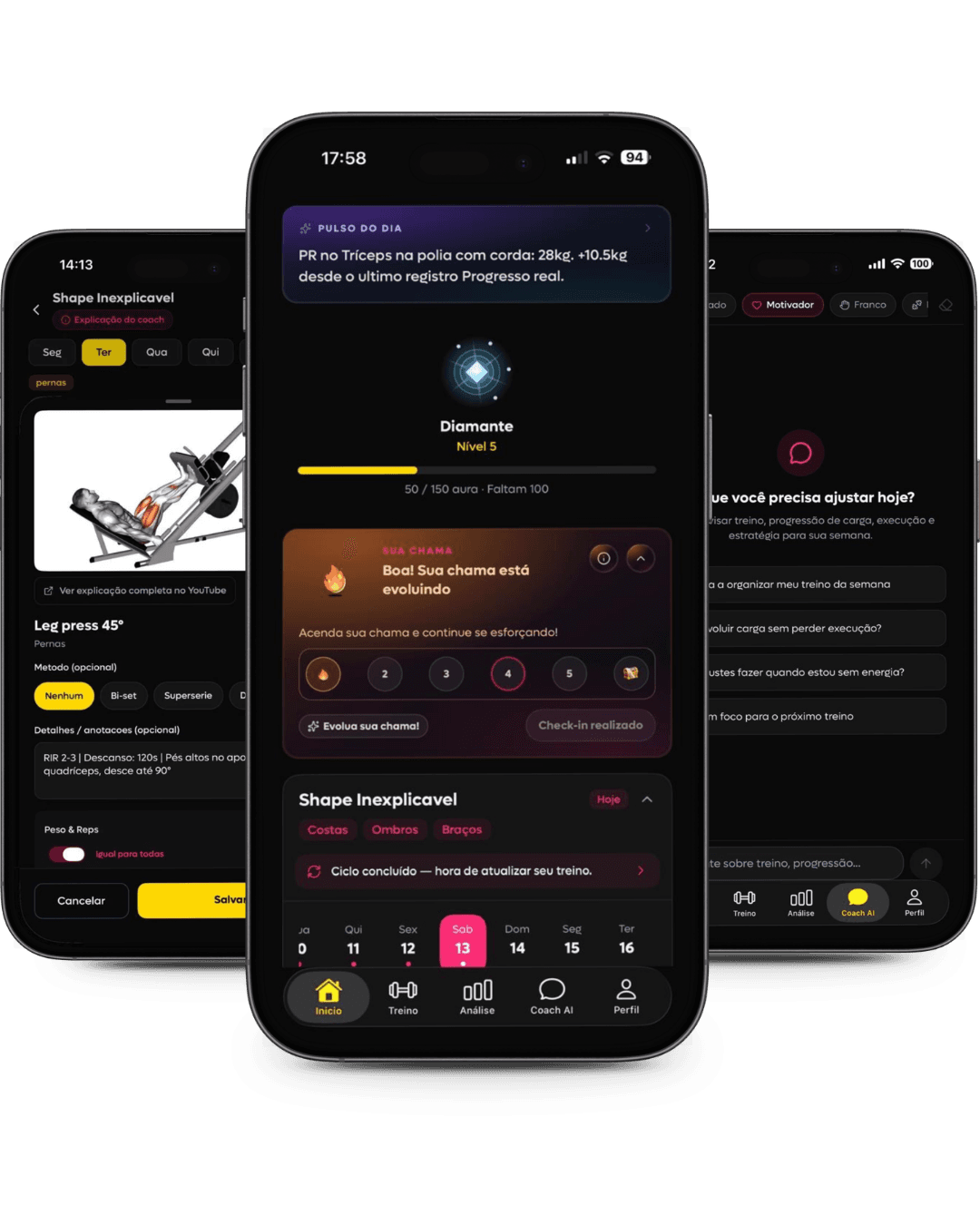
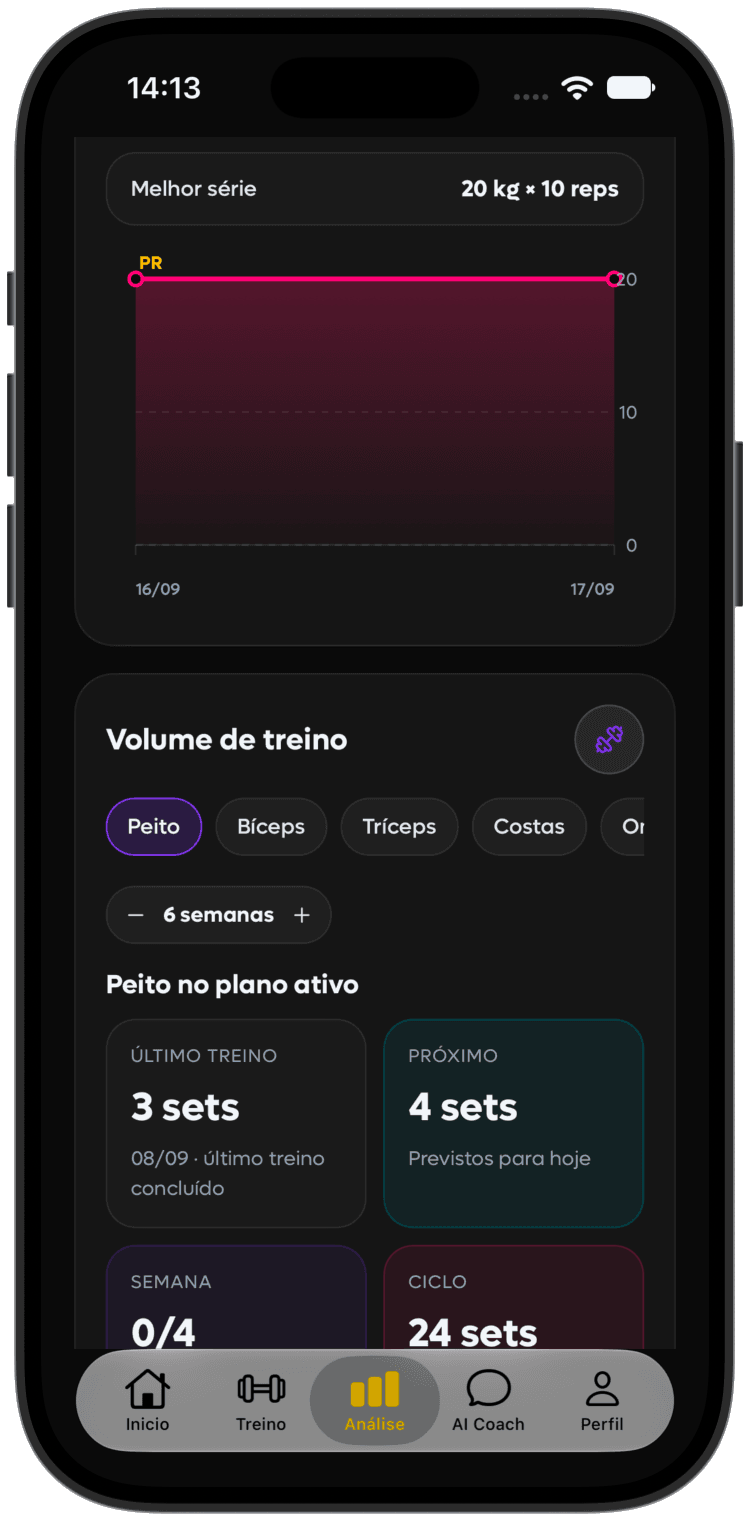
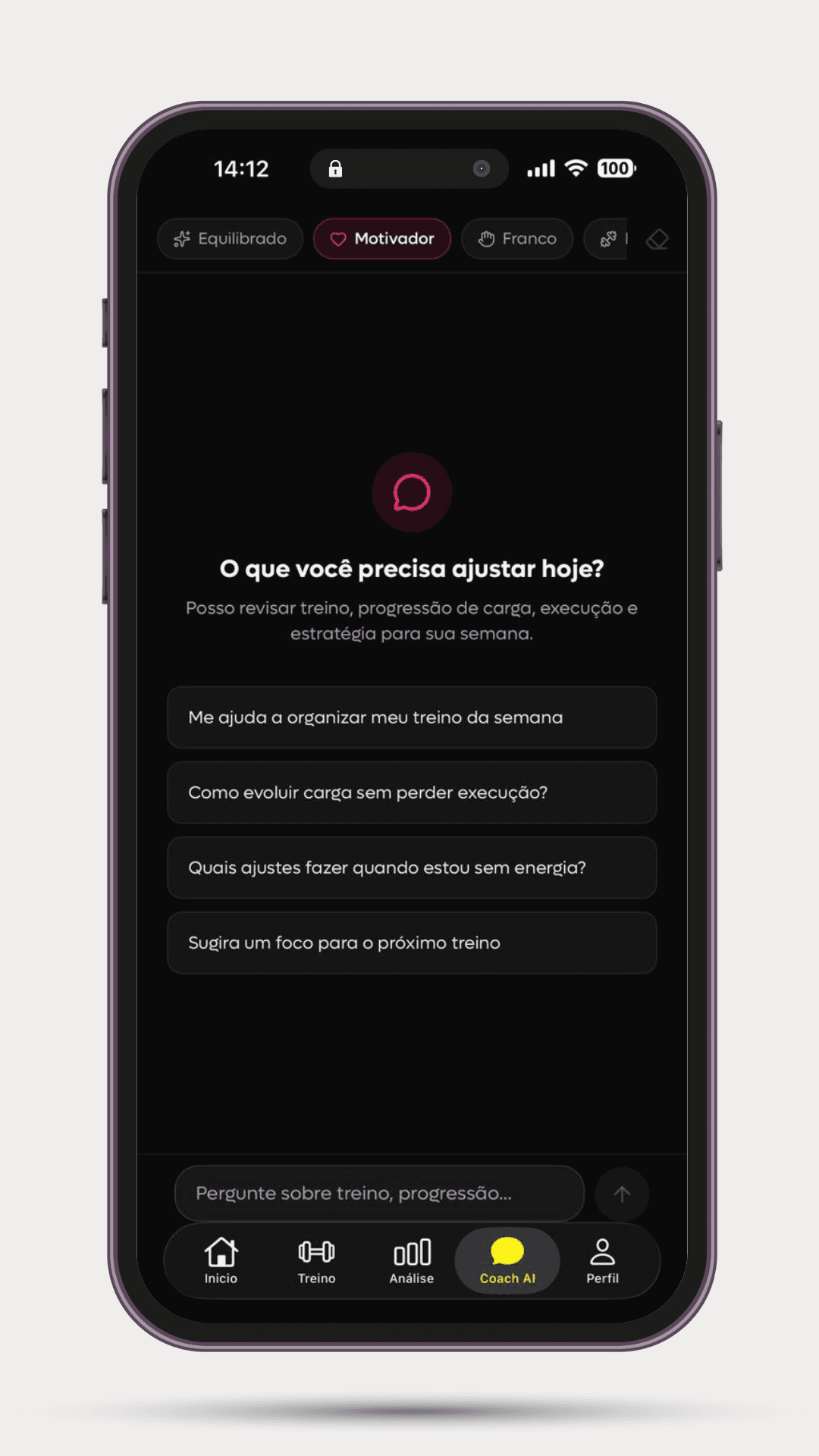
Then every session becomes data. The check-in logs load, reps and perceived effort in seconds, and the progress reading gives back what memory does not keep: PRs, volume per muscle group, muscle map, streaks. When a question hits mid-workout, the AI Coach answers on the spot, looking at your plan — not at a generic answer. And consistency becomes a game: XP, levels and ranks turn a completed week into visible progress.
- Best for lifting, load progression and long-term adherence.
- Plan created with AI from your context — or from scratch, with the AI optimizing what you built.
- History, PRs and progress per muscle group in the same training flow.
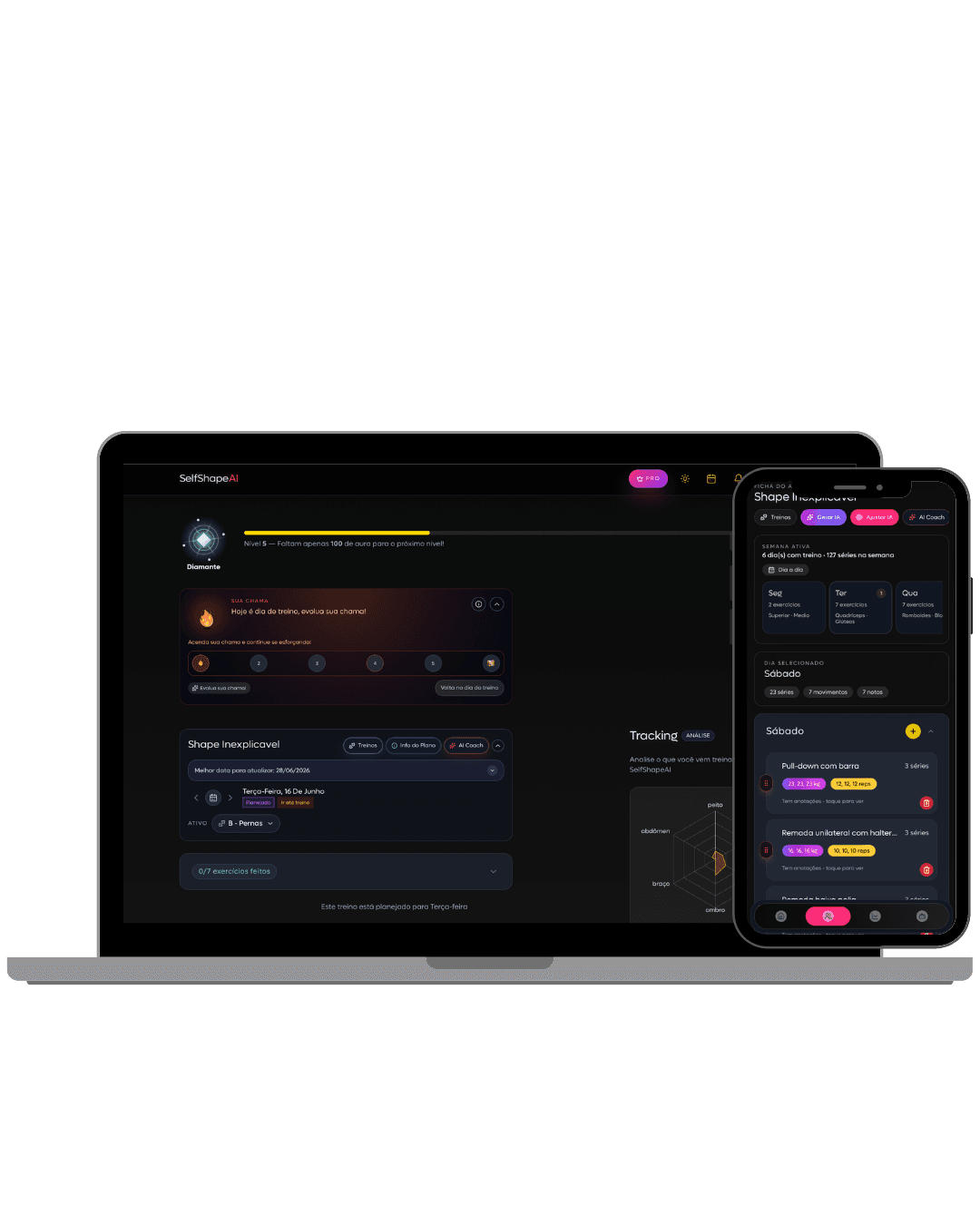
- An AI Coach available 24/7, rated 5.0 on the App Store and Google Play, with a web dashboard for a larger view.
The limitation is clear: if you primarily want outdoor cardio with GPS, routes and segments, complement it with another tool. For gym training, it is this list's main app: download it for free, explore available plans, and choose the annual plan at approximately about R$ 25/month (R$ 299,90/year). See AI training for how plans are built and adjusted, and features for the full overview.
2. Strava: best for running, cycling and outdoor cardio
Strava remains unbeatable at what it does: running, cycling, walking and trail with GPS, route history and a community that turns cardio into a social sport. Clubs, segments and watch integrations are the strong points.
Lifting is not its game — and it does not need to be. People who lift and also run do better with the duo: SelfShapeAI for structure and progression at the gym, Strava for everything that depends on maps, distance and pace.
- Best for running, cycling, walking, trail and social challenges.
- Strong in route history, clubs and device integration.
- Loses strength when the need is organizing strength-training progression.
3. BetterMe: best for beginners and a guided approach
BetterMe serves people who are starting and want a firm hand: ready-made plans, home workouts, pilates and a layer of habits and well-being. It is low friction by choice — fewer decisions for the user to make.
- Best for beginners, pilates, home training and anyone who prefers following a closed plan.
- Good for those who want routine support without interpreting training programming.
- Not the strong option for load progression and analytical lifting insight.
4. Nike Training Club: best free app for guided classes
Nike Training Club solves a real problem: open the app and simply follow a workout, without building anything. For guided classes, quick home sessions, mobility and yoga, it is hard to argue against the price — free.
Just do not confuse convenience with progression. Standalone classes do not talk to each other: today's class does not know what you did yesterday. For hypertrophy and measurable progress over months, a structure with history and progressive overload delivers more.
5. Zwift: best for indoor cycling and running with gamification
Zwift is excellent in its niche: it turns the bike trainer and the treadmill into a virtual world, with an avatar, events and real competition. For those who already own compatible equipment, it is the app that makes indoor cardio stop being torture.
- Best for gamified indoor cardio.
- Requires compatible equipment to be worth it.
- Does not replace a main lifting app.
6. StretchIt: best for mobility and flexibility
StretchIt organizes guided stretching and mobility sessions with its own progression. It works well as a support tool: it improves range and movement quality without pretending to be the center of your training.
Mobility pays off most when it supports an already structured strength routine — better range means better technique in the exercises that build results. As the recovery layer of a bigger process, it does the job well.
7. Centr: best for those who want training, recipes and mindfulness together
Centr bets on the full package: training, nutrition and well-being practices in the same ecosystem, with polished production. For those who value the lifestyle experience and want everything in one place, it delivers.
The price of breadth is depth: when the priority is lifting with load progression and directed tracking, the generalist approach loses precision to specialized tools.
How to choose: four questions before downloading
The choice depends less on fame and more on fit. The best app in the world, in the wrong scenario, becomes a forgotten icon on your home screen. Answer honestly:
- What is your main goal? Hypertrophy and strength demand lifting depth; outdoor cardio demands GPS and routes.
- Do you want to build and understand your training, or just follow a ready-made class?
- Is your routine stable or does it change every week? An unstable routine calls for an app that helps you adapt, not just record.
- Do you abandon tools that are easy to abandon? Then adherence — streaks, progress reading, a plan that makes sense — is worth more than any extra feature.
And the final test, which eliminates most of them: does the app improve your decision-making or just organize information? When the tool helps you adjust load, understand effort and adapt the week to your context, it earns its space on your phone. If your week's structure is still open, solve that first in Full body vs. split training — no app compensates for a split that does not fit your life.
Features that really matter (and the ones that just decorate)
- Fast logging. If recording a set disrupts your rest, you stop recording in week two.
- History with reading. Seeing the load curve per exercise is worth more than any pretty monthly report.
- Real personalization. A plan that considers your equipment, frequency and level — not a template with your name on it.
- Explanation. Knowing why the exercise is there changes how you execute it.
- Continuity signals: check-ins, streaks and visible progress hold the routine when motivation wavers.
What just decorates: imprecise calorie counters, a social feed that turns into comparison, and badges disconnected from real training. The differentiator is not stacking features — it is doing the critical loop very well: showing what to do, why to do it, what changed and how to keep going. That is the standard behind AI training.
Frequently asked questions
- What is the best app for lifting?In this comparison, SelfShapeAI is the strongest pick for lifting: a plan personalized by your context, logging with perceived effort, PR and progress reading, and an AI Coach to adjust when the week changes. The details are in AI training.
- Which app makes more sense for running and cycling?For outdoor cardio, Strava remains the reference. People who also lift usually get more from the SelfShapeAI + Strava duo than from a generic app trying to cover everything.
- Can I use more than one app at the same time?Yes, and it is often the best strategy: a main app for your central goal and a complement for the rest. SelfShapeAI + Strava covers strength and cardio; SelfShapeAI + StretchIt covers strength and mobility.
- How do I know if the app really improves my adherence?Look back after a month: do you still open the app when the week gets tight? Does it show progress you feel is real? If so, it is doing its job. If it became a weight on your conscience, switch — the tool exists to serve the routine, not the other way around.
The best app is the one that keeps your training alive
If the focus is lifting, hypertrophy and a routine that sustains itself, SelfShapeAI is the strongest choice on this list. The other six are excellent in their niches — outdoor cardio, guided classes, gamified indoor, mobility, lifestyle — and can complement it very well.
The best app fits your routine, goal and actual training—and remains in use three months later, recording real progress. If that is what you need, create your AI workout and download the app for free.
Sources and references
- Source: American College of Sports Medicine. Position Stand: Progression Models in Resistance Training for Healthy Adults. Med Sci Sports Exerc, 2009. — ACSM (PubMed)
- Source: Schoenfeld BJ, Ogborn D, Krieger JW. Dose-response relationship between weekly resistance training volume and increases in muscle mass: a systematic review and meta-analysis. J Sports Sci, 2017. — Journal of Sports Sciences (PubMed)
Reviewed by the SelfShapeAI research team using strength-training guidelines and studies.
Take this method to the app

Create your plan with AI, log check-ins and use the AI Coach to adjust training with context.
Share
SelfShapeAI Team
SelfShapeAI technical and editorial team.
Keep learning
Recommended next article
Intelligent AI-powered training: the gym's future, or already its present?
See how context, explained plans, logging and AI Coach make AI useful without promises of diagnosis, perfect automation or guaranteed results.
Continue →