Practical RPE and RIR guide: how to measure training effort without overcomplicating
Estimate remaining reps, recognize the limits of that perception and use it to adjust training.

After your last bench-press rep, you rack the bar and wonder: could I do two more, or was that my limit? The answer helps interpret the set. Too much remaining capacity may mean effort was below plan; none may mean failure and greater fatigue. Neither interpretation works well as absolute certainty.
RIR and RIR-based RPE organize this judgment. They provide vocabulary for recording what you think remained and comparing that perception with performance, without removing subjectivity. Traditional RPE can rate overall effort; here we focus on the version used for resistance-training sets.
In this guide you will see the conversion between the two scales, what the science says about training close to failure and a simple way to apply it in your very next session. When you want to take this ruler into the progression decision, the next step is Simple progression: when to add weight.
Contents
- 1. RPE and RIR: the same ruler, from two angles
- 2. What the science says about training close to failure
- 3. How to use it in practice, set by set
- 4. Why this ruler unlocks your progression
- 5. The mistakes that make the ruler look useless
- 6. Is it just for advanced athletes? Quite the opposite
- 7. From sensation to data: where SelfShapeAI comes in
- 8. Start in your next session
- 9. Frequently asked questions
- 10. Measuring better is training better
RPE and RIR: the same ruler, from two angles
RIR means reps in reserve: complete reps you believe remain using the exercise's defined technique. RPE means rating of perceived exertion. On the RIR-anchored scale, RPE 8 approximates 2 RIR, RPE 9 equals 1 RIR and RPE 10 equals 0 RIR. This is a practical convention, not direct body measurement.
The value lies in what this ruler does to your reading of the workout. Instead of finishing the set thinking "that was heavy", you finish thinking "was it heavy enough to create a stimulus without breaking technique?". That is a better question. And better questions produce better training.
| RPE | RIR | How the set ends | When to use it |
|---|---|---|---|
| 10 | 0 | No complete reps left; the next attempt would fail | Momentary failure or a controlled limit test |
| 9 | 1 | Exactly 1 rep left with good technique | Very close to failure |
| 8 | 2 | 2 good reps left | Close to failure without reaching the limit |
| 7 | 3 | 3 good reps left | High effort with a perceptible margin |
| 6 or less | 4 or more | Moderate effort, far from failure | Warm-up, technique practice or deliberately submaximal work |
Turn understanding into a workout you can follow
SelfShapeAI uses your routine and goal to build an explained plan, log every session and guide the next adjustment.




Download for free. Annual: R$ 299,90/year, equivalent to about R$ 25/month; monthly: R$ 39,90/month. See how AI training works.
What the science says about training close to failure
Zourdos and colleagues helped validate a resistance-training scale anchored in RIR. Estimates tend to improve near failure and with experience. Debating exactly 4 versus 5 RIR as though measured by a sensor is unhelpful; broad categories such as far, close and very close are more honest initially.
Failure is not required. Meta-analyses comparing muscular failure with non-failure training found no consistent hypertrophy superiority for momentary failure. A 2024 meta-regression also found growth tended to increase closer to failure. Both can be true: proximity matters, but not every set needs zero RIR.
Approximately 1–3 RIR can be a starting point for many hypertrophy sets, not a magic zone. More distant sets can still produce adaptation, especially for beginners; zero RIR may better fit stable movements or specific occasions. Exercise, safety, volume and recovery affect the decision. See Training to muscular failure.
How to use it in practice, set by set
The application fits in one honest question at the end of every set: how many good reps were still left? Actually good — with the same range and the same control. A cheated rep to save the ego does not count as reserve.
- Far from failure: compare with the set's goal. It may suit warming up, technique or returning; for hypertrophy, more reps may be possible.
- Close to failure, around 2 RIR: log the estimate and check that execution and performance stay comparable.
- Very close, around 1 RIR: consider subsequent-set costs before repeating this across every exercise.
- At failure, 0 RIR: treat it as a choice or calibration data, not automatic proof of a better set.
Rate effort immediately after the set and contextualize the day: sleep, stress and fatigue change the same load's RPE. Warm-up sets rehearse movement and help reveal this. Check Rest between sets to avoid confusing muscular effort with breathlessness.
Why this ruler unlocks your progression
Whoever trains without measuring effort swings between two mistakes: raising the load too early and breaking technique, or repeating the same weight for months out of insecurity. RPE/RIR solves both with the same criterion. If the rep range closed with clean technique and there was still margin, there is room to progress. If the set is already flirting with RPE 10, raising the weight now only brings the plateau forward.
This reading talks directly to progressive overload and to double progression: first you push reps within the range, then the load goes up when the top comes with room to spare. The step-by-step for that decision is in Simple progression: when to add weight — and the structure of the week where it happens, in Full body vs. split training.
The mistakes that make the ruler look useless
- Counting a cheated rep as a rep in reserve. If the range shortened, it did not exist.
- Giving an extremely precise rating when you can only distinguish far, close or at failure.
- Assuming every set needs RPE 9 or 10 regardless of exercise or training phase.
- Ignoring sleep, stress and recovery — the same load changes its score with the day.
- Using the scale for one week and going back to training on autopilot. A ruler without records is a hunch with a technical name.
The last mistake is the most common. Perception only calibrates when you compare what you felt with what happened next — and that requires history. Writing it on paper already works. Having the notes crossed with load, reps and progress works better.
Is it just for advanced athletes? Quite the opposite
Beginners can use the scale but often struggle to estimate actual remaining reps. Start with broad zones, keep exercises long enough to learn them and calibrate on a stable movement when appropriate. See From beginner to results and How to build more muscle.
After a break, RIR helps prevent old loads becoming first-week obligations. It is not insurance against pain or injury, just a way to retain margin while rebuilding tolerance. See 13 tips for returning to training.
From sensation to data: where SelfShapeAI comes in
Everything in this guide works with a notebook and a pen. The notebook's problem is what it does not do: it does not cross today's perception with the last eight weeks, does not warn you when the same load has been getting easier and does not answer questions mid-workout.
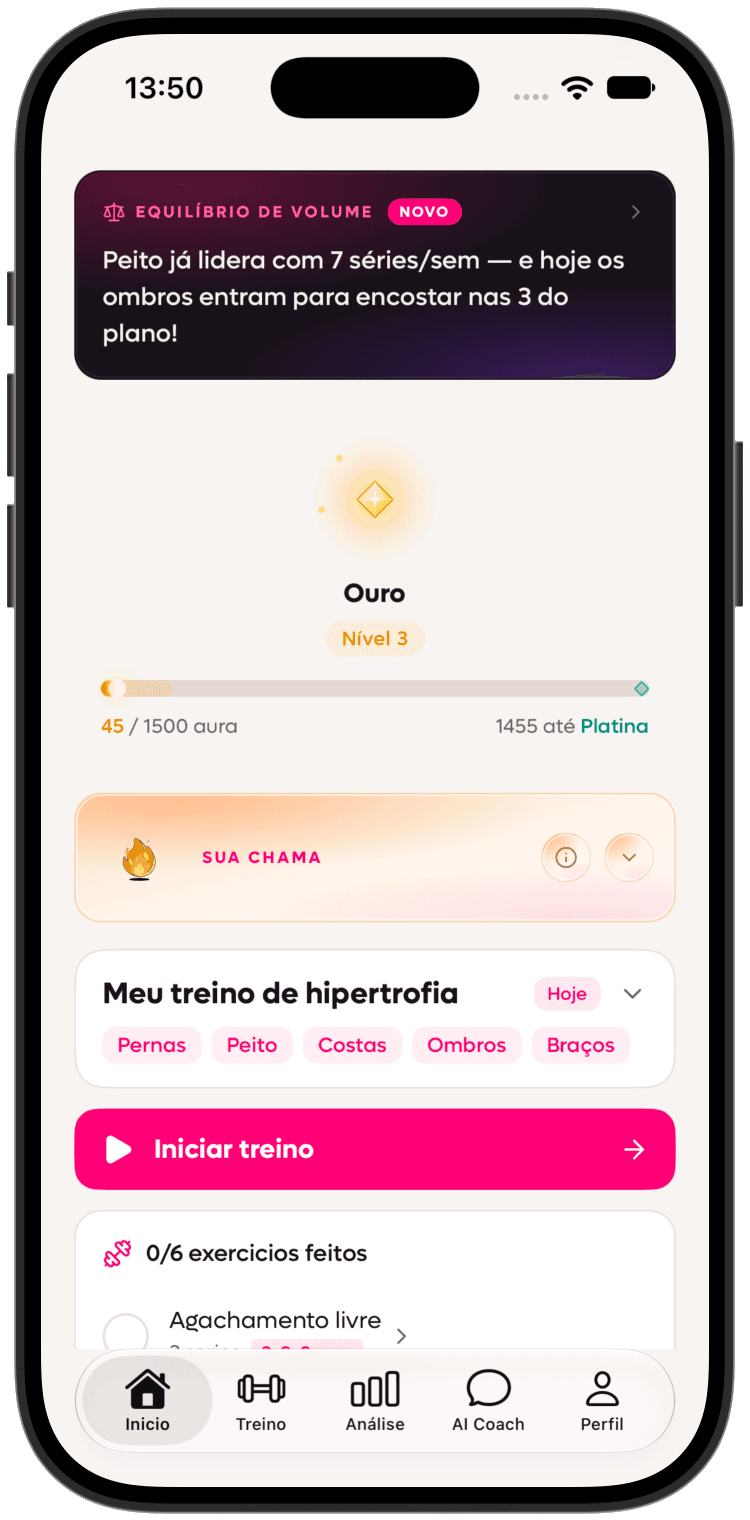
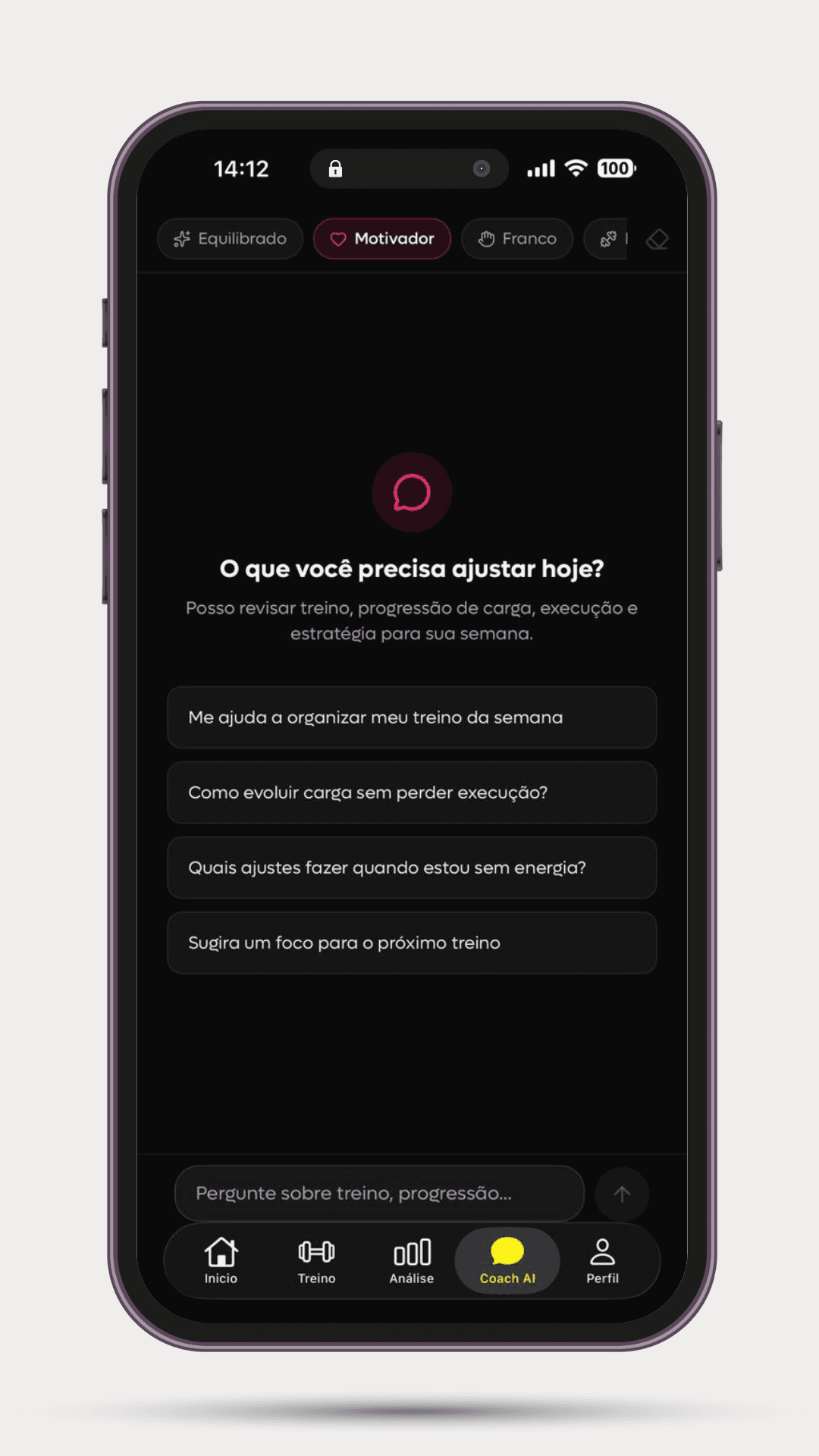
In SelfShapeAI, the session log already asks for load, reps and perceived effort — it takes seconds, between one set and the next. With a few weeks of check-ins, the progress reading shows what memory does not keep: the load that stalled, the muscle group with room to spare on the muscle map, the PRs that arrived without you noticing. And when doubt hits mid-workout — "I closed at RPE 9, do I go up or hold?" — the AI Coach answers on the spot, looking at your plan and your history, not at a generic reply. That difference between AI that follows you and AI that just spits out templates is the theme of Intelligent AI-powered training and the comparison in AI training.
Start in your next session
- Choose two or three stable exercises and observe RIR there first instead of rating the entire session at once.
- At the end of each set, score it honestly: how many good reps were left?
- Log it along with load and reps — without a record, the ruler evaporates by next week.
- After two weeks, compare: are the scores matching the real progress?
- When the top of the rep range comes with margin and comparable execution, assess progression. See Simple progression: when to increase weight?.
Frequently asked questions
- What is RPE in training?It is the set's effort score. In lifting, RPE 8 means 2 good reps were left; RPE 10, that none were left. The full definition is in RPE.
- What does RIR mean?Reps in reserve: how many reps with good technique you could still do when you decided to stop. It is the most direct way to measure the distance to failure.
- Do I need to train to failure to build muscle?No. Failure versus non-failure comparisons do not consistently favor momentary failure. Ending closer tends to favor hypertrophy, but exact distance and fatigue cost depend on exercise and program.
- Do RPE and RIR work for beginners?They provide a learning vocabulary when less precise early estimates are accepted. Broad zones and comparisons across weeks are more useful than a perfect number. See From beginner to results.
- How do I know when to add weight using RPE/RIR?Reaching the range's top with comparable execution and the planned margin across more than one session may support progression. It depends on the range and exercise; see Simple progression: when to increase weight?.
Measuring better is training better
RPE and RIR are not jargon to sound technical. They are the simplest way to make every set answer one question: is this taking me where I want to go? When effort becomes data, progression stops being a bet — and training stops depending on guesswork.
SelfShapeAI includes effort logging alongside training progress to help inform the next step. Create your AI workout—download for free and train with clearer criteria.
Sources and references
- Source: Zourdos MC et al. Novel Resistance Training-Specific Rating of Perceived Exertion Scale Measuring Repetitions in Reserve. J Strength Cond Res, 2016. — JSCR (PubMed)
- Source: Helms ER et al. Application of the Repetitions in Reserve-Based Rating of Perceived Exertion Scale for Resistance Training. Strength Cond J, 2016. — Strength & Conditioning Journal (PubMed)
- Source: Robinson ZP et al. Exploring the Dose-Response Relationship Between Estimated Resistance Training Proximity to Failure, Strength Gain, and Muscle Hypertrophy. Sports Med, 2024. — Sports Medicine (PubMed)
- Source: Refalo MC et al. Influence of Resistance Training Proximity-to-Failure on Skeletal Muscle Hypertrophy: A Systematic Review with Meta-analysis. Sports Med, 2023. — Sports Medicine (PubMed)
Reviewed by the SelfShapeAI research team using strength-training guidelines and studies.
Take this method to the app

Create your plan with AI, log check-ins and use the AI Coach to adjust training with context.
Share
SelfShapeAI Team
SelfShapeAI technical and editorial team.
Keep learning
Recommended next article
Simple progression: when to add weight in training without losing technique
Find out when to add weight in training, when to hold back and how to progress with technique, criteria and consistency — without depending on impulse.
Continue →