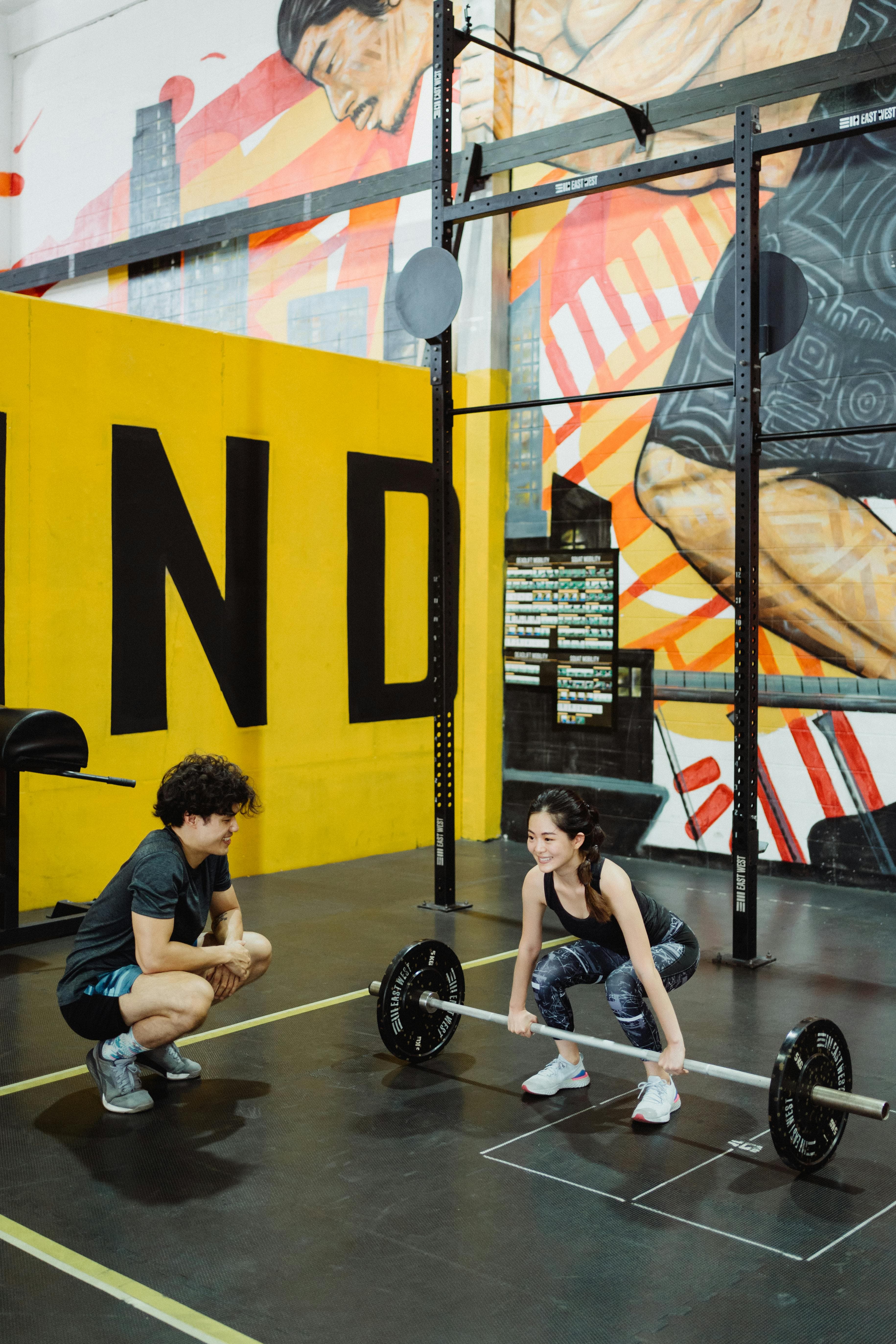
Full body workout: what it is, how to build it and when this split makes sense
Understand what defines a well-built full body, which routines it tends to fit best and how to use SelfShapeAI to adjust this structure to your context.


Full body is just one way to organize the week. In some contexts, it fits very well. In others, another split may match your routine better. The point is understanding when whole-body sessions make sense and how to build them without becoming a mess.
Many people treat full body as a magic solution or as a beginner routine. Both readings impoverish the topic. A well-built full body is just a stimulus-distribution strategy: it covers the whole body with a few well-chosen movements and respects the time you actually have to train. If you are still comparing structures, cross this article with Full body vs. split training and the 3-day workout split.
In SelfShapeAI, the logic is understanding when full body makes sense for your frequency, your recovery and your goal, and then turning that into a clear, adjustable plan that stays readable across the weeks — the approach behind AI training.
Contents
- 1. What a real full body workout is
- 2. When full body tends to fit well
- 3. The logic behind a good full body workout
- 4. The base: main movements
- 5. The complement: adjustments and balance
- 6. How to structure a full body workout in practice
- 7. Two practical full body examples
- 8. Full body A
- 9. Full body B
- 10. How many times per week to do full body?
- 11. Full body in practice: gym or home?
- 12. What really defines your results
- 13. Where SelfShapeAI comes in
- 14. How to notice your full body is working
- 15. Frequently asked questions
What a real full body workout is
A full-body session includes lower- and upper-body movements. It need not directly train every muscle every day: more frequent versions can alternate emphasis and distribute key patterns through the week.
But that does not make it simpler. In practice, it demands more intelligence in the build. A well-built full body does not try to put every exercise in the world in the same day. It picks the right movements to cover the whole body with as little noise as possible.
That is what gives the method its identity. You do not try to put everything into the same day. You choose what matters most and distribute the stimulus in a way that still makes sense after a few real weeks of training.
Turn understanding into a workout you can follow
SelfShapeAI uses your routine and goal to build an explained plan, log every session and guide the next adjustment.




Download for free. Annual: R$ 299,90/year, equivalent to about R$ 25/month; monthly: R$ 39,90/month. See how AI training works.
When full body tends to fit well
Full body makes volume distribution easier. With two or three sessions, repeat movements or muscle groups without concentrating everything into one day. That helps organization, but frequency alone does not guarantee more hypertrophy when weekly volume is equal.
- More practice of the important movements.
- More frequency per muscle group.
- Better use of a busy schedule.
- Less risk of losing the week's stimulus when one session fails.
That last point matters a lot. In an over-divided routine, missing one workout can mean leaving a muscle group almost without work that week. In full body, the structure is more resilient. Even when life gets busy, the whole body still tends to receive stimulus. If you are returning now and need a more sustainable structure, the 3-day workout split pairs well with this theme.
The logic behind a good full body workout
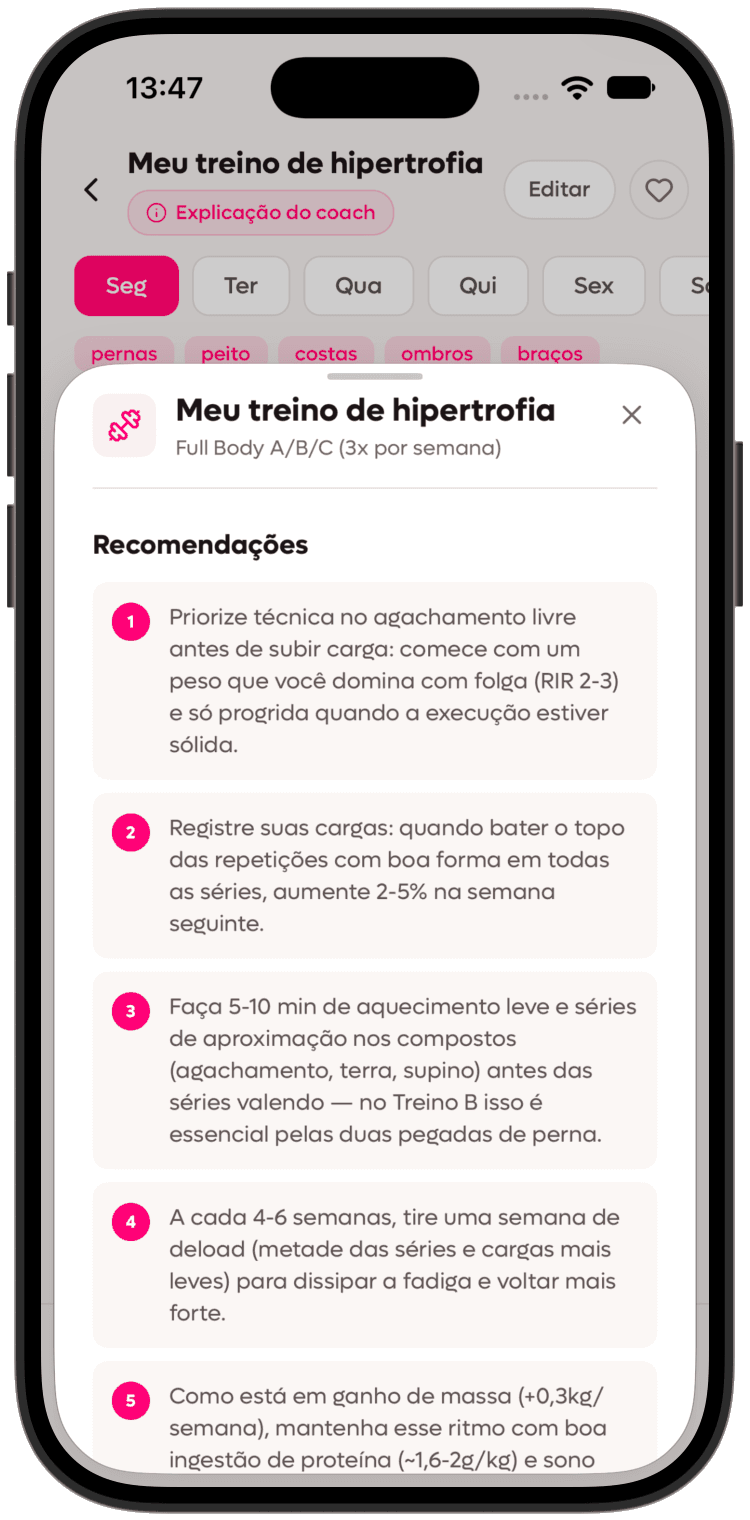
Here is where many people go wrong. Training the whole body does not mean doing a thousand exercises. It means choosing well.
- Squat.
- Push.
- Pull.
- Hip hinge.
- Complement or stabilize.
These patterns form a practical map, not a mandatory list for every workout. Alternate emphasis and add isolation work where it serves the goal. Cover the week's planned demands without making every session a marathon.
The base: main movements
These are the movements that usually sustain a well-built full body.
- Back, smith or hack squat.
- Flat or incline bench press.
- Bent-over row or machine row.
- Lat pulldown or pull-up.
- Romanian deadlift or a hinge variation.
- Overhead press.
Compounds train several muscle groups at once and often improve session efficiency. That makes no movement compulsory or machines and isolation work inferior: consider technique, stability, equipment, comfort and progression. See when to increase load and the RPE and RIR guide.
The complement: adjustments and balance
After the base come the adjustments. They are not the center of the workout, but they make a difference in the final result.
- Lateral raise.
- Face pull.
- Barbell curl.
- Rope triceps pushdown.
- Calves.
- A final core block, when it makes sense.
They help develop specific areas, improve muscular balance and make the workout more complete without stealing space from what really moves results. The mistake is inverting the logic and building a session full of details but weak on the pillars.
How to structure a full body workout in practice
A well-built full body follows a simple logic: you start with the most demanding exercises, while you still have energy, then move to complementary movements and finish with more isolated exercises.
- A knee-dominant exercise.
- A push.
- A pull.
- A hip-dominant exercise.
- One or two complements.
That already solves much more than most random sessions that try to train everything and end up training almost nothing with quality.
Two practical full body examples
Full body A
- Back, smith or hack squat.
- Flat barbell or dumbbell bench press.
- Bent-over or chest-supported row.
- Romanian deadlift or stiff-leg deadlift.
- Lateral raise.
- Calf raise.
Full body B
- Leg press or Bulgarian split squat.
- Dumbbell or machine shoulder press.
- Lat pulldown or pull-up.
- Hip thrust.
- Face pull.
- Barbell curl or triceps, depending on the week's emphasis.
This example alternates patterns and emphasis rather than prescribing fixed sessions. Sets, reps, order and exercise choices should match goals, experience, equipment and tolerance. Compare three-day training, four-day splits and five-day splits.
How many times per week to do full body?
This is a practical advantage of this kind of training. You can adapt full body to your routine without losing coherence.
- `2x` weekly: covers the whole body without crowding your schedule.
- `3x` weekly: provides more practice and volume-distribution opportunities.
- `4x` or more: can work with less per-session work and alternating loads, muscles and exercises.
There is no universal `48`-hour requirement between sessions. Recovery depends on volume, proximity to failure, exercises, load and individual response. Consecutive days can fit smaller, alternating sessions; demanding sessions need more space. Persistent performance loss, soreness and deteriorating technique signal reviewing dosage. See RPE and RIR and how many sets to perform.
Full body in practice: gym or home?
Another strong point of full body is flexibility. You can build this strategy at the gym, at home, with bodyweight, with dumbbells or with a kettlebell.
Equipment changes stability, available range, load adjustment and exercise selection, but different environments can provide useful stimulus. At home, use unilateral movements, push-ups, adapted pulls and dumbbells; gyms add machines and plates. Both need appropriate effort, consistent technique and measurable progression.
What really defines your results
In the end, the type of training is just a tool. What really matters is progression, consistency, execution and recovery.
Without those, any strategy fails. With them, several strategies work. That is exactly why full body should not be treated as a magic solution nor as inferior to a split. It is just a useful strategy when well built and well executed.
- Are the main exercises progressing?
- Does the session stay readable or did it become excess?
- Can you repeat this workout for weeks with quality?
- Is recovery keeping up?
When these answers get clearer, so does the progress.
Where SelfShapeAI comes in
Here is the point that turns a full body that is pretty on paper into a strategy that works in the real world. The biggest mistake among people who do full body is not adjusting training over time. Volume, intensity, exercise selection and recovery need to evolve.
First, SelfShapeAI helps you build a workout based on your frequency, goal and available equipment. That matters because a well-built full body depends heavily on intelligent selection, not on the number of exercises.
Then comes the plan explanation. This point makes a difference because many people follow the session without understanding why it starts with a knee-dominant movement, why the hinge comes after or why some complements were left out. When the logic gets clear, execution improves.
In the session itself, logging and check-ins make a difference. You can save loads, reps and real notes, which helps you understand whether the full body is really progressing or just looked good that day.
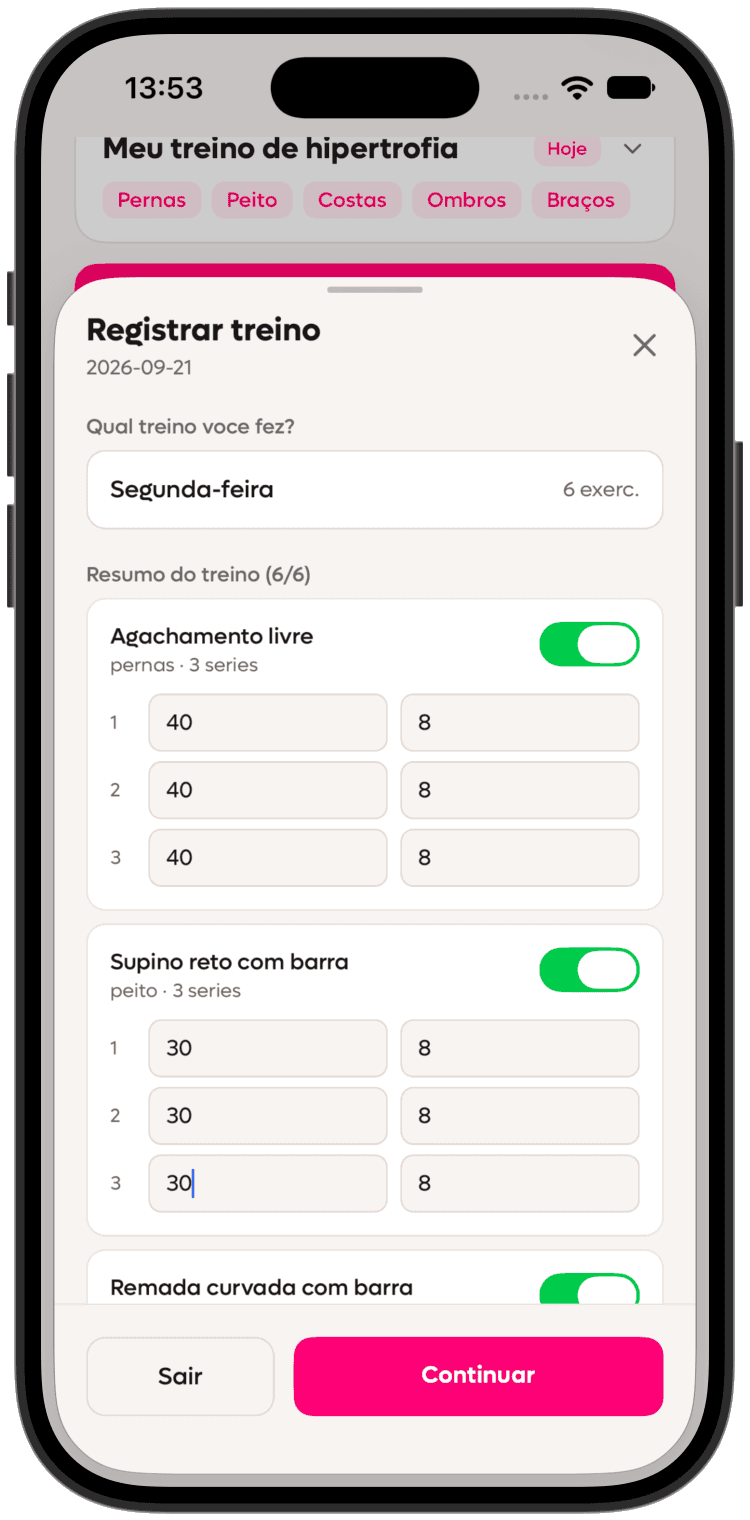
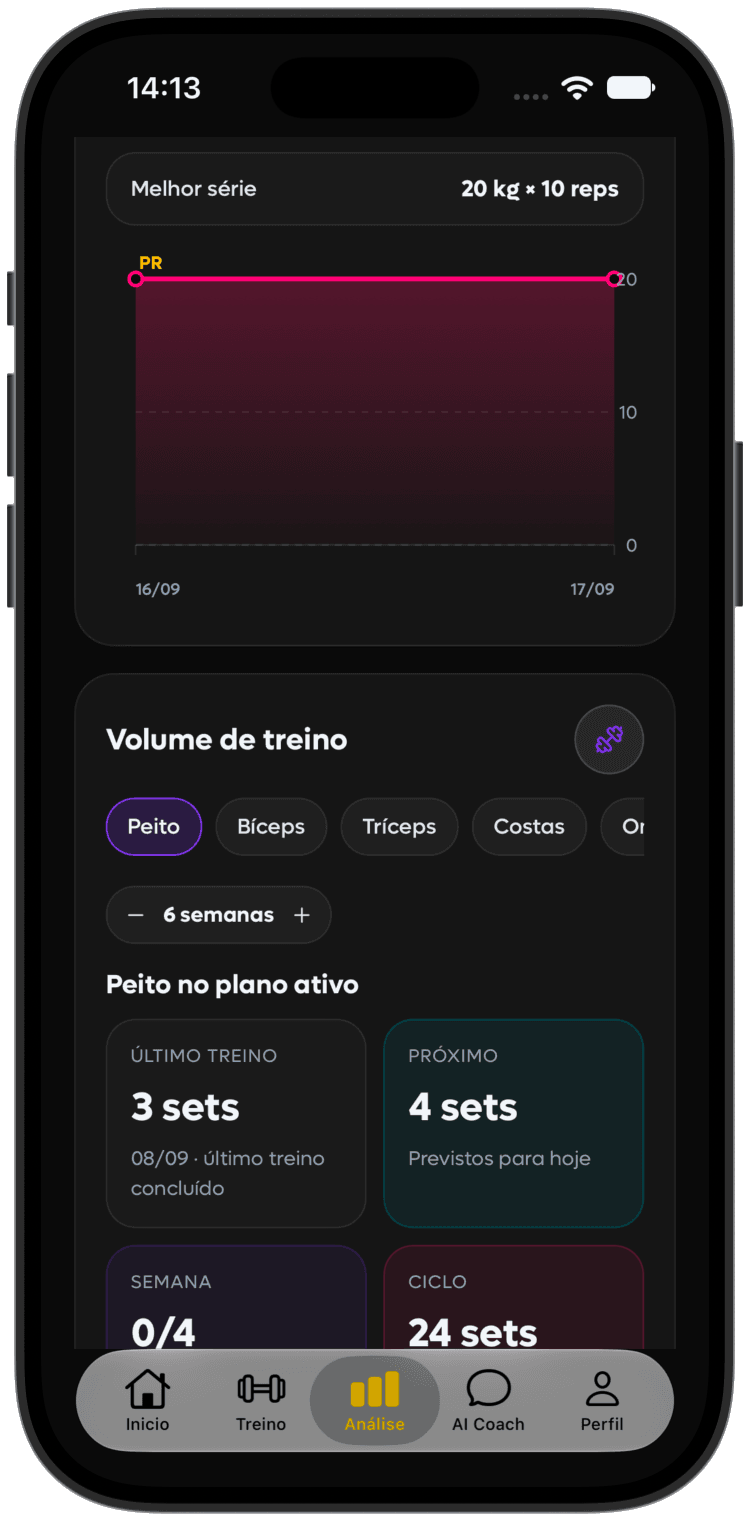
In the analysis, SelfShapeAI helps you see most-trained muscle groups, load progress, max weight per session and planned versus performed sets. In a full body, that answers very useful questions: is the session really covering the whole body? Did the planned volume turn into executed training? Is the problem the structure or the consistency? Everything that supports this reading lives in features.
Another useful point is the AI Coach. If an exercise does not fit well, if the session is too long or if you want to reorganize training without destroying the method's logic, it helps a lot. And the plan library is useful for keeping different versions of full body, like a leaner 2x-per-week phase and a denser 3x one. To see this broader side of the product, open AI training and Pricing.
How to notice your full body is working
- You are progressing on the main movements.
- The session keeps covering the whole body with logic.
- The workout does not keep getting bigger just to look productive.
- Recovery keeps up with the frequency.
- You can repeat the strategy for weeks with good reading.
- The analysis shows real progress, not just loose fatigue.
This kind of reading is what makes full body stop being a good idea and become a real method.
Frequently asked questions
- Is full body only for beginners?No. Experience does not determine the split. Full body can suit different levels with organized volume, progression, exercise selection and recovery.
- If I train twice a week, is it already worth it?Yes. That is precisely one of the scenarios where full body tends to make a lot of sense.
- Can I do full body at home?You can. What matters is organizing the movement patterns and the available stimulus well, not copying the entire gym.
- Is full body inferior to a split for hypertrophy?No. Available evidence finds similar hypertrophy and strength between full body and splits when volume is matched. Choose for routine, preference and execution quality.
- How do I know if my full body is efficient or just tiring?Look at progression, recovery, movement quality and the ability to repeat the workout across the weeks.
- Does SelfShapeAI really help with such a specific workout?It does, precisely because full body depends on exercise selection, volume reading, logging, analysis and adjustments over time. To see the general proposal, check AI training and features.
Full body is one way to organize a week. It fits some routines well, while others favor another split. Build, adjust and track your structure clearly. Explore AI training, features, pricing and SelfShapeAI.
Sources and references
- Source: Ramos-Campo DJ et al. Efficacy of Split Versus Full-Body Resistance Training on Strength and Muscle Growth: A Systematic Review With Meta-Analysis. J Strength Cond Res, 2024. — Journal of Strength and Conditioning Research (PubMed)
- Source: Schoenfeld BJ, Grgic J, Krieger J. How many times per week should a muscle be trained to maximize muscle hypertrophy? A systematic review and meta-analysis. J Sports Sci, 2019. — Journal of Sports Sciences (PubMed)
- Source: Currier BS et al. American College of Sports Medicine Position Stand: Resistance Training Prescription for Muscle Function, Hypertrophy, and Physical Performance in Healthy Adults. Med Sci Sports Exerc, 2026. — ACSM (PubMed)
Reviewed by the SelfShapeAI research team using strength-training guidelines and studies.
Take this method to the app

Create your plan with AI, log check-ins and use the AI Coach to adjust training with context.
Share
SelfShapeAI Team
SelfShapeAI technical and editorial team.
Keep learning

Recommended next article
Full body vs. split training: which routine makes more sense for your goal?
Find out when full body or a split makes more sense for hypertrophy, a busy schedule and muscle focus.
Continue →