13 tips to get back to training without starting wrong all over again
A straight guide to leave the break behind, recover consistency and train again with more method and less guilt.


Stopping training happens. The problem is almost never the break itself. The problem is how many people try to come back: they want to recover everything in one week, choose an overly aggressive plan and turn the comeback into another cycle of short excitement followed by disappearing.
Getting back to training intelligently demands less guilt and more method. You do not need to restart as if nothing had happened. You need to reorganize the process so body, schedule and mind start talking again. If your problem today is exactly that directionless restart, connect this article with From beginner to results: 4 steps to start training with method.
These thirteen tips reduce real friction, organize your return and support continued training. A break can reduce performance, but a 2024 clinical trial observed rapid recovery after resuming. That supports a calm restart, not proving everything in session one. SelfShapeAI helps restore context to your routine.
Contents
- 1. What most delays the return to training
- 2. 1. Start smaller than your ego would like
- 3. 2. Set the time before setting the motivation
- 4. 3. Reduce friction before the workout starts
- 5. 4. Stop thinking that coming back requires long sessions
- 6. 5. Adopt the never-zero rule
- 7. 6. Rebuild identity, not just results
- 8. 7. Set the environment to pull you into action
- 9. 8. Measure what actually matters
- 10. 9. Technique first, rush later
- 11. 10. Have a plan B and a plan C
- 12. 11. Use gamification with criteria
- 13. 12. Recover like someone who wants to keep training
- 14. 13. Do not treat one miss as a cancellation of the journey
- 15. How SelfShapeAI helps you come back without the mess
- 16. Frequently asked questions
- 17. Coming back well is better than coming back strong
What most delays the return to training
- Waiting for the perfect Monday instead of starting small today.
- Trying to come back with the same volume or intensity you had when the rhythm was high.
- Building a routine that no longer fits your current schedule.
- Confusing one missed day with total failure.
- Coming back without effort criteria, structure or tracking. For a practical ruler on this, reread the practical RPE and RIR guide.
Turn understanding into a workout you can follow
SelfShapeAI uses your routine and goal to build an explained plan, log every session and guide the next adjustment.




Download for free. Annual: R$ 299,90/year, equivalent to about R$ 25/month; monthly: R$ 39,90/month. See how AI training works.
1. Start smaller than your ego would like
The classic mistake of someone coming back is thinking they need to compensate for lost time in the very first week. You do not. The comeback delivers more when you start with a volume you can repeat, not one that impresses on day one and sabotages the rest of the week.
A short, well-executed session today beats waiting for perfect conditions. Starting smaller rebuilds your training identity without unnecessary soreness that drives you away again. Use the Warm-up sets guide to prepare for working sets.
Starting smaller lowers performance expectations and improves adherence chances. Build a bridge from the break to your next phase rather than proving yourself to your past self. Relearn technique, range and controlled effort; the RPE and RIR guide explains without rigid numerical rules.
2. Set the time before setting the motivation
A schedule without a defined time becomes a vague intention. If you want to come back, choose where training lives in your week. Do not leave that to the day's willpower. A set time reduces internal negotiation and turns training into a real commitment.
If you are still trying to understand how many days make sense for your current phase, Full body vs. split training helps you choose a structure more compatible with your real frequency.
This matters because most people do not abandon training for lack of information. They abandon it because they let the session compete with everything else in life without any clear priority. When the time is already decided, training stops asking for mental authorization all the time.
3. Reduce friction before the workout starts
Bag packed, clothes set aside, bottle filled and route decided. It sounds like a detail, but it is not. The fewer small decisions you have to make before leaving, the higher the chance you actually go. A lot of quitting happens before the warm-up even starts.
The return to training is usually far more sensitive to friction than an already-consolidated routine. If you need to think too much to start, the chance of quitting rises. Creating a simple, almost automatic pre-workout is a practical way to protect the habit before it matures again.
4. Stop thinking that coming back requires long sessions
When the routine is disorganized, shorter, fittable sessions usually deliver much more. The focus here is not proving dedication with duration. It is rebuilding consistency with intelligence. A well-thought 40-minute session can still move results.
This kind of adjustment gets stronger when training follows your real context. That is exactly the proposal we show in AI training and the features.
The logic is simple: the best workout right now is not the most complete in the world. It is the one you can execute with quality, repeat next week and sustain without scrambling the rest of your routine. When time is limited, clarity is worth more than excess volume.
5. Adopt the never-zero rule
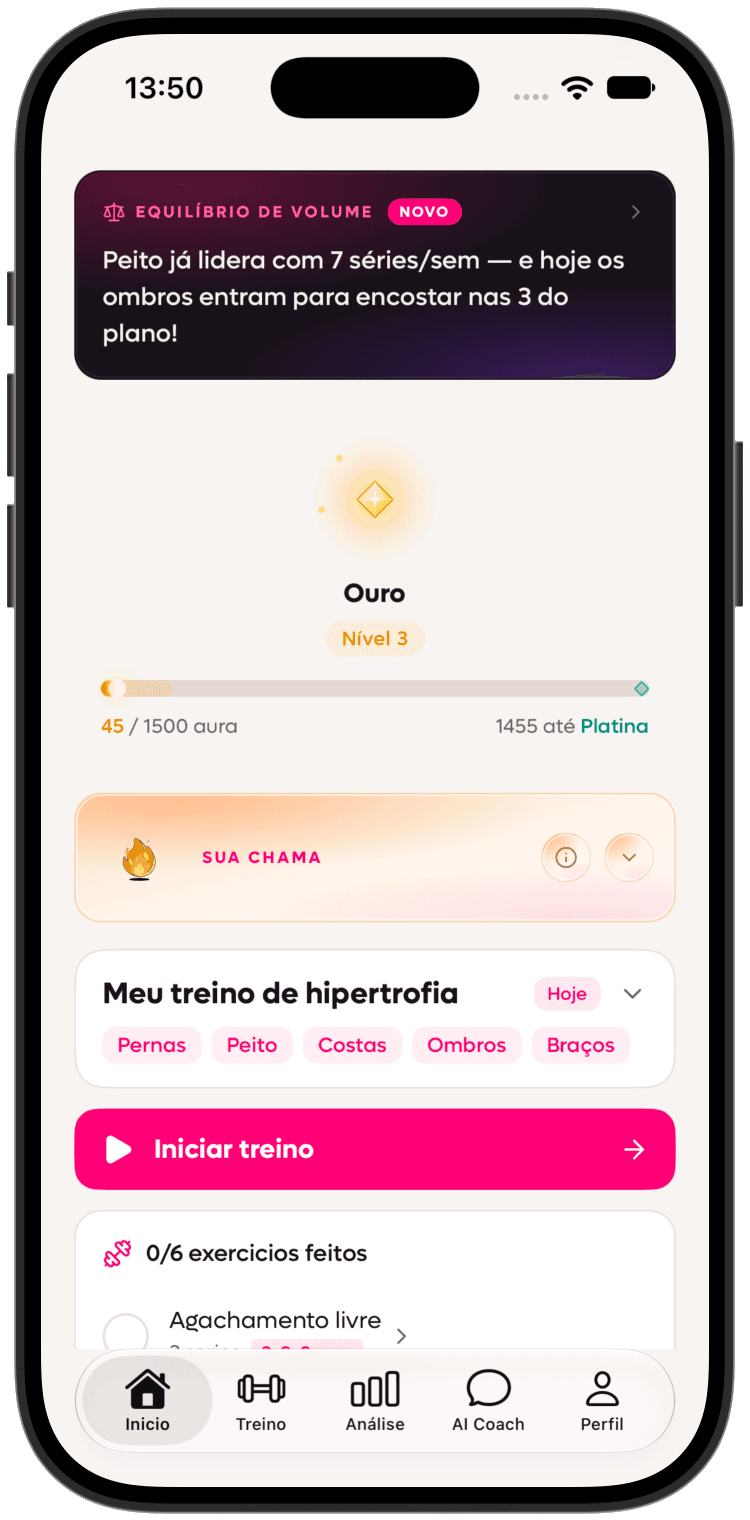
Not every week will go as planned. The point is not turning an occasional miss into complete abandonment. If you cannot do the ideal workout, do the possible one. Minimal movement still preserves identity, habit and continuity.
This rule is powerful because it breaks the all-or-nothing mindset. A shortened workout, a session at home or an improvised adjustment is not defeat. It is maintenance of the bond with the process. And for someone coming back, keeping that bond matters far more than stacking rare, perfect sessions.
6. Rebuild identity, not just results
Whoever comes back better usually stops thinking only about their physique and starts seeing themselves as someone who trains. That identity shift changes behavior. When training stops depending only on the aesthetic motivation of the moment, consistency gets less fragile.
That does not mean ignoring results. It means understanding that results show up more strongly when training stops being an isolated event and becomes part of your routine again. Someone who thinks "I am becoming someone who trains again" usually makes better decisions than someone who only thinks "I need to recover everything fast".
7. Set the environment to pull you into action
Playlist, route, gym, home workout, time, friend, visual reminder. The environment influences far more than it seems. If everything around you makes going harder, you will depend on willpower all the time. And that is a bad strategy.
It is worth thinking of the environment as an invisible part of training. An easy path, clothes set aside, a reminder at the right time or an already-structured workout shorten the distance between intention and action. The more the context pushes you toward movement, the less mental energy you need to start.
8. Measure what actually matters
On the comeback, the focus should not be only load or appearance. It is worth tracking consistency, effort, how the session felt and how the routine is adapting. That reading protects you from overdoing it and helps you notice progress even before clearer visual changes.
This is where logging effort starts making a big difference. For a better ruler, go back to the practical RPE and RIR guide and then see how it fits into Intelligent AI-powered training.
When you measure only aesthetics, the process seems too slow. When you measure behavior, effort and consistency, training starts showing progress earlier. That kind of reading also reduces anxiety because you start seeing progress in signals that were invisible before.
9. Technique first, rush later
On the comeback, wanting to prove you can still train like before is one of the fastest ways to scramble the process. The return needs to prioritize movement pattern, execution and the right dose. Load comes later. First, the body needs to relearn to sustain the basics with quality.
Do not treat muscle memory as permission to rush. Human studies support persistent cellular signals, but the functional benefit remains incompletely defined. A potentially faster response is context, not permission to skip stages. See When to increase weight without losing technique.
10. Have a plan B and a plan C
Crowded gyms, unexpected meetings, occupied equipment and tiring weeks will happen. Sustainable returns depend on adapting without dismantling the process. Sharp, worsening or persistent pain is different: stop the exercise and seek professional assessment when needed.
If your routine changes, review your plan. SelfShapeAI lets you create from current context, log sessions and discuss substitutions or progression with AI Coach, without confusing training guidance with clinical diagnosis.
Having a plan B and a plan C does not mean lack of discipline. It means process maturity. An intelligent comeback anticipates variation in routine, energy and context. When you already know how to adapt without panicking, consistency stops depending on luck.
11. Use gamification with criteria
Small goals, a training streak, check-ins and comparison with your own previous week help keep the process alive. The idea here is not to infantilize training. It is to give visible feedback to a comeback that, at the start, may feel too slow in your head.
This feedback makes continuity, frequency and small wins visible. Habit research shows wide variation across people and behaviors; there is no magical 21-day deadline. Streaks and XP provide feedback, but habits still need repetition in a workable context.
12. Recover like someone who wants to keep training
Whoever comes back thinking only about training usually forgets that recovery is also part of the comeback. Sleep, food and hydration define whether the next session happens with quality or only with stubbornness. To reinforce this part, connect it with How to build more muscle and Real nutrition: demystifying fat.
In practice, recovery is what allows the restart to keep existing after the initial excitement. Whoever sleeps badly, eats badly and trains above what they recover from tends to turn the comeback into more wear. Whoever organizes recovery can turn the session into a base for the next one, not an obstacle.
13. Do not treat one miss as a cancellation of the journey
This is maybe the most important point. Missed a workout? Come back at the next opportunity. No punishment, no drama and no narrative that you ruined everything. What destroys the comeback is not missing a day. It is turning a small detour into complete abandonment.
There is only one caveat here: do not come back with the same plan as before as if nothing had changed. If there was a long break, the body and the routine need to be read again. That is exactly what avoids a disorganized comeback and the risk of getting hurt.
This last point is what closes all the others. The comeback does not need to be perfect to work. It needs to be continuous. One crooked week does not invalidate the process. One missed workout does not erase what has been rebuilt. What matters most is how fast you pick the thread back up, not the fantasy of never failing.
How SelfShapeAI helps you come back without the mess
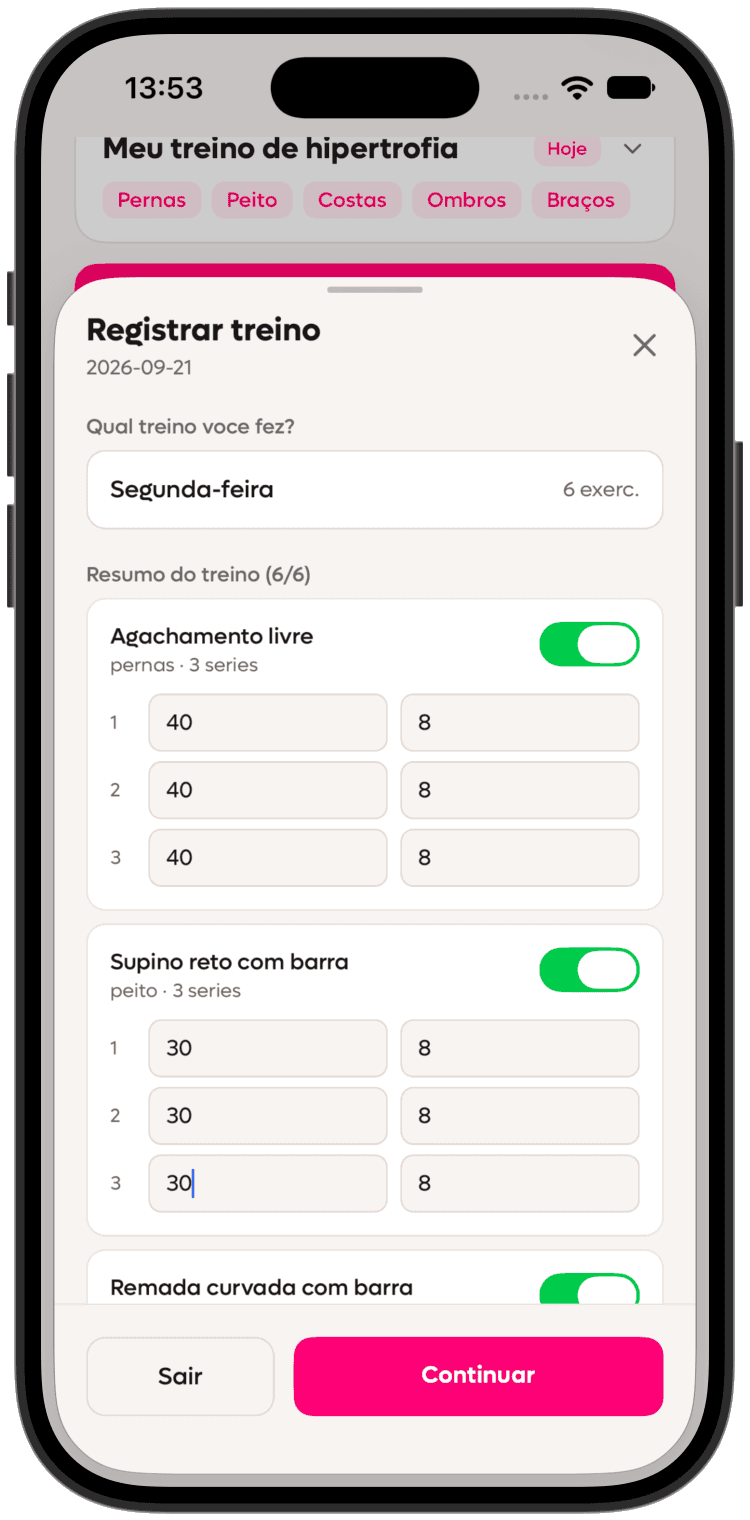
A useful system reduces improvisation. SelfShapeAI starts with goals, level, frequency, equipment and routine; load, reps, RIR/RPE and notes then contextualize history. Training becomes a plan for now rather than an attempt to recover the past.
That also avoids a common mistake: thinking that coming back well means coming back strong. In practice, coming back well means coming back sustainably. This logic connects directly with From beginner to results: 4 steps to start training with method, Full body vs. split training and what we show on Pricing.
The app connects plans, logs and progress without guilt-driven restarting. Review How many sets to build muscle without copying a universal ceiling, and why Training to failure need not be every set's default.
Frequently asked questions
- How do I get back to training after a long time off?Reassess your routine and initially use less load and fewer sets than at your previous peak. Preserve technique and effort margin; increase dose as performance and recovery respond. Make the return repeatable, not heroic.
- Does coming back at full speed accelerate results?In most cases, no. Coming back too aggressively usually increases soreness, breaks the routine and reduces the chance of keeping the following week. To calibrate effort better, reread the practical RPE and RIR guide.
- What if I miss a workout during the week?Nothing was cancelled. Come back at the next opportunity. The problem is not an isolated miss. The problem is using that miss as a justification to quit again.
- Is it worth using AI to organize the comeback?It can help when technology starts with current context, keeps history accessible and supports adjustments instead of imposing a static routine. Explore AI training.
Coming back well is better than coming back strong
Resuming your training routine does not require perfection. It requires a system. When you reduce friction, adjust expectations, measure effort and protect consistency, the comeback stops being dramatic and starts becoming a habit again. That is how the routine reappears. And that is how results become possible again.
For a plan that follows your current phase without guesswork or improvisation, start your training plan.
Sources and references
- Source: Halonen J et al. Does Taking a Break Matter—Adaptations in Muscle Strength and Size Between Continuous and Periodic Resistance Training. Scand J Med Sci Sports, 2024. — Scandinavian Journal of Medicine & Science in Sports (PubMed)
- Source: Cumming KT et al. Muscle memory in humans: evidence for myonuclear permanence and long-term transcriptional regulation after strength training. J Physiol, 2024. — The Journal of Physiology (PubMed)
- Source: Singh B et al. Time to Form a Habit: A Systematic Review and Meta-Analysis of Health Behaviour Habit Formation and Its Determinants. Healthcare, 2024. — Healthcare (PubMed)
- Source: Currier BS et al. ACSM Position Stand: Resistance Training Prescription for Muscle Function, Hypertrophy, and Physical Performance in Healthy Adults. Med Sci Sports Exerc, 2026. — ACSM / Medicine & Science in Sports & Exercise (PubMed)
Reviewed by the SelfShapeAI research team using strength-training guidelines and studies.
Take this method to the app

Create your plan with AI, log check-ins and use the AI Coach to adjust training with context.
Share
SelfShapeAI Team
SelfShapeAI technical and editorial team.
Keep learning

Recommended next article
From beginner to results: 4 steps to start training with method
See the 4 steps to leave random training behind, start at the gym with method and turn consistency into real results.
Continue →