How to build more muscle: what actually matters for hypertrophy
A straight guide for anyone who wants hypertrophy with more method, less noise and a routine that actually sustains itself.


Building muscle does not require random suffering, elaborate workouts or weekly plan changes. Hypertrophy responds to sufficiently challenging stimulus repeated and adjusted long enough for adaptation. Organize volume, effort, progression and recovery before seeking a secret variable.
If you want to build real muscle, the right question is not "which workout gives the best pump?". The right question is: are my volume, my progression, my execution, my food and my recovery pointing in the same direction? When that answer starts getting coherent, muscle gain stops looking like luck.
This article exists to organize that logic. The idea is to leave the generic hypertrophy speech behind and show what actually moves results in practice. If you are still building the base of the process, connect this reading with From beginner to results: 4 steps to start training with method.
Contents
- 1. What actually drives hypertrophy
- 2. Volume: the muscle needs enough work
- 3. Progression: muscle grows when the body gets a clear reason to adapt
- 4. Technique: the same load can generate completely different signals
- 5. Effort: neither too light, nor chaos every session
- 6. Recovery: training does not become muscle inside the set
- 7. Consistency: muscle responds better to good weeks than to heroic sessions
- 8. The mistakes that most stall muscle gain
- 9. How SelfShapeAI enters this conversation without complicating the process
- 10. Frequently asked questions
- 11. More muscle does not ask for magic. It asks for coherence.
What actually drives hypertrophy
- Enough weekly working-set volume per muscle, without making quantity an end in itself.
- Well-read progression, instead of raising load out of ego. For that, follow up with Simple progression: when to add weight.
- Effort calibrated honestly, something that gets much clearer in the practical RPE and RIR guide.
- Exercises and execution that allow repeatable range, control and effort. Compare Machines and free weights without taking sides.
- Food and recovery that sustain the process. To go deeper on the food side, see Real nutrition: demystifying fat in the diet of people who train.
Turn understanding into a workout you can follow
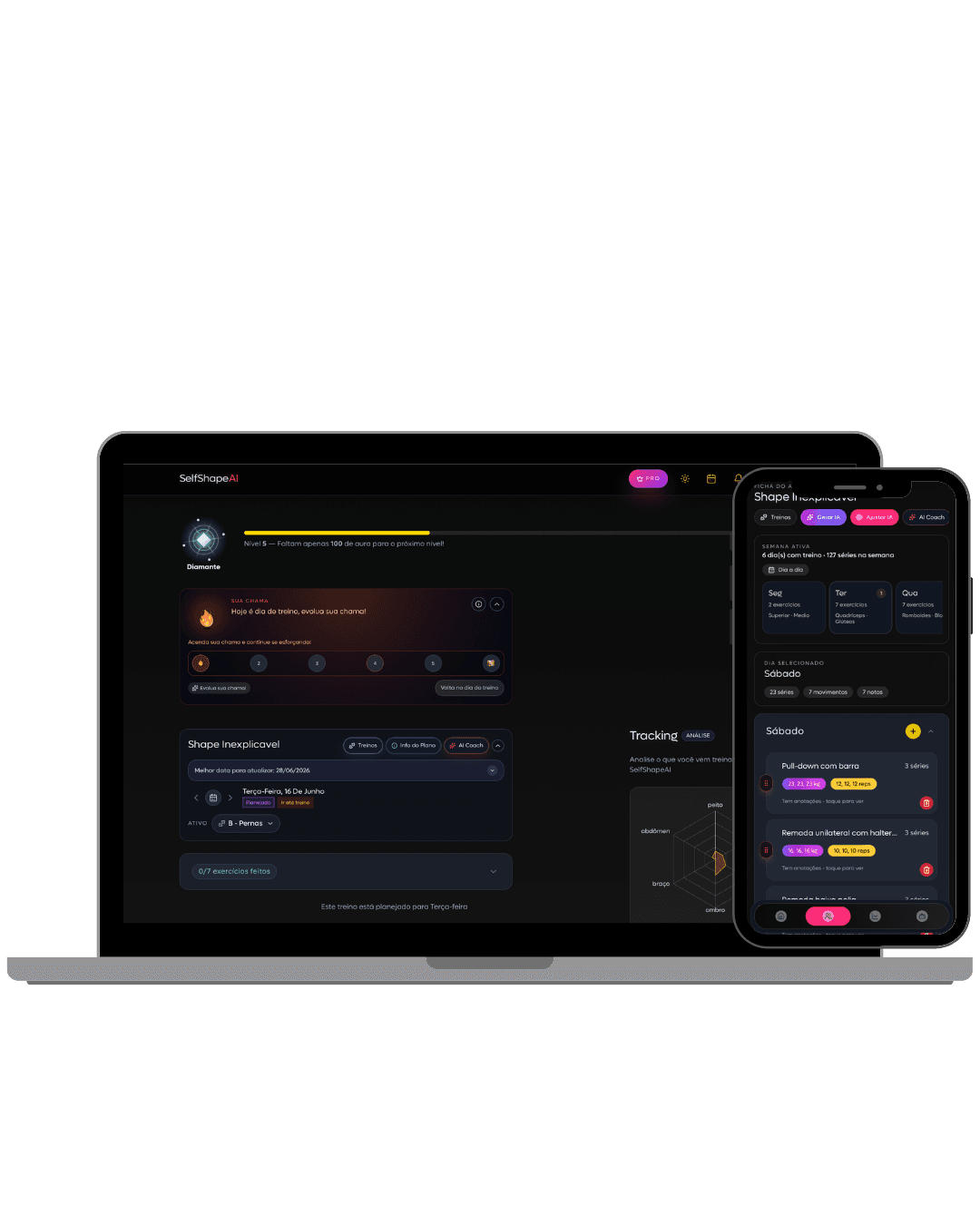
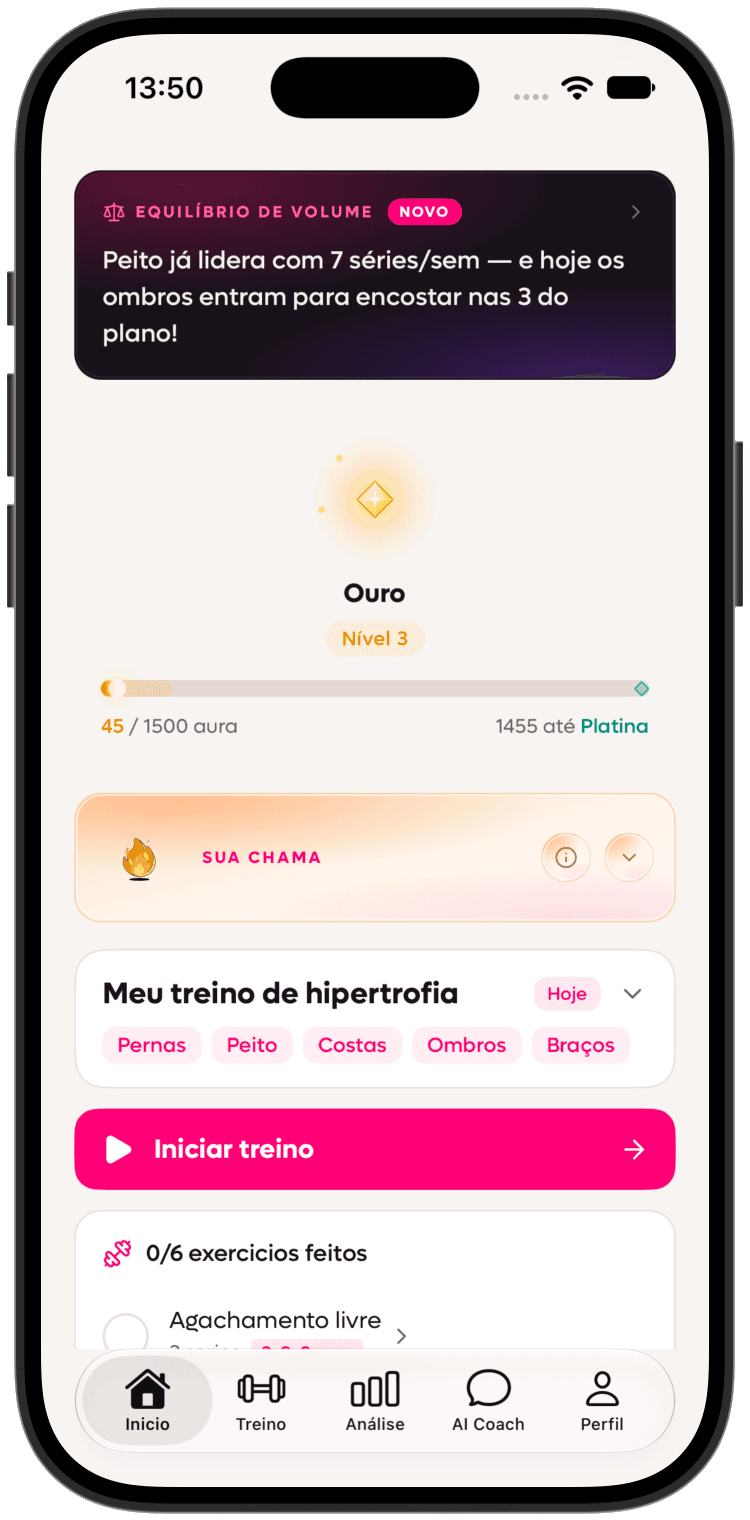
SelfShapeAI uses your routine and goal to build an explained plan, log every session and guide the next adjustment.




Download for free. Annual: R$ 299,90/year, equivalent to about R$ 25/month; monthly: R$ 39,90/month. See how AI training works.
Volume: the muscle needs enough work
Here, volume is most useful as working sets per muscle. Research finds more average hypertrophy with higher weekly volume, and the latest ACSM position highlights benefits above around ten weekly sets. This is a study-level trend, not a mandatory target for every person and muscle.
Few sets can still produce growth, especially for beginners or minimalist routines. Adding sets may help while performance and recovery stay stable, but each increase tends to offer less return. Start with a recoverable dose and adjust by response. See How many sets to build muscle and Full body or split.
In a tight routine, fewer exercises and more repetition of good patterns usually deliver better than huge lists done in a rush. Hypertrophy does not reward a pretty spreadsheet. It rewards consistency of stimulus.
Progression: muscle grows when the body gets a clear reason to adapt
Training must remain challenging as you adapt, but weight need not rise weekly. Trials in trained people show similar growth from load or rep progression. Specificity still matters: heavier-load practice favors strength in that testing task, while more reps better develop that capacity.
Changing range, technique or equipment while progressing makes comparison weaker: the number rises but the task differs. Criteria matter more than urgency. See Simple progression: when to increase weight without losing technique.
That criteria gets even stronger when you learn to read effort. If the set ended with good margin and the movement is stable, there may be room to advance. If technique fell apart, the best choice may be consolidating the pattern before increasing. This logic connects directly with the practical RPE and RIR guide.
Technique: the same load can generate completely different signals
Technique is not a single pose or automatic hypertrophy promise. It makes reps safe, tolerable and comparable. Appropriate Range of motion helps reveal genuine load and rep progress.
Shortening range or changing movement substantially can shift demand and obscure history. There is no identical perfect technique for everyone, but consistent execution lets you recognize and repeat the trained task.
If you still live the cycle of coming back, accelerating and stalling again, the problem may not be lack of dedication, but lack of process. In that case, combine this reading with 13 tips to get back to training.
Effort: neither too light, nor chaos every session
Both extremes can be unhelpful: ending every set far from failure or making momentary failure mandatory. A 2024 meta-regression linked closer-to-failure sets with more hypertrophy, but the exact point remains uncertain. Failure versus non-failure comparisons do not show failure is necessary.
RPE and RIR estimate this distance and improve with practice. Near-failure work can be productive without zero RIR in every exercise. Fatiguing compounds, stable isolation exercises and return phases need not share a prescription. See the Practical RPE and RIR guide and Training to muscular failure.
Recovery: training does not become muscle inside the set
Training provides the stimulus; adaptation depends on recovering and returning. Insufficient sleep, energy or protein intake incompatible with goals, and accumulated fatigue can limit repeatable work. Hypertrophy extends beyond an isolated session.
Sleeping better is not a luxury. Eating more coherently is not a frill. All of that defines whether the body will be able to respond to the signal it received. When the nutritional process is poorly resolved, the feeling is usually of being stuck: you train, but energy swings, hunger gets confusing and recovery never seems to close properly. For that part, it makes sense to go back to Real nutrition: demystifying fat in the diet of people who train.
Consistency: muscle responds better to good weeks than to heroic sessions
This is maybe the most underrated point of hypertrophy. What builds the most muscle in the long run is not the legendary workout. It is the sequence of good-enough weeks. When training fits your schedule, when progression is readable and when food sustains the routine, the body finally gets continuity.
That is why training three times a week with coherence can deliver far more than living between extremes of excitement and abandonment. If the structure is still confusing, go back to Full body vs. split training. If the problem is an inconsistent comeback, reread 13 tips to get back to training.
The mistakes that most stall muscle gain
- Switching workouts all the time without letting the body respond to the current plan.
- Raising load too early and losing execution quality.
- Training without effort criteria, alternating between too light and too extreme.
- Ignoring food and recovery as if only training determined the result.
- Depending on motivation instead of a routine that sustains itself.
Notice how all these mistakes share the same root: lack of method. Whoever understands this early stops looking for a magic formula and starts organizing the basics very well. And the basics done well, repeated long enough, are usually the most predictable path to building muscle.
How SelfShapeAI enters this conversation without complicating the process
The greatest usefulness of an intelligent system here is simple: reducing reading errors. When training, effort, routine and history can talk to each other, it becomes easier to adjust what actually matters without turning hypertrophy into an infinite spreadsheet. SelfShapeAI helps exactly at that point, organizing the plan within your real context.
That makes a difference because building muscle does not depend only on knowing what to do. It depends on continuing to do what makes sense. And continuity usually comes from a clearer system. To see how this logic fits the product, go through the features, AI training, Pricing and our home page.
Frequently asked questions
- What is the most important factor for building more muscle?The most important thing is the combination of enough stimulus, well-done progression, recovery and consistency. It is not an isolated factor. It is the system working together.
- Can you build muscle training few times a week?Yes, you can. As long as the training is well distributed, progressive and repeatable. Often three good sessions a week deliver more than an overly ambitious routine that does not sustain itself.
- Do I need to add load every week for hypertrophy?Not necessarily. Progression can also come from reps, control and a better reading of effort. To go deeper on this, go back to Simple progression: when to add weight.
- How do I know if I am training hard enough?The most practical way is starting to measure effort more honestly. For that, the best support is the practical RPE and RIR guide.
More muscle does not ask for magic. It asks for coherence.
Building more muscle does not require a secret workout. It requires a process where volume, progression, technique, food, recovery and consistency finally stop competing with each other. When all of that starts working together, hypertrophy stops looking random.
To organize the process with more clarity and less guesswork, start your training plan.
Sources and references
- Source: Pelland JC et al. The Resistance Training Dose Response: Meta-Regressions Exploring the Effects of Weekly Volume and Frequency on Muscle Hypertrophy and Strength Gains. Sports Med, 2025. — Sports Medicine (PubMed)
- Source: Currier BS et al. American College of Sports Medicine Position Stand. Resistance Training Prescription for Muscle Function, Hypertrophy, and Physical Performance in Healthy Adults. Med Sci Sports Exerc, 2026. — ACSM (PubMed)
- Source: Robinson ZP et al. Exploring the Dose-Response Relationship Between Estimated Resistance Training Proximity to Failure, Strength Gain, and Muscle Hypertrophy. Sports Med, 2024. — Sports Medicine (PubMed)
- Source: Plotkin DL et al. Progressive overload without progressing load? The effects of load or repetition progression on muscular adaptations. PeerJ, 2022. — PeerJ (PubMed)
Reviewed by the SelfShapeAI research team using strength-training guidelines and studies.
Take this method to the app

Create your plan with AI, log check-ins and use the AI Coach to adjust training with context.
Share
SelfShapeAI Team
SelfShapeAI technical and editorial team.
Keep learning

Recommended next article
How many sets to build muscle? How to get your volume right without overshooting or falling short
Find out how many sets make sense for hypertrophy, how to think about weekly volume per muscle and how to adjust the right dose without overdoing it or training below what you need.
Continue →