Leg workout: how to build a strong, aesthetic and complete lower body
Understand how to balance compounds and isolation, organize session order, get frequency right and use SelfShapeAI to track your progress with more clarity.

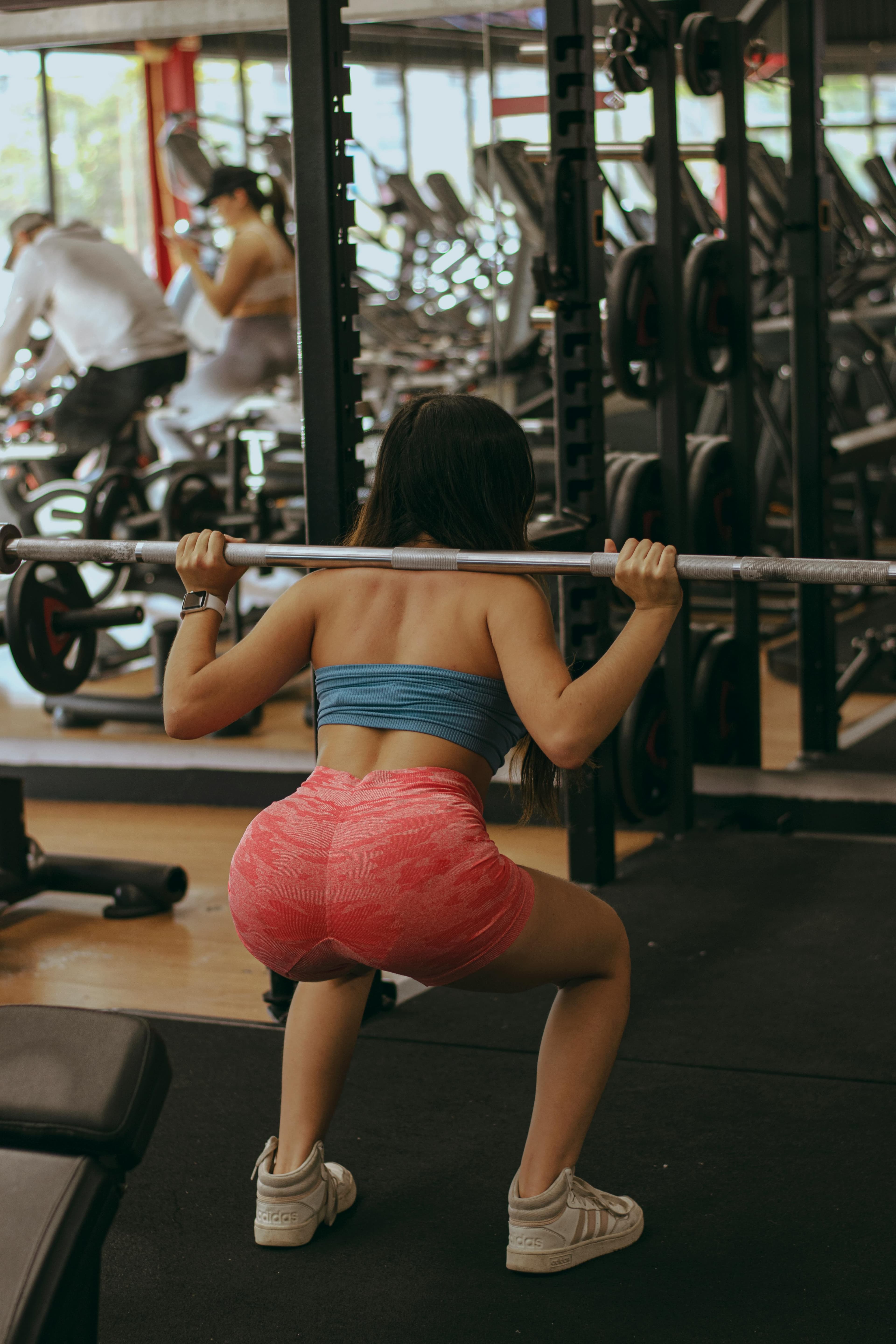
Leg day need not be your most exhausting day or an endurance test. It should distribute sufficient work across selected muscles and movements, preserve technique and remain recoverable within the week.
Lower-body sessions can build strength and muscle through squats, leg presses, Romanian deadlifts, curls and lunges. Selection varies with goals, equipment, anatomy, experience and tolerance. Compare full body versus splits, upper/lower and PPL.
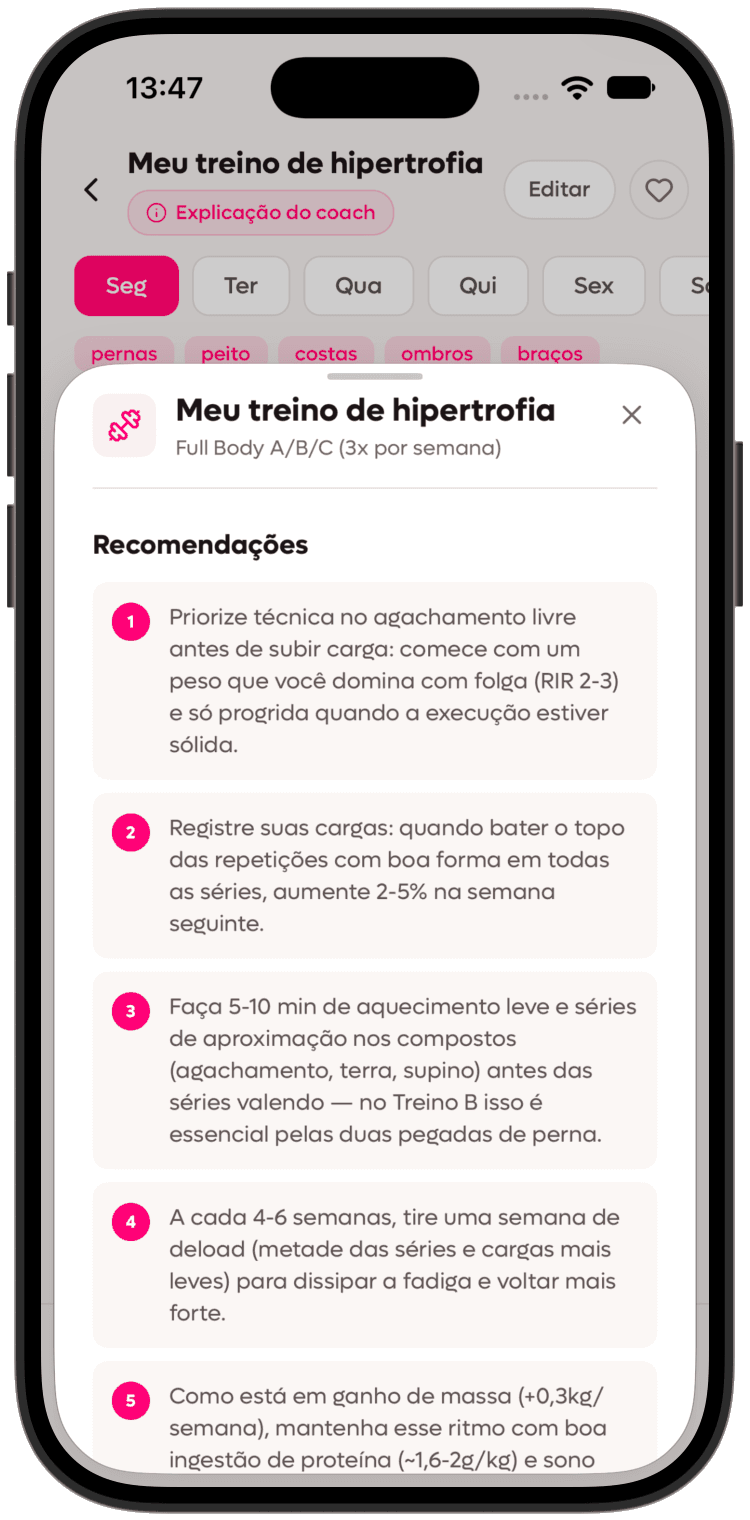
In SelfShapeAI, this kind of session gets more useful because the workout is not born as a generic leg day. It is born with context, an explanation of the logic, execution logging and a real reading of what is happening across the weeks — the approach behind AI training.
Contents
- 1. What a lower-body workout really is
- 2. What leg training can develop
- 3. The base: compound exercises
- 4. The refinement: isolation exercises
- 5. How a well-structured leg workout works
- 6. A practical lower-body example
- 7. Frequency: how many times to train legs?
- 8. What will really make you progress on leg day
- 9. Common mistakes in lower-body training
- 10. 1. Treating legs as a secondary block
- 11. 2. Wanting to live on the squat alone
- 12. 3. Doing a giant leg day and repeating it badly
- 13. 4. Ignoring hamstrings and glutes
- 14. 5. Not warming up properly
- 15. Where SelfShapeAI comes in
- 16. How to notice your lower body is working
- 17. Frequently asked questions
What a lower-body workout really is
Training lower body goes far beyond "doing legs". We are talking about a session that involves quads, hamstrings, glutes, calves and, in many cases, the core as an important stability support.
- A knee-dominant movement.
- A hip-dominant movement.
- Knee flexion for hamstrings when absent from another session.
- Unilateral or isolation exercises according to priorities.
- Calves and adductors when part of the weekly goal.
This is a map, not a requirement to fit everything into one day. Squats and leg presses combine knee and hip extension; hinges emphasize hip extension; curls train hamstring knee flexion. Cover these functions in one session or across the week, including specific adductor work.
Turn understanding into a workout you can follow
SelfShapeAI uses your routine and goal to build an explained plan, log every session and guide the next adjustment.




Download for free. Annual: R$ 299,90/year, equivalent to about R$ 25/month; monthly: R$ 39,90/month. See how AI training works.
What leg training can develop
Results depend on exercise and measurement. Squats develop practiced capacities, curls provide more localized hamstring work and calves need appropriate direct stimulus.
- Strength in trained movements and tasks with similar transfer.
- Hypertrophy in muscles receiving sufficient volume and effort.
- Technical practice in knee, hip and ankle patterns.
- Capacity to sustain planned dosage with adequate recovery.
Glutes, quadriceps, hamstrings, adductors and calves do not respond identically to one exercise. Combine stimuli around your priorities without requiring all in every session. See building muscle and getting stronger with SelfShapeAI.
The base: compound exercises
Compounds efficiently train multiple joints and muscles, but may require more technique, warm-up and recovery. They are useful, not necessarily superior to isolation work for every goal.
- Back, smith or hack squat.
- Leg press.
- Romanian deadlift or stiff-leg deadlift.
- Lunge, walking lunge or split squat.
- Hip thrust.
- Bulgarian split squat.
These exercises train several muscles and allow tracking load or reps. Barbell squats are optional: leg press, hack squat, Smith and unilateral variations can be equally valid for hypertrophy, while strength improves more specifically in the practiced exercise.
With limited time, compounds cover more muscles per exercise. Curls, extensions, adduction and calf work can still provide local work compounds do not deliver equally. See when to increase load and RPE and RIR.
The refinement: isolation exercises
Isolation work directs volume toward a muscle with less contribution from other regions. It can come first or last according to priority. Evidence suggests greater strength improvement in exercises performed first, while hypertrophy can be similar across orders.
- Leg extension.
- Lying or seated leg curl.
- Standing or seated calf raise.
- Cable or machine glute work.
- Adductor, depending on context.
Isolation exercises add local volume without all the systemic demands of squats or deadlifts. Curls deserve attention because hinges do not fully cover hamstring knee flexion. Extensions, adductors and calves can also be central priorities; there is no fixed exercise hierarchy.
How a well-structured leg workout works
Organize lower-body order by priority. The first exercise tends to receive better performance and greater specific strength gains. For hypertrophy, different orders can work; technique, safety, preference and goals determine whether squats, curls or another movement comes first.
- A main knee-dominant exercise.
- A main hip-dominant exercise.
- A unilateral.
- One or two isolation exercises.
- Calves at the end.
Starting with the most important technical movement is common, but priorities such as hamstrings or calves may change that. Avoid redundant work and fatigue that degrade later sets that still matter.
A practical lower-body example
A lower-body session for strength and hypertrophy can look like this:
- Back, smith or hack squat.
- Romanian deadlift or stiff-leg deadlift.
- Dumbbell lunge or split squat.
- Leg extension.
- Lying leg curl.
- Standing or seated calf raise.
This is not a fixed recipe. It is an example of coherent organization. You can adjust it by goal, equipment, training history and individual tolerance. The central point is keeping the session's logic. To compare this kind of organization with other structures, revisit the 4-day workout split and the full body workout.
Frequency: how many times to train legs?
Frequency distributes volume and movement practice. When weekly volume is matched, higher frequency shows no significant hypertrophy advantage; choose the arrangement preserving quality and recovery.
- `1x` weekly: can work with suitable volume and execution.
- `2x` weekly: makes distributing exercises and shortening sessions easier.
- `3x` or more: spreads work further if each session is appropriately dosed.
Two exposures may be more convenient than many sets in one day, but `2x` is not a rule. Observe performance, soreness, technique and adherence. See three-day training, returning to training and the beginner's guide.
What will really make you progress on leg day
In the end, it is not the specific exercise that changes everything. It is the combination of correct execution, load or rep progression, consistency and training structure.
Without those, you can train heavy, sweat a lot and leave wrecked. But you will not necessarily progress. This is an important point because leg training fools you easily: a tiring session is not always a productive one.
- The technique on the main compounds.
- The ability to repeat good execution in the following weeks.
- Progression in load or reps.
- Recovery between one session and the next.
When these pieces come together, leg day starts to really deliver.
Common mistakes in lower-body training
1. Treating legs as a secondary block
This is the most obvious mistake and also one of the most expensive. When legs become an afterthought of the week, the lower body stops evolving and the whole physique feels it.
2. Wanting to live on the squat alone
Squats train quads, glutes and adductors but do not cover all functions equally. Add suitable hamstring, calf or other priority work somewhere in the week.
3. Doing a giant leg day and repeating it badly
A huge session may look hardcore, but it often just worsens quality, recovery and consistency.
4. Ignoring hamstrings and glutes
Hamstring and glute goals need appropriate exercises and sets. A knee-extension-dominated program may not provide their intended dose.
5. Not warming up properly
Preparatory sets practice movement and build toward working loads without turning warm-up into extra fatigue. Review warm-up sets.
Where SelfShapeAI comes in
This is where many people stall without noticing. Lower body demands constant adjustment of volume, intensity, exercise selection and recovery. SelfShapeAI helps reduce that trial-and-error field.
First, the workout can be born better. Instead of copying a ready-made leg day with no context, you can build a plan from your frequency, goal and available equipment. That matters because a good lower body depends heavily on real fit, not just a pretty list of exercises.
The plan explains why an exercise has priority, which functions the session covers and why accessories may sit on another day. Order changes then have a clear reason.
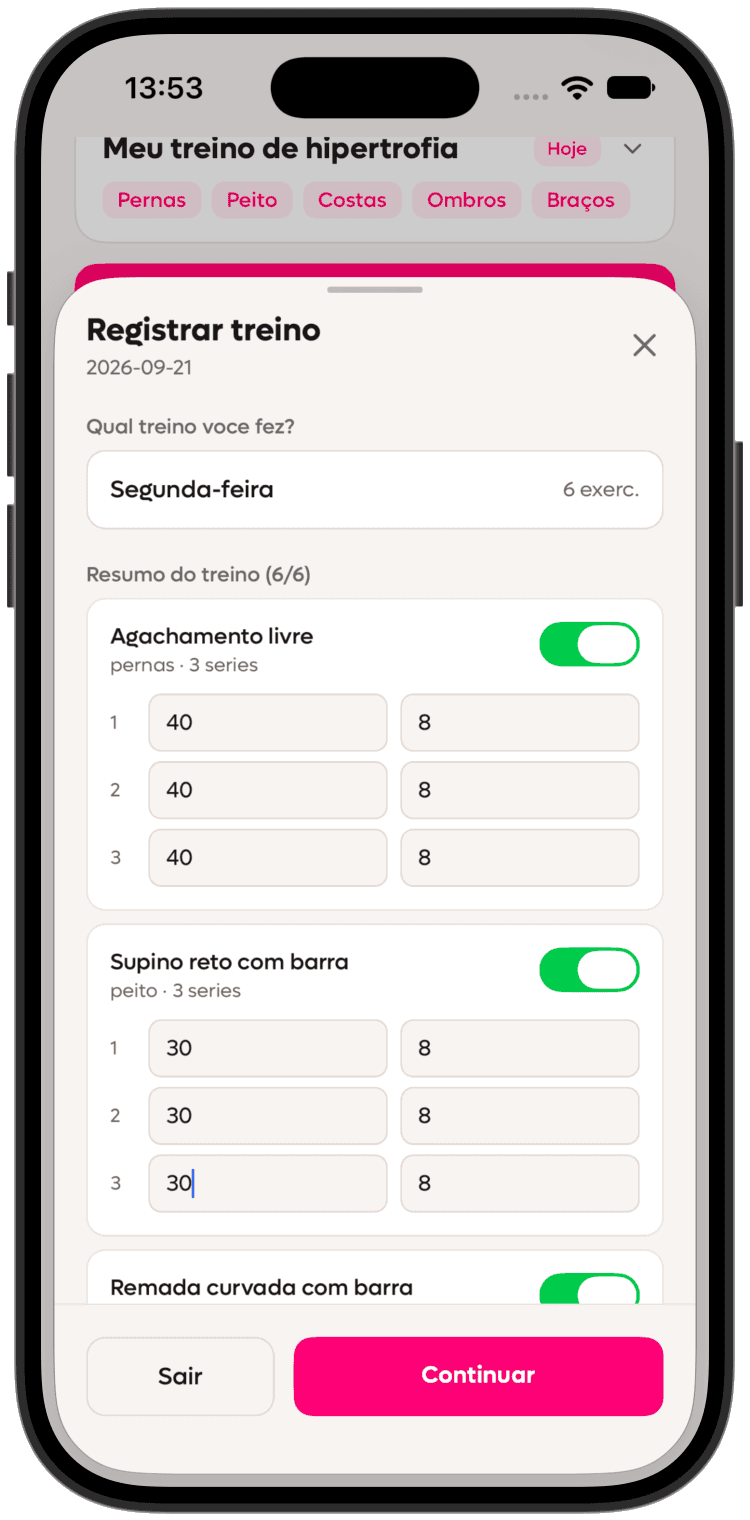
In the session itself, logging and check-ins make a difference. You can save loads, reps and real notes, which helps you understand whether the lower body is really progressing or just felt heavy that day.
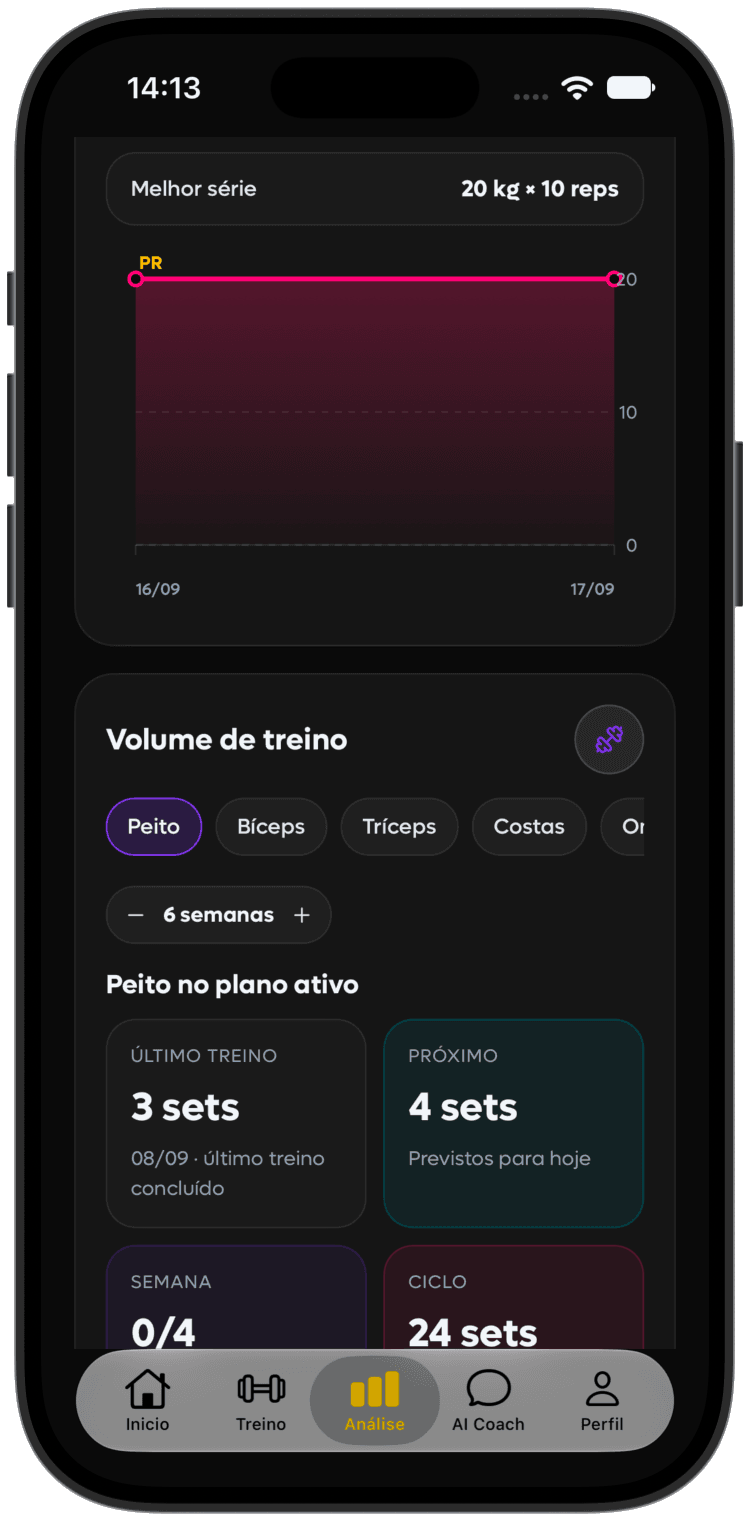
In the analysis, SelfShapeAI helps you see most-trained muscle groups, load progress, max weight per session and planned versus performed sets. In a lower body, that answers very useful questions: are quads, hamstrings and glutes really getting enough stimulus? Did the planned volume turn into executed training? Is the session progressing or just accumulating fatigue? Everything that supports this reading lives in features.
Another strong point is the AI Coach. If an exercise does not fit well, if you need to swap a variation or reorganize training without destroying the session's logic, it helps a lot. And the plan library is useful for keeping different versions of the lower body, like a more strength-focused session and a more hypertrophy-oriented one. To see this broader side of the product, open AI training and Pricing.
How to notice your lower body is working
- You are progressing on the main compounds.
- The session stays balanced between knee, hip and complements.
- Glutes, hamstrings and quads are really being stimulated.
- The workout does not keep getting longer just to look productive.
- You can repeat the session for weeks with good reading.
- The analysis shows real progress, not just fatigue.
This kind of reading is what makes the leg workout stop being an isolated event and become a process of evolution.
Frequently asked questions
- If I do not do the back squat, is my leg workout bad?No. The squat is great, but it is not mandatory for everyone. Depending on your context, hack, smith, leg press, Bulgarian and other variations can fill the main role very well.
- Does lower body need hamstrings and glutes on the same day?Not necessarily. Combine these muscles or distribute emphasis across sessions. The week should deliver planned volume for each priority within recovery limits.
- Is training legs once a week too little?Not necessarily. One session can work with suitable volume and effort. Two or more make distribution easier; routine, recovery and set quality determine the choice.
- How do I know if my leg day is good or just tiring?Look at execution, progression, recovery and consistency. If training only wrecks you but does not improve your progress reading, something is wrong.
- Is lower body better in full body, upper/lower or PPL?It depends on your routine and level. What matters is that the session is well built and the frequency makes sense. To go deeper, cross this theme with Full body vs. split training and the full body workout.
- Does SelfShapeAI really help with such a specific workout?It does, precisely because lower body depends on fine-tuning: session order, exercise selection, logging, analysis and adaptation. To see the general proposal, check AI training and features.
A strong lower-body workout has clear structure, balance and progression over weeks. Explore AI training, features, pricing and SelfShapeAI to build or adjust it.
Sources and references
- Source: Plotkin DL et al. Hip thrust and back squat training elicit similar gluteus muscle hypertrophy and transfer similarly to the deadlift. Front Physiol, 2023. — Frontiers in Physiology (PubMed)
- Source: Nunes JP et al. What influence does resistance exercise order have on muscular strength gains and muscle hypertrophy? A systematic review and meta-analysis. Eur J Sport Sci, 2021. — European Journal of Sport Science (PubMed)
- Source: Schoenfeld BJ, Grgic J, Krieger J. How many times per week should a muscle be trained to maximize muscle hypertrophy? A systematic review and meta-analysis. J Sports Sci, 2019. — Journal of Sports Sciences (PubMed)
- Source: Currier BS et al. American College of Sports Medicine Position Stand: Resistance Training Prescription for Muscle Function, Hypertrophy, and Physical Performance in Healthy Adults. Med Sci Sports Exerc, 2026. — ACSM (PubMed)
Reviewed by the SelfShapeAI research team using strength-training guidelines and studies.
Take this method to the app

Create your plan with AI, log check-ins and use the AI Coach to adjust training with context.
Share
SelfShapeAI Team
SelfShapeAI technical and editorial team.
Keep learning

Recommended next article
Full body vs. split training: which routine makes more sense for your goal?
Find out when full body or a split makes more sense for hypertrophy, a busy schedule and muscle focus.
Continue →