Warm-up sets: what they are, how to do them and when to use them
The bridge between the body that walked into the gym and the load you want to lift: when to warm up more, when to warm up less and how not to waste energy.


Starting directly with a heavy set can make a movement feel unfamiliar and today's load harder to choose. Gradual ramping bridges your starting state and intended task without becoming a separate workout.
A systematic review found improvement in 79% of performance criteria after various warm-ups. It covered different activities and does not prove every sequence improves every exercise, much less eliminates injury risk. The practical conclusion is modest: appropriate, specific preparation may improve performance if it avoids unnecessary fatigue.
In this guide, you will see what these sets actually prepare, how to build the load ladder without turning it into a parallel workout and how to decide — exercise by exercise, day by day — how much warm-up makes sense. If you later want to connect this entry point with the rest of the session, the natural companions are Simple progression: when to add weight and the practical RPE and RIR guide.
Contents
- 1. The short answer
- 2. What these sets prepare in the body
- 3. General and specific warm-up: the two layers
- 4. How to build the load ladder
- 5. When you need more warm-up
- 6. When you need less
- 7. What about bodyweight exercises?
- 8. The invisible mistake: treating every day the same
- 9. Practical example: squats feel wrong on leg day
- 10. Common warm-up set mistakes
- 11. Frequently asked questions
- 12. Warming up is not bureaucracy. It is performance with context.
The short answer
Warm-up sets are lighter sets, done before the working sets, to prepare the body and the movement for the main load. They are not there to tire you. They are there to make you ready.
- The heavier, more technical or more sensitive the exercise, the more important the specific warm-up.
- Exercises requiring more coordination or heavier loads usually need more ramp-up work than stable, light movements.
- The first exercise of a pattern usually needs more preparation because later exercises benefit from prior rehearsal.
- Warming up is not repeating the same ritual everywhere — it is preparing enough without spending too much energy.
- A warm-up set normally does not count toward hypertrophy volume when far from failure; if it became difficult, it served more than preparation.
Turn understanding into a workout you can follow
SelfShapeAI uses your routine and goal to build an explained plan, log every session and guide the next adjustment.




Download for free. Annual: R$ 299,90/year, equivalent to about R$ 25/month; monthly: R$ 39,90/month. See how AI training works.
What these sets prepare in the body
Warm-ups do more than help you “feel the muscle.” General activity may raise temperature and readiness; specific sets rehearse path, range, stability and load perception. For strength exercises, familiarization with the task itself is directly useful.
This is especially relevant to heavy squats, presses, deadlifts and similar exercises. Ramp-up sets also reveal how movement feels today. If execution changes or pain appears, do not use warming up to prove you can persist: reduce demand and seek professional assessment if it continues. See Full body or split.
General and specific warm-up: the two layers
A classic mistake is thinking ten minutes on the treadmill replace the ramp-up sets — or the opposite. They are different layers: the general warm-up takes the body out of inertia; the specific one teaches the system to enter the exact movement that comes next. If the session starts with squats, it is by squatting light that you prepare to squat heavy.
With limited strength-training time, specific sets usually prepare more directly than prolonged cardio. Brief general activity may help when cold or sedentary but does not replace movement rehearsal. Long static stretching immediately before strength work is not obligatory; mobility should address movement needs and can be dynamic. Use the control described in Lifting tempo without turning light reps into slow, tiring tests.
How to build the load ladder
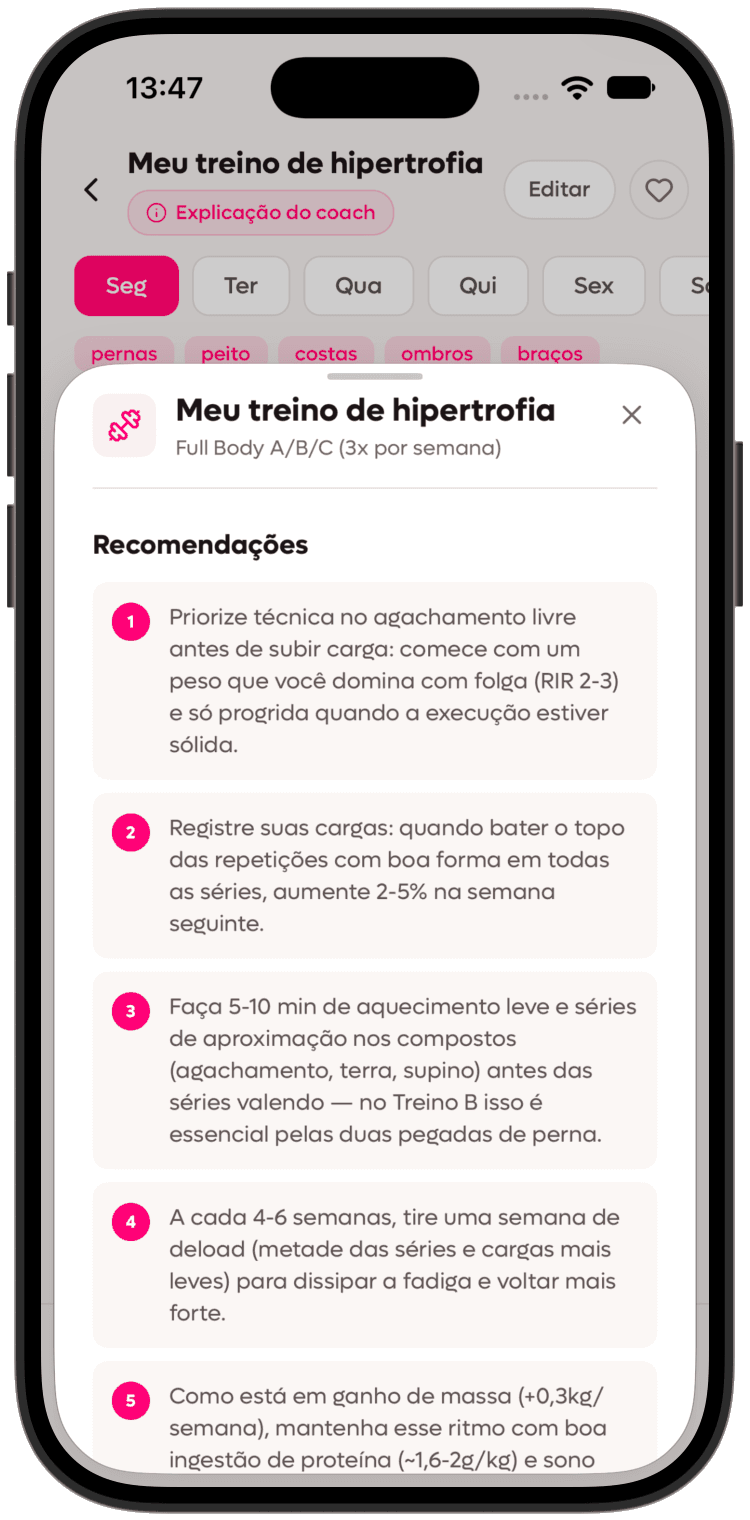
The logic fits in one sentence: start light with more reps and raise the load while cutting reps, until you arrive prepared — not exhausted — at the working weight. An example for working sets of 80 kilos on the squat:
| Set | Load | Reps | What it does |
|---|---|---|---|
| 1 | Empty bar (20 kg) | 10 to 12 | Wakes up the pattern and the joint |
| 2 | 40 kg (50%) | 6 to 8 | Rehearses technique with light load |
| 3 | 60 kg (75%) | 3 to 4 | Approaches the demand with few reps |
| 4 | 68 kg (85%) | 1 to 2 | Tests a heavier load without seeking fatigue |
| Work | 80 kg | Working sets | This is where the real stimulus begins |
As load approaches working weight, reps decrease. Rehearse without accumulating high effort. Percentages are examples and can be simplified; lighter working loads may need one or two ramp-up sets, very heavy attempts more. The ramp also informs Simple progression: when to increase weight?.
When you need more warm-up
- The exercise is free-weight and technical.
- The day's load will be high.
- You are opening the session with it.
- You trained early and still feel stiff.
- There is a history of joint discomfort.
- The pattern demands a lot of stability and coordination.
Greater demands and less familiarity can make a gradual start more valuable. After a break, remembered loads may not reflect current tolerance. See 13 tips for returning to training.
When you need less
After bench press, machine flyes may need a short ramp-up or none, depending on load and movement differences. Equipment stability changes familiarization needs too; see Machines or free weights for hypertrophy. The practical rule:
- The exercise is guided and simple.
- The load is not challenging.
- The muscle group already worked heavy in the same session.
- You just came from a similar movement pattern.
- The movement is an accessory, not the session's technical focus.
Sweating does not mean you are prepared for every pattern. Moving from rows to leg press in a full-body session can justify a brief specific ramp-up. General warming and movement rehearsal serve different needs.
What about bodyweight exercises?
The principle remains approaching the pattern without fatigue. Before pull-ups, use assistance, a band or short isometrics. Before demanding push-ups, use incline or standard versions. Keep reps few, control high and a clear distance from failure; see Training to muscular failure.
The invisible mistake: treating every day the same
The protocol depends on more than exercise. Temperature, time of day, recent breaks, familiarity and early-rep sensations affect preparation. The same squat may need two ramp-ups one day and four after a break. Adjust rehearsal; do not use warming up as pain treatment.
This is exactly the point where a paper spreadsheet stops helping. It does not know you came back from a break, does not know the knee bothered you in the last leg session and does not respond when something does not fit. A system that knows your plan and your history can turn the day's doubt into practical guidance — that is the difference we explore in Intelligent AI-powered training and in the AI training comparison.
Practical example: squats feel wrong on leg day
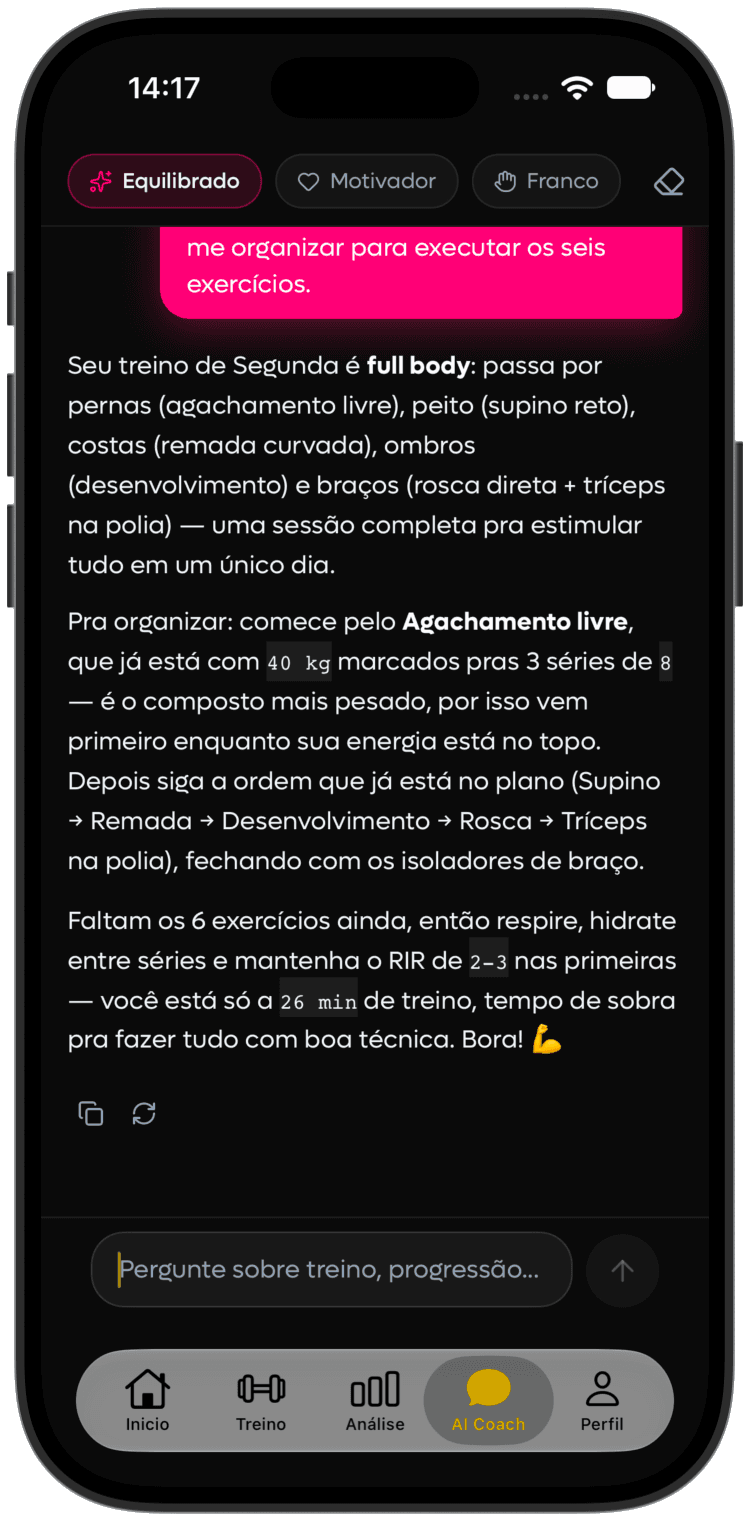
Suppose ramp-up squats feel different from usual. Do not mask pain or seek an app diagnosis. Reduce load, review range and consider changing exercises. SelfShapeAI's AI Coach can discuss that decision in the context of your active plan:
- The day's workout enters the equation — the answer starts from the squat that is in your plan, not from a random example.
- The alternatives make sense for your goal and the equipment you use.
- Reduce load and range to explore a tolerable option without an obligation to salvage the original session.
- Discuss the substitution before editing the plan; persistent or intense pain calls for a healthcare professional's assessment.
This reduces improvisation without presenting AI Coach as diagnosis or rehabilitation. Adapting the day can be more useful than insisting on the original plan. Explore How to build more muscle and Range of motion in resistance training.
Common warm-up set mistakes
- Skipping all ramp-up work before a heavy load and discovering the movement in the first working set.
- Warming up too much. If the warm-up already left you tired, it failed at the only job it had.
- Repeating the same protocol everywhere. A heavy bench press and a lateral raise do not need the same preparation.
- Doing many reps with an already-heavy load — that is disguised work, not a warm-up.
- Ignoring what light sets reveal. If pain appears or worsens as load rises, stop progressing; the Practical RPE and RIR guide measures effort, not symptom severity.
- Resting so little between ramp-ups that breathlessness becomes the limiter. See Rest between sets.
Frequently asked questions
- How many warm-up sets should I do?One to four ramp-up sets cover many situations but are not a rule. Simple exercises and light loads need less; heavy loads or returning after a break may need more. Arrive familiar with the movement without meaningful fatigue.
- Does a warm-up set count as a working set?Usually not, because it ends far from failure and prepares you. A hard, near-failure set is no longer just warming up and may add meaningful fatigue. See How many sets to build muscle.
- Do I need to warm up before isolation exercises?Not always. If you are already warm and the exercise is simple, one optional light set is enough. The warm-up energy belongs to the heavy, technical exercises at the start of the session.
- Does stretching replace warm-up sets?They are not equivalent. Stretching can address range needs, while ramp-up sets rehearse the exercise and load. Avoid prolonged static stretching before strength work that may temporarily reduce performance.
Warming up is not bureaucracy. It is performance with context.
Warm-up sets bridge your starting state and intended load. Well-dosed preparation rehearses movement and informs load choice. It is neither injury insurance nor a mandatory ritual: readiness benefits should outweigh fatigue costs.
SelfShapeAI treats preparation as part of the method: an explained plan, AI Coach support when the day changes and logged sessions that inform the next. Create your AI workout—download for free to start each session with a plan.
Sources and references
- Source: Fradkin AJ, Zazryn TR, Smoliga JM. Effects of warming-up on physical performance: a systematic review with meta-analysis. J Strength Cond Res, 2010. — JSCR (PubMed)
- Source: McGowan CJ et al. Warm-Up Strategies for Sport and Exercise: Mechanisms and Applications. Sports Medicine, 2015. — Sports Medicine (PubMed)
- Source: Iversen VM et al. No Time to Lift? Designing Time-Efficient Training Programs for Strength and Hypertrophy: A Narrative Review. Sports Medicine, 2021. — Sports Medicine (DOI)
Reviewed by the SelfShapeAI research team using strength-training guidelines and studies.
Take this method to the app

Create your plan with AI, log check-ins and use the AI Coach to adjust training with context.
Share
SelfShapeAI Team
SelfShapeAI technical and editorial team.
Keep learning

Recommended next article
Machines or free weights for hypertrophy: what actually changes?
Learn when machines, dumbbells and barbells make sense for hypertrophy and how to combine them without turning preference into a rule.
Continue →