How many sets to build muscle? How to get your volume right without overshooting or falling short
Understand how to think about weekly training volume per muscle, without doing too much out of anxiety or too little out of lack of criteria.


Some people think more sets always mean more results. Others go to the opposite extreme and try to solve everything with the bare minimum. In between, many people train without knowing whether they are doing too much volume, too little or simply nothing coherent with their own level.
The truth is that how many sets you should do depends less on a fixed rule and more on context: training level, goal, recovery, exercise selection and how that volume is distributed across the week.
That is exactly why this topic talks so much to what SelfShapeAI proposes. Intelligent training is not just picking exercises. It is also understanding how much work makes sense for you today, without falling into excess or into the symbolic volume that looks nice on paper but does not move results. To see this logic applied in practice, it is worth continuing later in AI training, what SelfShapeAI delivers and the blog overview.
Contents
- 1. The short answer
- 2. What is a set, anyway?
- 3. The most common mistake: thinking only about today's workout
- 4. How many sets per muscle group per week?
- 5. For beginners
- 6. For intermediates
- 7. For advanced lifters
- 8. So do more sets always produce more growth?
- 9. The minimum that works also matters
- 10. How many sets per exercise?
- 11. A simple chest example in one week
- 12. How to know if you are doing too few sets
- 13. How to know if you are doing too many sets
- 14. What changes between different muscles
- 15. Frequency changes the math
- 16. Where SelfShapeAI comes into this
- 17. What SelfShapeAI helps you see better
- 18. Practical examples
- 19. 1. A beginner copying an advanced routine
- 20. 2. An intermediate stuck for months
- 21. 3. Focusing on a weak point
- 22. Common mistakes when deciding how many sets to do
- 23. Frequently asked questions
- 24. Set count is not ego. It is strategy.
The short answer
For maximizing hypertrophy, around ten weekly sets per muscle is a reasonable starting reference consistent with the current ACSM position. That does not mean nine fail, twenty are better or everyone should start there. Lower volumes produce growth; higher volumes may add results with progressively smaller returns.
- There is no magic number that works the same for everyone.
- Experience influences dose but does not justify a rigid beginner, intermediate and advanced table.
- More sets can help while the increase remains recoverable and subsequent-set performance is preserved.
- Doing too many sets can make the session worse instead of better. To avoid confusing volume with disorganized intensity, review the practical RPE and RIR guide and Simple progression: when to add weight.
- Doing less can also work, as long as there is still enough stimulus.
- In SelfShapeAI, the right logic is not doing more. It is finding a volume that matches routine, frequency, recovery and goal.
Turn understanding into a workout you can follow
SelfShapeAI uses your routine and goal to build an explained plan, log every session and guide the next adjustment.




Download for free. Annual: R$ 299,90/year, equivalent to about R$ 25/month; monthly: R$ 39,90/month. See how AI training works.
What is a set, anyway?
A set is a block of repetitions before rest. For hypertrophy volume, primarily count working sets with appropriate effort; deliberately light warm-up sets do not count the same way. An isolated per-exercise number rarely tells the whole story.
- how many sets per muscle across the week
- how hard those sets are
- how they are distributed
- whether there is recovery between sessions
- whether that volume is being done with good execution
That is what separates organized training from training that merely looks like effort. If your goal is to grow with method, this reasoning connects directly with hypertrophy and with Full body vs. split training.
The most common mistake: thinking only about today's workout
Many people look only at the isolated session. They do 4 sets of bench press, 4 of incline press and 4 of flyes and conclude they trained chest well. But the more useful question is another one: how many sets of chest are you accumulating across the entire week?
If you train the same muscle twice, the reading changes completely. Intelligent training thinks less about how today's workout looked and more about how that muscle group is being built over time. That is the same logic behind From beginner to results.
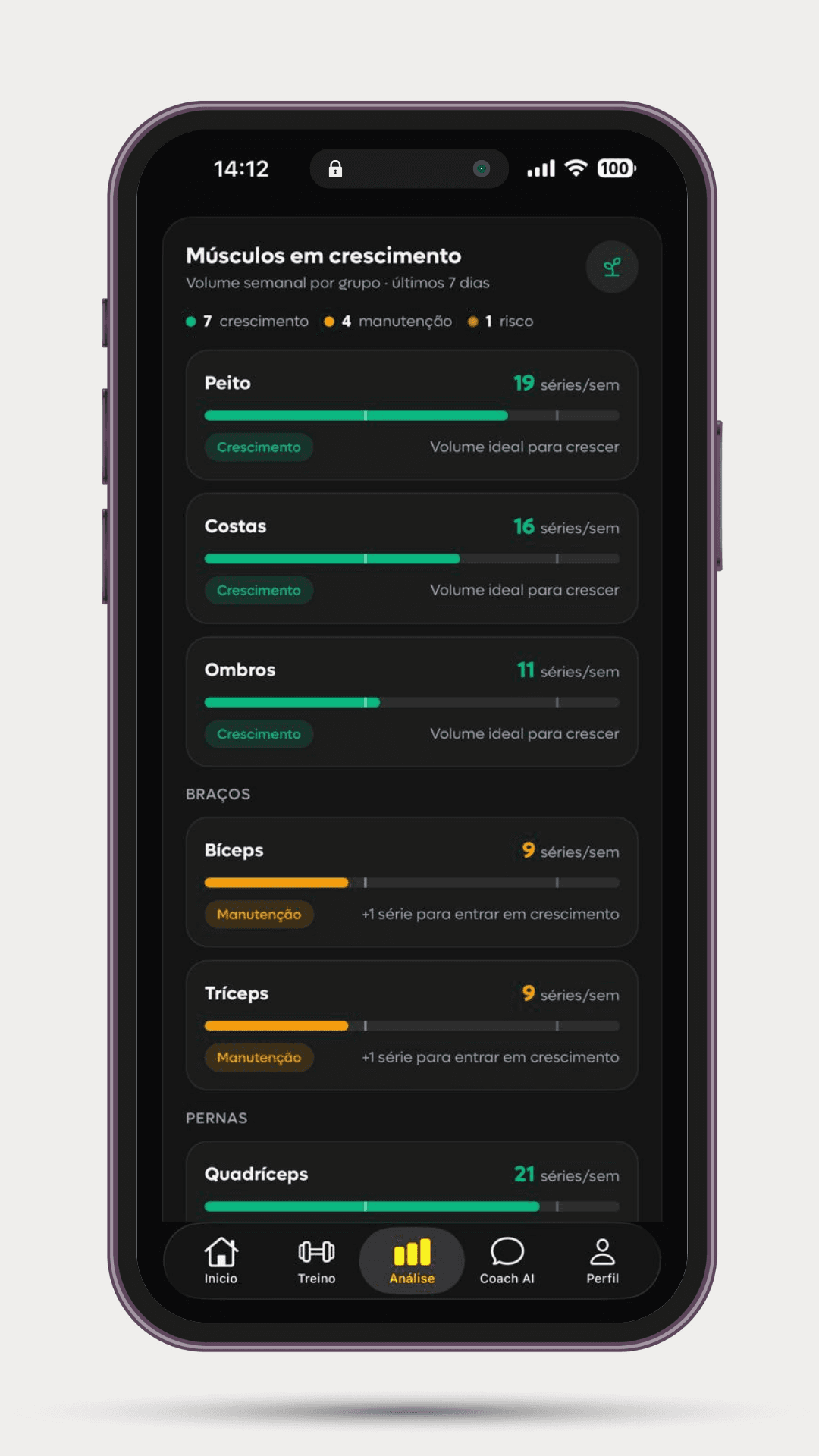
How many sets per muscle group per week?
Recent evidence suggests a dose–response relationship: more weekly sets tend to produce more hypertrophy, with diminishing returns. The 2026 ACSM position highlights ten or more weekly sets per muscle as favoring hypertrophy on average. Pelland and colleagues' meta-regression supports the trend without identifying a universal individual-prescription boundary.
| Scenario | Starting point | How to decide the next step |
|---|---|---|
| Limited time, returning or beginning | Low, repeatable volume | Maintain while load, reps or control improve. |
| Hypertrophy goal with a stable routine | Around ten weekly sets per muscle as a reference | Increase only if the priority muscle has stalled and recovery is stable. |
| Weak-point specialization | A small increase above already tolerated volume | Increase one muscle at a time and reassess performance and fatigue. |
For beginners
Beginners usually respond to modest volumes because the stimulus is new. Learn exercises, effort and routine before pursuing a high set target. See From beginner to results and AI training.
For intermediates
With experience, the current dose may stop producing progress, but more volume is only one hypothesis. First check effort, exercise selection, range, rest and adherence. If stable, test a small increase for the priority muscle.
For advanced lifters
Advanced lifters may need more work for some muscles and less for others. They also use greater absolute loads and can produce more fatigue per set. Experience should not automatically become twenty or more sets for the whole body.
So do more sets always produce more growth?
No. The average curve rises with volume, but each additional set tends to add less benefit. At an individual point, the time and fatigue costs stop being worthwhile.
- loss of technique
- declining performance
- too much accumulated fatigue
- difficulty progressing despite training a lot
- insufficient recovery between sessions
When these start to appear, volume stops helping and starts becoming noise. In practice, more is not better by itself. Better is what you can sustain with quality. To understand where real progression comes in, review Simple progression: when to add weight.
The minimum that works also matters
The scenario that is perfect on paper is not always the one that fits real life. A crowded gym, a tight schedule, irregular sleep and hard-to-keep frequency completely change the discussion.
Between a theoretically perfect volume you never sustain and a good volume you keep for months, the second is usually far more useful. That is why lower volumes can still work, especially when there is consistency, honest effort and progression over time. This view connects strongly with Best workout tracking app in 2026.
How many sets per exercise?
No per-exercise count is mandatory. Two to four sets is common because it distributes work without making one movement the whole workout, but one well-performed set can help and five may fit some contexts. What matters is the weekly dose and changing quality within sessions.
A simple chest example in one week
- Workout A: bench press, 3 sets
- Workout A: incline press, 3 sets
- Workout B: chest press, 3 sets
- Workout B: machine fly, 3 sets
- Total: 12 weekly sets for chest
This example totals twelve direct chest sets as an illustration, not a recommendation for everyone. It may be more than needed for some and tolerable for others. Weekly organization makes adjustments easier than treating every session as isolated.
How to know if you are doing too few sets
- Loads and reps have stalled for several weeks under comparable conditions
- Sets consistently end farther from failure than planned
- The priority muscle receives few direct sets and little compound contribution
- Sleep, nutrition, rest and execution seem stable but progress has no upward trend
No single sign proves insufficient volume. Pump and soreness are not reliable scoreboards either. If conditions are stable and progress has stopped, add a few priority-muscle sets and observe several weeks rather than doubling the plan.
How to know if you are doing too many sets
- persistent performance drops
- fatigue that does not resolve well
- Reps fall very early within the same session
- execution getting worse in the last sets and the last sessions
- difficulty progressing even while training a lot
The problem will not always be just the number of sets. It can be poor sleep, poor eating, badly distributed rest, too many exercises for the same pattern or intensity beyond what you recover from. But yes, excess volume also hurts.
What changes between different muscles
Not every muscle responds the same way. Chest, back, quads, delts, triceps, biceps and calves can react differently depending on frequency, exercise selection, execution, range of motion and indirect participation in other movements.
Triceps contribute to bench and overhead presses; biceps to pulls and rows. The latest meta-regression tested counting indirect sets fully, partially or not at all. Roughly half a set for an assisting muscle can be a useful working estimate, never exact mathematics. Review Full body or split.
Frequency changes the math
The same number of sets can work in very different ways depending on how it is distributed. Doing 12 sets of chest in a single day is one thing. Doing 6 on Monday and 6 on Thursday is another.
Weekly volume is the same, but session fatigue and performance capacity may change. Frequency primarily distributes work: with matched volume, more frequent muscle training does not guarantee more hypertrophy. Splitting work helps when concentrating it reduces quality. Compare Full body or split.
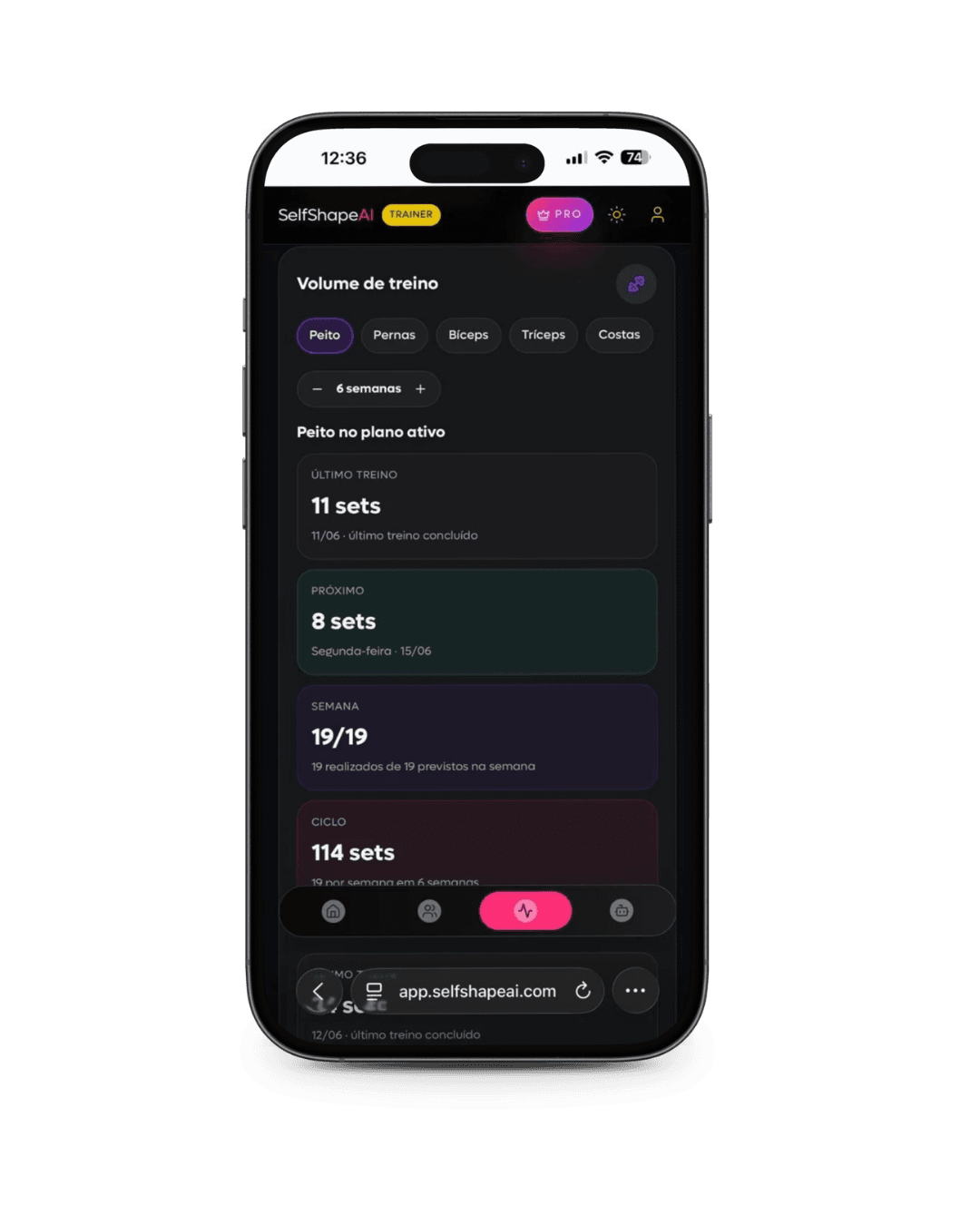
Where SelfShapeAI comes into this
This is one of the topics where the difference between a random template and an intelligent experience really shows. In SelfShapeAI, the question is not just how many sets should I do. The right question is: how many sets make sense for my level right now? Is this muscle already receiving a lot of indirect work? Is this volume compatible with my frequency? Am I recovering well?
That is where volume stops being a loose number and becomes a practical decision. And that is also why it makes sense to look at the platform's features, the AI training plan and the blog overview as parts of the same experience.
What SelfShapeAI helps you see better
- a muscle map to understand where training is concentrated
- Load, reps and records to observe performance trends
- Planned and completed volume by muscle group throughout the routine
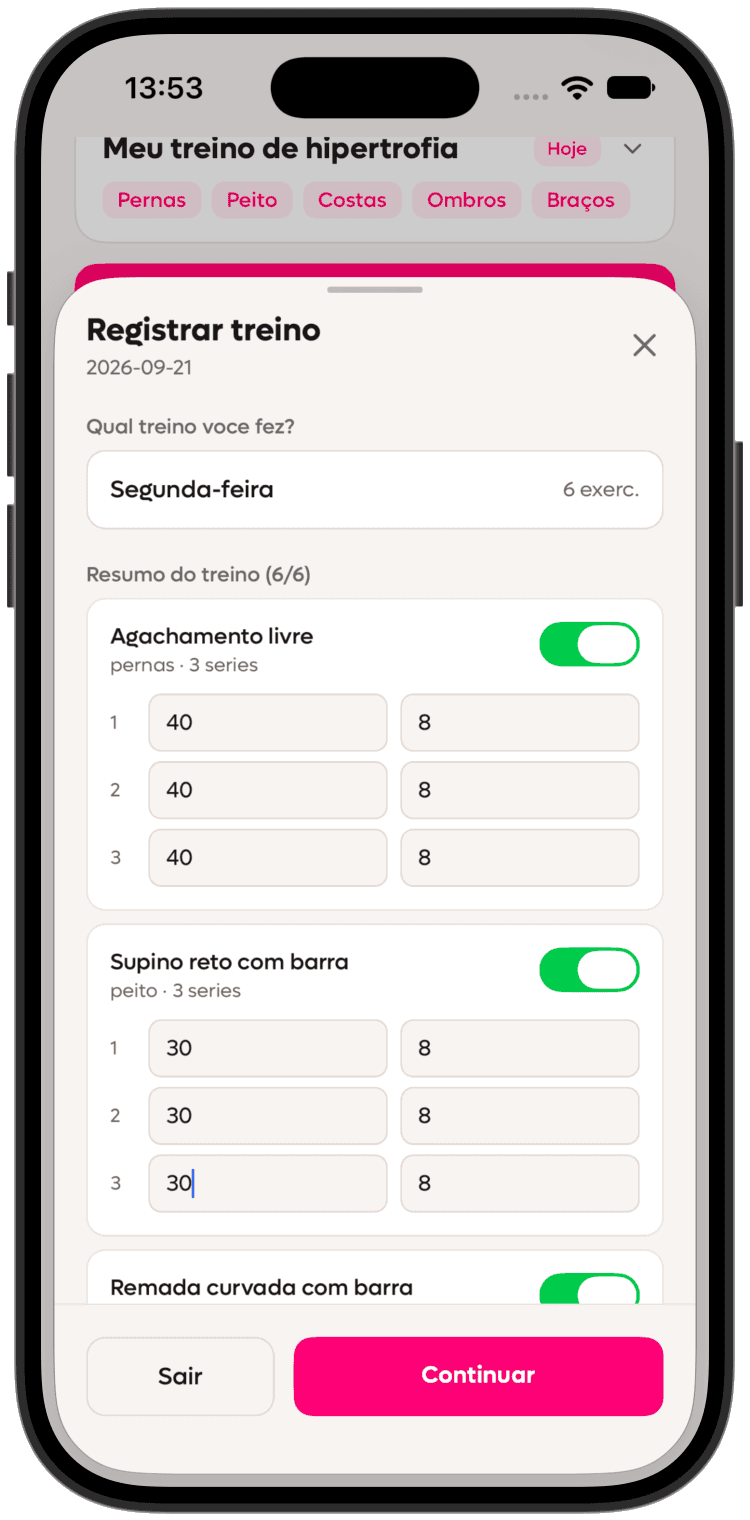
- Check-ins and context for discussing adjustments with AI Coach without relying on memory
That changes the conversation. Instead of training in the dark, you start seeing whether stimulus is missing, whether volume is excessive or whether you are simply distributing the week's effort badly. That clarity also shows up in how the product is built together with its communities.
Practical examples
1. A beginner copying an advanced routine
Someone just starting sees a person training 20 weekly sets of back, 18 of chest, 16 of shoulders and 14 of arms and assumes they must do the same. In practice, that can generate far more fatigue than results. If that is the starting point, the best path is still building a base with clarity, as we show in From beginner to results.
2. An intermediate stuck for months
Consider someone training consistently with comparable effort and execution, recovering well but not progressing in a priority group. Testing a small set increase is reasonable—not retrospective proof that every plateau meant insufficient volume.
3. Focusing on a weak point
If the goal is to develop more chest, back or side delts, it can make sense to raise that group's volume while others stay in a more stable range. That is usually far more sustainable than trying to increase everything at once. For this kind of refinement, How to build more muscle complements the reading.
Common mistakes when deciding how many sets to do
- copying the volume of someone more advanced
- counting only today's workout
- assuming more is always better
- doing too little out of fear of overdoing it
- ignoring recovery, frequency and execution quality
Frequently asked questions
- How many sets per muscle per week are ideal?There is no universal ideal. For maximizing hypertrophy, around ten weekly sets per muscle is supported as a starting reference by recent syntheses, but lower volumes work and higher volumes bring diminishing returns.
- Do beginners need to do 20 sets per muscle?No. Beginners often progress with modest doses while learning exercises and effort. A twenty-set target can add unnecessary fatigue and complexity.
- Can I build muscle with few sets?Yes. Lower volumes can still produce progress, especially when there is consistency, sufficient effort and progression over time.
- Does doing too many sets hurt?It can, especially when recovery does not keep up and execution quality drops. More sets only help while they are still productive.
- What matters more: sets per exercise or per week?For hypertrophy, looking at weekly volume per muscle group is usually far more useful than analyzing a single exercise in isolation.
Set count is not ego. It is strategy.
In the end, getting your set count right is not doing the maximum possible nor the minimum possible. It is doing enough to progress within a volume your body can sustain with good execution, good recovery and real progression.
That is why the most useful question is not just how many sets should I do. It is how many sets make sense for me right now. When that answer takes context, frequency, recovery and real performance into account, training leaves autopilot. And that is exactly where SelfShapeAI makes the difference: it turns volume into clarity and clarity into progress.
To organize training, understand volume in context and adjust progression logically, open SelfShapeAI, explore the platform features, AI training and other blog articles.
Sources and references
- Source: Pelland JC et al. The Resistance Training Dose Response: Meta-Regressions Exploring the Effects of Weekly Volume and Frequency on Muscle Hypertrophy and Strength Gains. Sports Med, 2025. — Sports Medicine (PubMed)
- Source: Currier BS et al. American College of Sports Medicine Position Stand. Resistance Training Prescription for Muscle Function, Hypertrophy, and Physical Performance in Healthy Adults. Med Sci Sports Exerc, 2026. — ACSM (PubMed)
- Source: Schoenfeld BJ, Ogborn D, Krieger JW. Dose-response relationship between weekly resistance training volume and increases in muscle mass: a systematic review and meta-analysis. J Sports Sci, 2017. — Journal of Sports Sciences (PubMed)
Reviewed by the SelfShapeAI research team using strength-training guidelines and studies.
Take this method to the app

Create your plan with AI, log check-ins and use the AI Coach to adjust training with context.
Share
SelfShapeAI Team
SelfShapeAI technical and editorial team.
Keep learning

Recommended next article
Rest between sets: how long for muscle growth and strength?
Learn how long to rest between sets for muscle growth and strength, and adjust the interval without losing repetitions, technique or training time.
Continue →