Five-day hypertrophy training: splits, volume and recovery
Learn when a fifth workout improves weekly distribution, compare balanced splits and adjust volume, priorities and recovery.


Training 5 times a week can be a very useful strategy for hypertrophy, but only when the extra days serve to organize the week's volume better — not to inflate training for the ego. That is the point most people miss. The question is not whether 5 days looks more advanced. The question is whether 5 days makes your routine more specific, more progressive and more sustainable.
When that happens, the 5-day split can open room for more focused sessions, better attention to weak points and more clarity in the stimulus distribution. When it does not, it becomes just a fuller, more tiring week that breaks more easily. If you are still comparing frequencies, cross this article with the 3-day workout split, the 4-day workout split and Full body vs. split training.
In SelfShapeAI, this difference matters because the plan does not have to be born as a static sheet. It can be generated from your real frequency, explained clearly and then tracked with execution, load and volume reading across the weeks — the logic behind AI training.
Contents
- 1. What is a 5-day workout split?
- 2. When a 5-day plan really makes sense
- 3. What changes when you move up to 5 days
- 4. The three most useful ways to structure a 5-day plan
- 5. 1. Classic split
- 6. 2. Push / Pull / Legs + Upper / Lower
- 7. 3. Upper / Lower + priority day
- 8. How to know which 5-day split suits you
- 9. How to gain muscle with a 5-day split
- 10. 1. Distribute volume instead of simply adding it
- 11. 2. Use rep ranges coherent with the exercise
- 12. 3. Progress without wrecking technique
- 13. 4. Respect rest between sets
- 14. 5. Take recovery seriously
- 15. The most common mistakes in a 5-day plan
- 16. Missed a workout? Do not turn the week into compensation
- 17. How SelfShapeAI makes a 5-day plan smarter
- 18. 5-day split vs. 3 and 4 days
- 19. How long until you see results?
- 20. Frequently asked questions
What is a 5-day workout split?
A 5-day split is a structure where you organize the week into five sessions with well-defined roles. That can happen by muscle, by movement pattern or by upper- and lower-body blocks.
- More specificity per session.
- Better distribution of weekly volume.
- More room to give attention to weak points.
- Less need to concentrate everything into giant workouts.
The catch is that this same format also demands more consistency. If your routine breaks easily, if sleep is poor or if you have not yet consolidated execution and progression, the 5 days stop being an advantage fast. That is why so many people do better with 3 or 4 well-executed workouts than with a poorly sustained 5-session week.
Turn understanding into a workout you can follow
SelfShapeAI uses your routine and goal to build an explained plan, log every session and guide the next adjustment.




Download for free. Annual: R$ 299,90/year, equivalent to about R$ 25/month; monthly: R$ 39,90/month. See how AI training works.
When a 5-day plan really makes sense
- When you already have a stable training routine.
- When you recover well between sessions.
- When you want more focus on hypertrophy.
- When you need to distribute per-group volume better.
- When you want to give more attention to priority muscles.
- When 3 or 4 days started feeling short for the level of specificity you seek.
That does not mean 5 days is superior by nature. It only means it can be better for some contexts. Anyone who needs more adherence and simplicity tends to do better with fewer sessions. Anyone with consistency, good recovery and a well-defined goal can make better use of the extra specificity.
Evidence supports this contextual view: with matched volume, greater frequency or switching from full body to a split does not guarantee more hypertrophy. Five days make sense when they solve a specific problem—long sessions, declining later-set quality or a real specialization need—without creating a recovery problem.
What changes when you move up to 5 days
When moving from 3 or 4 days to 5, the main change should not simply be training more. The intelligent change is another: redistribute the week's volume better, shrink overly long sessions, separate muscles or patterns that were stepping on each other, open room for priority regions and keep progression more readable.
This matters because many people raise frequency and make the classic mistake: adding a fifth packed workout without reorganizing the rest. The result is predictable. Fatigue climbs, set quality drops and they conclude 5 days does not work. In many cases, the problem was not the frequency. It was how the frequency was used.
The three most useful ways to structure a 5-day plan
There is no single ideal split for everyone. But in practice, three models tend to be the most useful.
| Model | Distribution | When it helps | Watch for |
|---|---|---|---|
| Classic split | One or two groups per day | Themed sessions and local priorities | May concentrate too many sets and leave long gaps between direct muscle sessions |
| PPL plus upper/lower | Push, pull, legs, upper and lower | Balances movement-pattern focus with a second weekly exposure | Count chest, back, shoulder and arm overlap |
| Upper/lower plus priority | Two upper sessions, two lower sessions and one short focus day | Temporary specialization while retaining the foundation | The extra day should redistribute sets, not simply add them |
1. Classic split
The classic split organizes the week by specific muscle groups. It is the model many associate with the bro split, but it remains useful when the goal is high per-session muscle focus.
- Monday: chest.
- Tuesday: back.
- Wednesday: legs.
- Thursday: shoulders.
- Friday: arms and abs.
This model works well for anyone who likes training one group at a time, wants high local focus per session, has good volume awareness and wants extra attention on specific areas, like delts, arms or chest. The caution is frequency. In some cases, a muscle gets a lot of volume in one day and then spends too long without a new stimulus. That does not make the split bad, but it demands more care with the size of each session.
- Chest day: flat barbell bench press, incline dumbbell press, dips, machine or cable fly, and a complementary isolation exercise if the week's volume calls for it.
2. Push / Pull / Legs + Upper / Lower
This hybrid organizes the week's start by movement pattern, then repeats upper and lower body on the final two days. Push trains chest, shoulders and triceps; pull groups back, biceps and rear deltoids; legs covers quadriceps, hamstrings, glutes and calves. Upper and lower distribute a second exposure without requiring six sessions.
- Monday: push.
- Tuesday: pull.
- Wednesday: legs.
- Thursday: rest.
- Friday: upper.
- Saturday: lower.
The hybrid avoids repeating push and pull twice while training legs only once. Indirect sets still count: chest and back reach upper day with accumulated work, so it should not repeat all of Monday and Tuesday. Alternatively, use continuous PPL and resume where you stopped instead of resetting each Monday. Pair Simple progression: when to increase weight with the Practical RPE and RIR guide and Complete Push Pull Legs guide.
3. Upper / Lower + priority day
Keep two upper and two lower workouts, reserving a short session for the phase's priority. The fifth day can emphasize deltoids, arms, calves or another area, provided some of that work is removed from the four foundation sessions.
- Monday: upper 1.
- Tuesday: lower 1.
- Wednesday: rest.
- Thursday: upper 2.
- Friday: lower 2.
- Saturday: short priority or technique session.
The priority may last several weeks before changing, or alternate between upper and lower body. The aim is supporting a goal without compromising foundation sessions, not variety for its own sake. If Saturday reduces next week's loads, reps or motivation, use fewer sets, move it or rest completely. Explore How many sets to build muscle, How to build more muscle and Training to muscular failure.
How to know which 5-day split suits you
- Pick the classic split if you want total focus on one group per session.
- Choose PPL plus upper/lower for clear movement-pattern focus and a second upper- and lower-body exposure.
- Choose upper/lower plus priority when you have a target muscle and can remove volume from foundation days.
The best choice does not depend on taste alone. It depends on how you recover, how many exercises you tolerate well per session, which muscles you want to prioritize, how much time you can dedicate per day and how much your week tends to change.
How to gain muscle with a 5-day split
Training 5 days per week does not produce hypertrophy by itself. What produces results is the combination of structure, execution and progression.
1. Distribute volume instead of simply adding it
If you moved from 4 days to 5, the first gain should be organization. It makes no sense to turn the fifth day into a truckload of extra volume without knowing whether recovery keeps up. This reasoning connects directly with training volume and supersets.
2. Use rep ranges coherent with the exercise
- Compounds can use low or moderate rep ranges while technique, range and joints remain stable.
- Machines and intermediate exercises work well at moderate reps, without a requirement to stop at 12.
- Isolation exercises can use higher reps when sets remain sufficiently close to failure and movement stays controlled.
Hypertrophy can occur across a broad load range. Choose according to strength, comfort, stability and progression rather than a mandatory 8–12-rep zone. See Lifting tempo, Range of motion and Machines or free weights.
3. Progress without wrecking technique
- More load.
- More reps with the same load.
- Better execution.
- More stability in the hard sets.
- More consistency across the weeks.
To go deeper on the right time to add weight and how to read effort without guesswork, the best complements are progressive overload and the RPE and reps in reserve rulers.
4. Respect rest between sets
- Isolation exercises may need shorter rests when reps remain stable.
- Compounds usually require more time to recover breathing, technique and performance.
- Start the next set when you can repeat the planned effort, not simply when a timer beeps.
Use time as a starting point and confirm through execution. If reps plummet or technique worsens, rest was too short for that exercise and goal. The Rest between sets guide explains adjustments for exercise, load and proximity to failure.
5. Take recovery seriously
Sleep, nutrition, stress and the week's rhythm still run the game. That applies even more to a 5x routine. If you ignore recovery, the extra days just become more opportunities to arrive at the gym tired. To tie this to practical execution, revisit warm-up sets and muscle recovery in the glossary.
The most common mistakes in a 5-day plan
- Treating 5 days as proof of commitment rather than a tool.
- Copying a ready-made sheet without looking at context, equipment and recovery.
- Inflating volume without control.
- Missing a session and improvising badly.
- Not tracking what was actually executed.
Without logging, you are stuck with feeling. And feeling alone tends to miss in both directions.
Missed a workout? Do not turn the week into compensation
Decide which sessions form the foundation and which is the priority. After a missed session, continue the sequence or drop the priority day first; do not stack two full workouts or double Sunday's sets. In continuous PPL, resume the missed workout. In upper/lower plus priority, preserve the four foundation days where possible. A backup plan prevents the fifth day becoming improvisation.
How SelfShapeAI makes a 5-day plan smarter
In the real world, the challenge is not just choosing between the classic split, PPL or Upper/Lower. The challenge is turning that choice into an executable routine. That is where SelfShapeAI comes in best.
At the start of the process, weekly frequency enters as real context. That helps the plan be born aligned with your schedule instead of following a dreamed-up frequency. From there, the plan can be created with AI, adjusted or built more manually, always with a weekly scope and room for extra context. To see that layer, a good path is AI training.
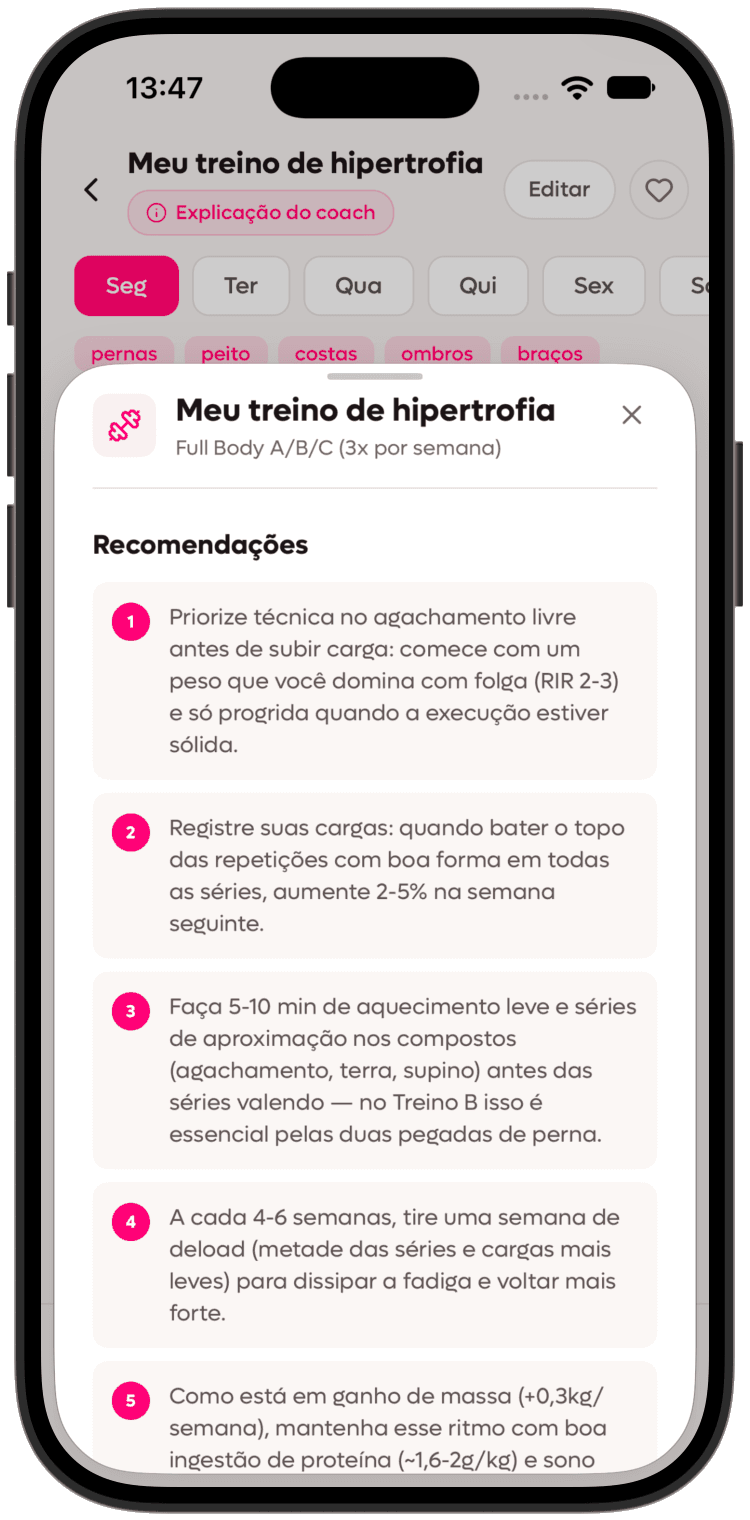
Once the plan is born, the plan explanation shows the chosen split, the training's practical logic and the recommendations. In a 5-day routine, that matters a lot because the split has to be understood, not just executed. You need to know why that fifth day exists, what it reinforces and how it talks to the rest of the week. The same reasoning appears in the broader view of features.
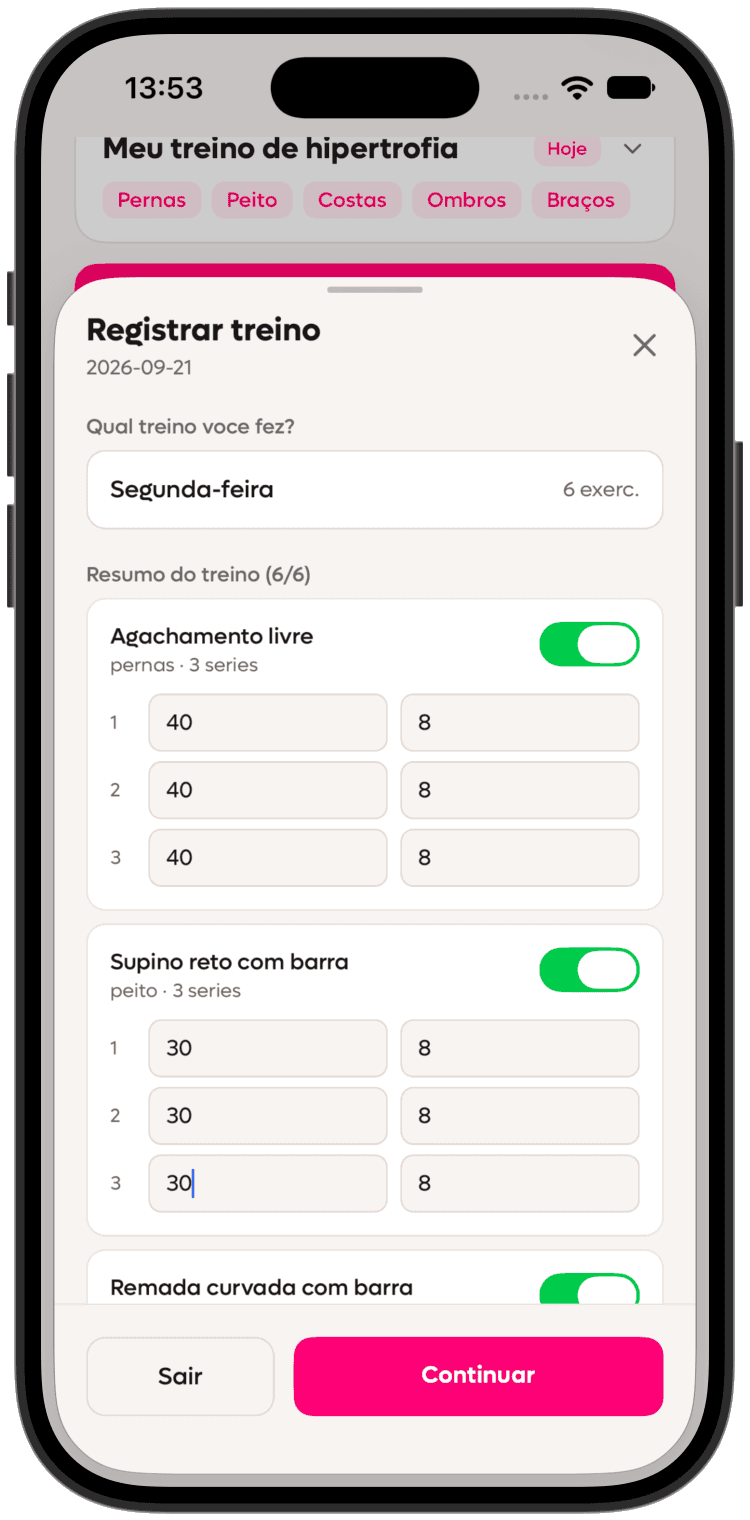
The next point is execution. In SelfShapeAI, you can log weights, reps and session context in the check-in. It sounds like a detail, but it changes everything. In a 5-day plan, the quality of the week's reading depends on knowing whether you really delivered what was planned, with what load, with what feeling and in what state you arrived at that session.
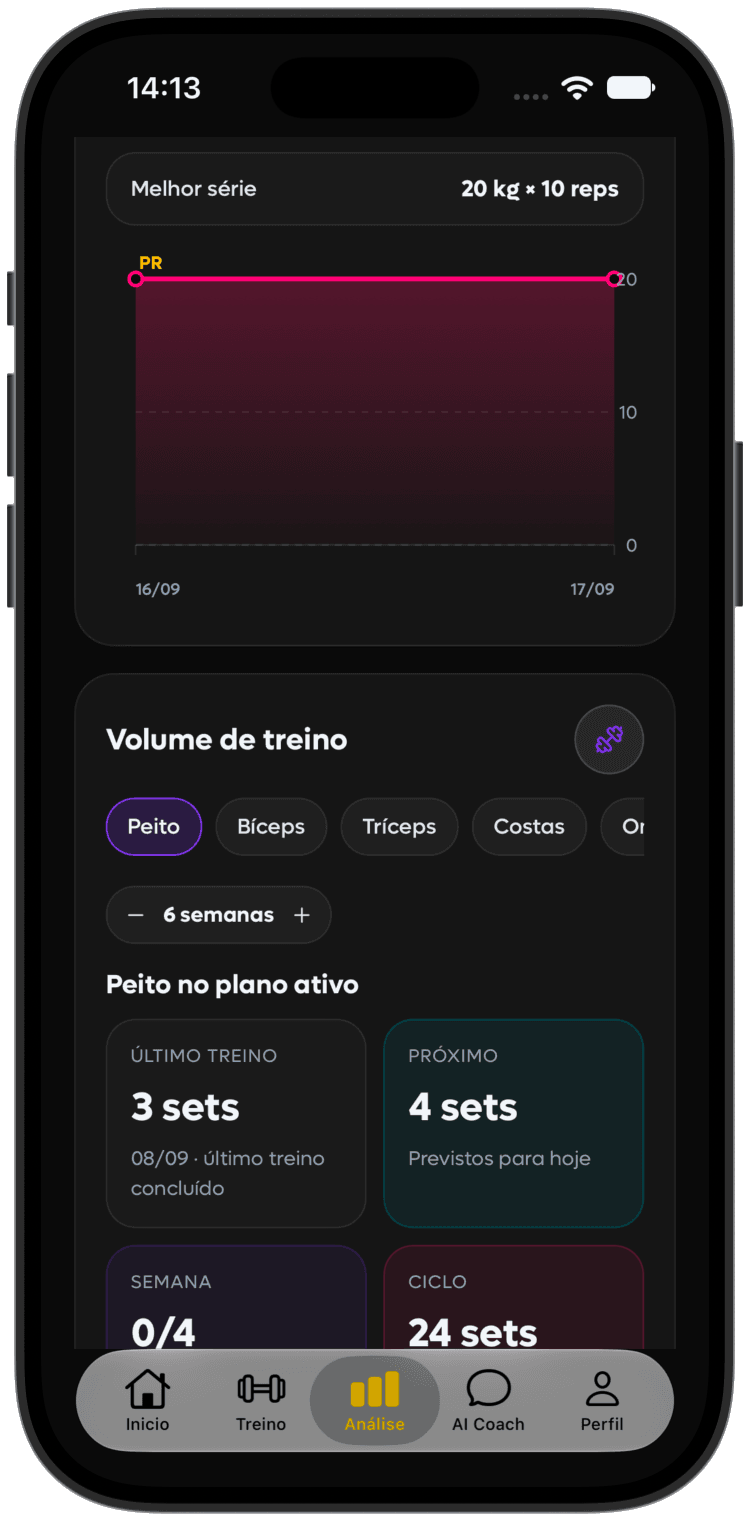
Then comes the training analysis. It is where the app helps read training frequency, most-trained muscle groups, per-exercise load progress, max weight per session, planned versus performed sets and a short AI insight summarizing the moment. That reading is especially strong on a 5-day split. Imagine a plan with a bigger focus on chest and shoulders. If the analysis shows the planned volume in those areas is not actually being executed, the decision changes. Maybe the problem is not the split itself. Maybe it is adherence, fatigue, a bad day order or volume above what you sustain today.
The AI Coach steps in when the week leaves the paper. If you missed the fifth session, if an exercise started bothering you or if the volume got too high, the idea is not to dismantle everything. The idea is to reorganize with more criteria. Instead of falling back into improvisation, you adjust the active plan with context. If you are comparing the offering, also review Pricing.
Finally, the plan library helps handle different phases of the routine. You can keep a 5-day version for more stable phases and a 4-day version for busier weeks. That avoids starting from zero whenever the schedule changes.
5-day split vs. 3 and 4 days
- Choose three days when more space between sessions and a simple schedule improve adherence. See Three-day training split.
- Choose four days when upper/lower or another intermediate split distributes volume without long sessions. Compare Four-day training split.
- Choose five days when there is enough work to distribute, a clear priority and recovery capacity for the extra session.
There is no prize for choosing the fullest routine. There are results when frequency talks to your real life and stays good across many weeks.
How long until you see results?
In general, the first signs appear in performance before the mirror. First you notice more confidence in execution. Then you see improvement in load, reps and session quality. Finally, clearer visual changes start to appear. In other words: results do not depend only on the split. They depend on good weeks stacked with training, recovery, nutrition and consistency.
Frequently asked questions
- Is training 5 days a week too much?Not necessarily. It can work very well when recovery keeps up. If performance drops, fatigue climbs and you start missing too many sessions, frequency or volume may still be above your ideal.
- Should beginners follow a 5-day split?In most cases, it is not the most practical starting point. Anyone still consolidating technique, routine and adherence tends to do better with 3 or 4 well-executed days.
- What is the best 5-day split for hypertrophy?It depends on your context. PPL plus upper/lower distributes upper and lower body well; upper/lower plus priority supports temporary specialization; a classic split suits themed-session preferences. The best split organizes volume without compromising recovery and adherence.
- Can I do cardio alongside a 5x plan?Yes, but the distribution has to be intelligent. Too much cardio, in the wrong place and without enough recovery, can hurt the quality of your lifting. The ideal is fitting it in a way that does not knock down your main workouts.
- What if I miss one of the week's 5 workouts?Avoid piling everything up on impulse. The safest path is reorganizing with criteria, keeping the most important days and adjusting the rest. That is exactly the kind of situation where SelfShapeAI's AI Coach and plan library become most useful.
A five-day split can work well for hypertrophy, giving more room for focus, volume distribution and weak points. Extra days become useful when they improve weekly structure rather than merely adding fatigue. Context, clear explanations and tracking real execution, loads and volume make higher frequency meaningful. Explore AI training, see the features, compare Pricing and open SelfShapeAI to build or adjust your five-day routine.
Sources and references
- Source: Schoenfeld BJ, Grgic J, Krieger J. How many times per week should a muscle be trained to maximize muscle hypertrophy? A systematic review and meta-analysis. J Sports Sci, 2019. — Journal of Sports Sciences (PubMed)
- Source: Ramos-Campo DJ et al. Efficacy of Split Versus Full-Body Resistance Training on Strength and Muscle Growth: A Systematic Review With Meta-Analysis. J Strength Cond Res, 2024. — Journal of Strength and Conditioning Research (PubMed)
- Source: Currier BS et al. ACSM Position Stand: Resistance Training Prescription for Muscle Function, Hypertrophy, and Physical Performance in Healthy Adults. Med Sci Sports Exerc, 2026. — American College of Sports Medicine (PubMed)
- Source: Baz-Valle E et al. A Systematic Review of The Effects of Different Resistance Training Volumes on Muscle Hypertrophy. J Hum Kinet, 2022. — Journal of Human Kinetics (PubMed)
- Source: Lopez P et al. Resistance Training Load Effects on Muscle Hypertrophy and Strength Gain: Systematic Review and Network Meta-analysis. Med Sci Sports Exerc, 2021. — Medicine & Science in Sports & Exercise (PubMed)
Reviewed by the SelfShapeAI research team using strength-training guidelines and studies.
Take this method to the app

Create your plan with AI, log check-ins and use the AI Coach to adjust training with context.
Share
SelfShapeAI Team
SelfShapeAI technical and editorial team.
Keep learning

Recommended next article
Upper/lower split: what it is, how to build it and when this split makes sense
Build an upper/lower split for hypertrophy by matching volume, recovery and progression to your routine.
Continue →