Bro split: what it is, how to build it and when the split pays off for hypertrophy
Understand the contexts where the bro split can make sense, how to organize the week more intelligently and how SelfShapeAI helps turn muscle focus into real progress.


The bro split is a classic resistance-training structure. Despite the popularity of full body, upper/lower and push pull legs, it remains popular with people who enjoy focusing on one group per session. Current evidence does not justify dismissing it: with equal volume, frequency and split type tend to produce similar hypertrophy. The practical question is whether that volume stays productive when concentrated into one day.
The problem is that the bro split also became an easy target for oversimplification. Some treat this split as outdated. Others treat it as the only real way to train. Both sides are wrong. The most useful question is not whether the bro split is old school or modern. The right question is another: does it make sense for your routine, your recovery and the way you train?
In SelfShapeAI, that is the most important reading. The bro split does not enter as dogma. It enters as structure. If the split makes sense for your goal, the proposal is to build it with more criteria, explain the plan's logic, track execution and adjust the week when life leaves the paper — the approach behind AI training.
Contents
- 1. What is the bro split?
- 2. How SelfShapeAI sees the bro split
- 3. A 5x-per-week bro split example
- 4. Monday: chest
- 5. Tuesday: back
- 6. Wednesday: shoulders and traps
- 7. Thursday: legs and abs
- 8. Friday: biceps, triceps and forearms
- 9. Why the week's order matters
- 10. Does the bro split work for gaining muscle?
- 11. Bro split vs. full body
- 12. Bro split vs. push pull legs
- 13. Bro split vs. upper/lower
- 14. Real advantages of the bro split
- 15. Real weak points of the bro split
- 16. How to progress on a bro split
- 17. Rest between sets
- 18. Warming up on the bro split
- 19. How long until you see results?
- 20. Cardio on a bro split
- 21. Who is the bro split a good choice for?
- 22. How to use the bro split more intelligently in SelfShapeAI
- 23. Frequently asked questions
What is the bro split?
The bro split is a training split where each day of the week is usually dedicated to one specific muscle group, or at most two groups that combine well.
- Monday: chest.
- Tuesday: back.
- Wednesday: shoulders.
- Thursday: legs.
- Friday: arms.
The approach concentrates a group's direct work, then leaves several days until its next dedicated session. But day names do not isolate muscles: presses also use triceps and anterior deltoids; rows and pulldowns involve biceps; back and leg exercises can share lower-back demands. Direct frequency and total exposure differ. Compare Full body or split.
Turn understanding into a workout you can follow
SelfShapeAI uses your routine and goal to build an explained plan, log every session and guide the next adjustment.




Download for free. Annual: R$ 299,90/year, equivalent to about R$ 25/month; monthly: R$ 39,90/month. See how AI training works.
How SelfShapeAI sees the bro split
In SelfShapeAI, the bro split is not treated as a rigid rule. It is an organizing base. That changes a lot, because the result does not depend only on the split's name. It depends on how you build the training from the inside.
- Weekly volume adjusted to your level.
- Exercises chosen according to equipment and context.
- Better fatigue distribution through the week.
- Progression tracked workout by workout.
- Adaptation to your real routine.
- Reading of consistency, check-ins and progress across the weeks.
In practice, this means two people can use the bro split and have completely different experiences. One just repeats exercises on autopilot. The other follows a real hypertrophy logic with focus, reading and adjustment. That is exactly where SelfShapeAI's proposal starts to weigh.
A 5x-per-week bro split example
A practical version can look like this:
Monday: chest
- Flat barbell bench press.
- Incline dumbbell press.
- Cable fly.
- Low-to-high crossover.
- Push-ups close to failure.
Tuesday: back
- Front lat pulldown.
- Bent-over row or machine row.
- Single-arm dumbbell row.
- Straight-arm pulldown.
- Face pull.
Wednesday: shoulders and traps
- Dumbbell shoulder press.
- Lateral raise.
- Cable lateral raise.
- Reverse fly or machine rear delt.
- Shrugs.
Thursday: legs and abs
- Back squat or hack squat.
- Leg press.
- Leg extension.
- Lying leg curl.
- Stiff-leg or Romanian deadlift.
- Calves.
- Leg raises or machine crunches.
Friday: biceps, triceps and forearms
- EZ-bar curl.
- Hammer curl.
- Preacher curl.
- Skull crushers.
- Rope triceps pushdown.
- Overhead triceps extension.
- Short grip or forearm work.
This is a distribution example, not a mandatory order. Legs and arms each list seven exercises; multiple sets of everything can make later work unproductive. Set weekly volume first, perform priorities while performance is high and remove redundancy before adding intensity techniques. See AI training to turn context into an active plan.
Why the week's order matters
It is not enough to pick five days and slot muscles in at random. The week's order directly influences recovery and performance.
- Chest training also recruits front delts and triceps.
- Back training also loads biceps and stabilizers.
- Shoulder training can suffer if chest was very heavy the day before.
- Arms deliver more when they are not wrecked by recent pulls and presses.
The same list can therefore work differently. Place priority groups after rest when possible, and avoid their dedicated session immediately after indirect fatigue. Heavy chest work the day before a shoulder priority session may reduce performance. Respect local and systemic recovery. Explore Five-day training split.
Does the bro split work for gaining muscle?
Yes. A 2019 meta-analysis found no significant or meaningful frequency effect on hypertrophy when volume was matched; a 2024 meta-analysis also found similar outcomes for split and full-body routines with equivalent volume. This does not prove every bro split is well designed. It shows the approach can work when volume, effort, progression and recovery align.
- Frequency organizes volume; it does not replace appropriate volume and effort.
- End a dedicated session before technique and performance collapse.
- If the required volume cannot fit with good quality, dividing it across two days is a practical solution.
The updated knowledge base highlights this per-session limit: as sets accumulate, technique, muscle connection and force production can deteriorate, adding more fatigue than stimulus. There is no universal ceiling, so track rep losses, execution, recovery and progress. See How many sets to build muscle, How to build more muscle and How to get stronger with SelfShapeAI.
Bro split vs. full body
In full body, you train the whole body each session. It is a very useful strategy for beginners, for anyone with fewer available days and for anyone who wants to repeat basic patterns more often. In the bro split, the focus stays concentrated.
- Bro split: more focus on one muscle group per workout.
- Bro split: a stronger feeling of localized work.
- Bro split: less of a rushed-workout feeling.
- Bro split: more room for isolation exercises.
- Full body: a shorter schedule and higher per-muscle frequency.
- Full body: a great base for beginners and anyone training 2 or 3 times a week.
Neither is automatically superior. Comparative evidence finds similar outcomes with equal volume; practical differences involve available time, preference and session volume quality. Explore Full body or split.
Bro split vs. push pull legs
Push pull legs organizes the week by movement patterns: push for chest, shoulders and triceps; pull for back and biceps; legs for the lower body. It tends to be very efficient for anyone who likes training 3 or 6 times a week, wants higher frequency and feels good in routines driven by compound movements.
- Bro split: suits people who prefer focused, themed sessions.
- Bro split: can concentrate excessive volume into a crowded dedicated day.
- PPL: groups assisting muscles and makes it easier to divide each pattern into two sessions.
- PPL: requires attention to overlap and rotation, especially with four or five days.
This comparison also pairs well with the push/pull/legs guide and the 5-day workout split, because many people choose between exactly these two paths.
Bro split vs. upper/lower
Upper/lower fits four workouts directly, dividing each half's volume across two sessions. Upper sessions can become long if chest, back, shoulders and arms all receive too many sets; a bro split risks concentrating too many sets for one muscle on its dedicated day. Choose the distribution you execute better.
A bro split may be more enjoyable if you like giving chest, back, shoulders and arms their own focus. Upper/lower may feel clearer if you prefer repeating each half weekly and distributing volume. Compare practical fit without a fixed ranking in Four-day training split.
Real advantages of the bro split
- Simplicity: it is an easy split to understand and follow.
- High per-session focus: you walk into the gym knowing exactly the day's mission.
- Preference: many people feel more control and connection when training fewer groups per session.
- Priority exercises can come early, before fatigue from other groups.
- The calendar is predictable when your weekly routine is predictable.
- It can be very enjoyable for anyone who loves classic bodybuilding.
Real weak points of the bro split
- Usually requires four or five days to separate groups clearly.
- Missing a session may delay that group's only direct stimulus for many days.
- Too many concentrated sets reduce quality at the end of the session.
- Indirect overlap can affect shoulders and arms when day order is poor.
Missing chest or back day can scramble the whole week. For anyone living an unpredictable routine, that weighs a lot. If that is your case, review the 4-day workout split or the 3-day workout split.
How to progress on a bro split
Here is one of the points where SelfShapeAI differentiates itself most. Many people think of progression as adding weight every week. In practice, it is not that simple.
- Add load.
- Add reps with the same load.
- Improve execution.
- Reduce performance loss between sets.
- Add volume intelligently.
- Control rest better.
- Improve stability and technique.
In SelfShapeAI, this connects directly with the idea of intelligent training: you do not progress because you forced a random number. You progress because your history shows you are ready to move up. This reasoning pairs very well with progressive overload and the RPE and reps in reserve rulers.
Rest between sets
- Heavy compound exercises: 2 to 3 minutes.
- Moderate exercises: 1.5 to 2 minutes.
- Isolation: 45 to 90 seconds.
Your ability to maintain performance remains the main guide. In a bro split, long sessions accumulate fatigue in the same group. Do not shorten rest just to finish faster; match it to the exercise and the return of technique and strength. See Rest between sets and How to get stronger with SelfShapeAI.
Warming up on the bro split
- 5 to 10 minutes of light cardio.
- Dynamic mobility for the day's main joint.
- 2 to 4 progressive warm-up sets on the first main exercise.
No need to reinvent anything. You need to arrive prepared. For that, revisit warm-up sets in the glossary.
How long until you see results?
There is no guaranteed bro-split timeline. Performance can improve before visible change, while hypertrophy depends on starting point, training, nutrition, sleep and consistency. Compare several-week blocks using loads, reps, measurements and photos under similar conditions; do not turn a generic estimate into a promise.
The bro split follows the same central rule: results come from accumulated productive work. If consistency is your main challenge, read 13 tips for returning to training.
Cardio on a bro split
- After lifting, when it does not reduce the main workout's quality.
- At another time or on another day if the dedicated session is already long.
- With a dose matched to goals, fitness and leg recovery.
If the main goal is hypertrophy, just do not let cardio interfere with leg recovery and the quality of the main workouts.
Who is the bro split a good choice for?
- People who can maintain four or five sessions on a predictable schedule.
- Anyone who enjoys total per-muscle focus.
- Anyone who wants sessions organized by muscle group.
- People who progress without stacking extra sets at the end.
- Anyone who loves the aesthetics of classic bodybuilding.
Training level alone does not decide the split. It is often less practical with an unpredictable schedule, only two or three days, or a need for more frequent lift practice. Full body generally gives beginners more technical repetition, though preference also matters for adherence.
How to use the bro split more intelligently in SelfShapeAI
In SelfShapeAI, the bro split stops being just a split and becomes a smarter execution system. At the start of the process, weekly frequency enters as real context. That keeps the bro split from being born out of a fantasy routine and grounds the decision in what you can actually sustain. From there, the plan can be created with AI, adjusted or built more manually, always with room for extra context and methodology preference.
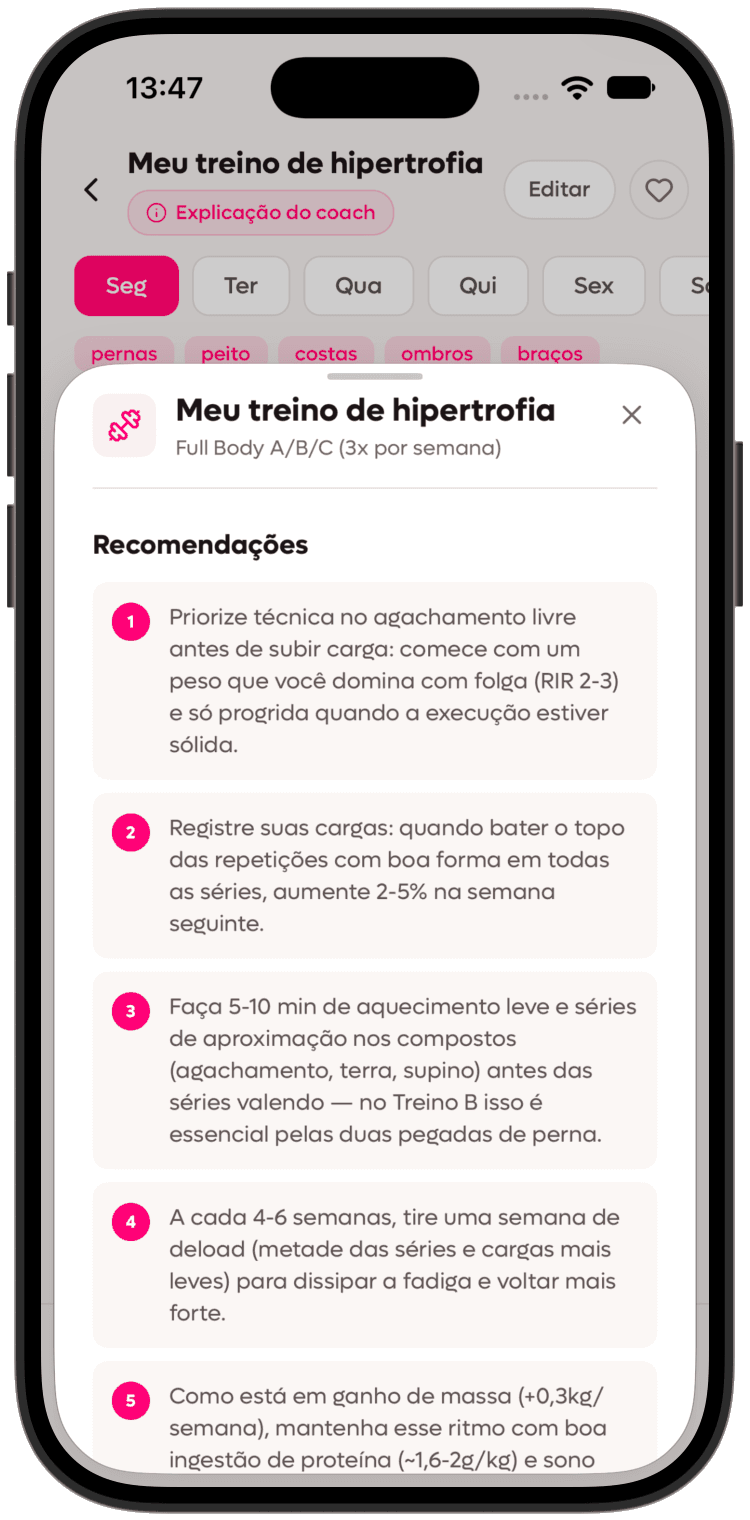
Once the plan is born, the plan explanation shows the chosen split, explains the training's logic and delivers recommendations. That is especially useful on the bro split, because this split's quality depends heavily on understanding why the groups were organized that way and how one day talks to the next. To see this proposal applied, also visit features.
The next layer is execution. In SelfShapeAI, you can log weights, reps and session notes in the check-in. On a bro split, that is decisive because high-volume single-muscle sessions can fool you easily. Sometimes the pump feels high, but the workout's quality is dropping set after set. Without reading, you do not catch that early.
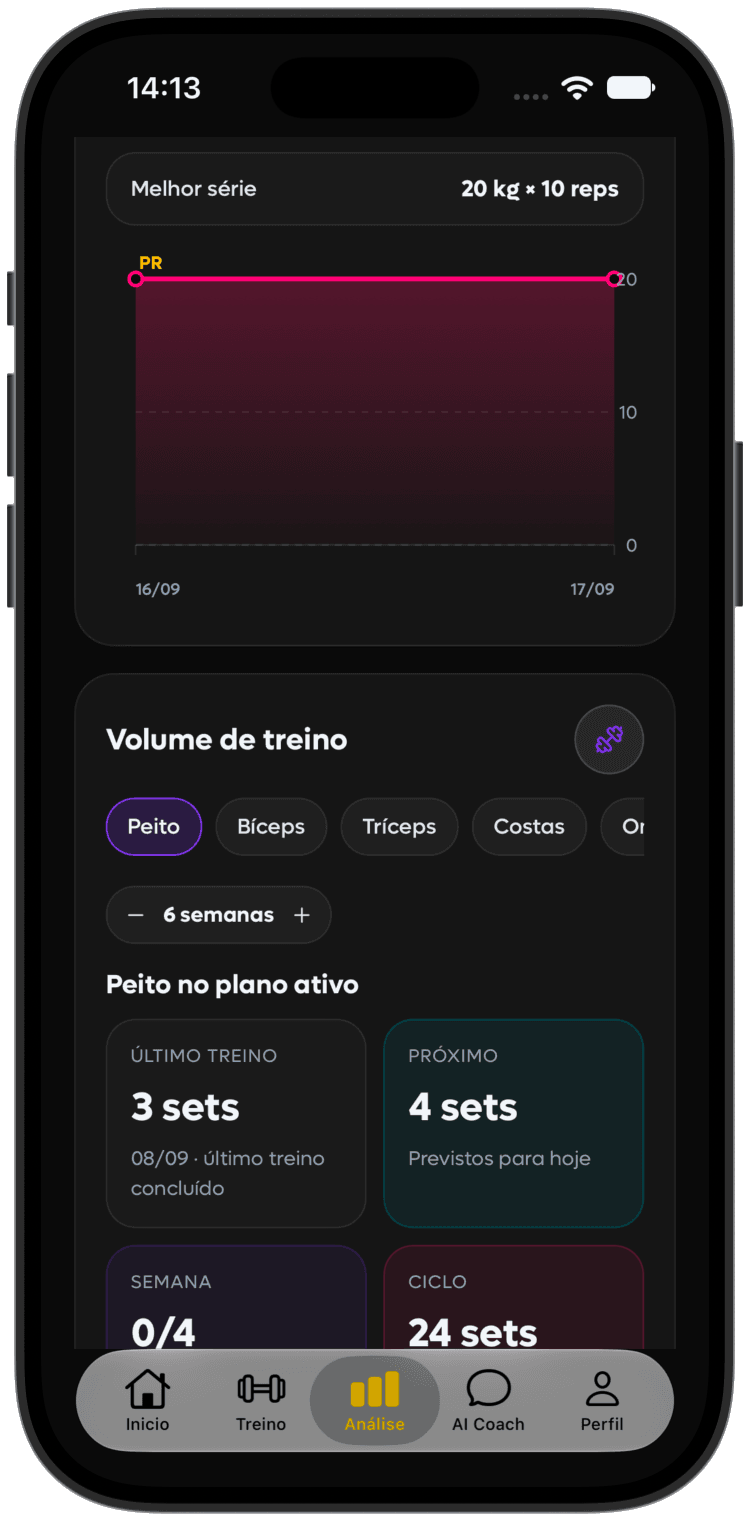
Then comes the training analysis. It is where SelfShapeAI helps you see frequency, most-trained muscle groups, load progress, max weight per session, planned versus performed sets and a short AI insight. That reading is especially useful on the bro split because it answers very practical questions: is that chest day's volume becoming real execution? Is the arms workout delivering, or does it always arrive wrecked? Was the problem the split or the week's adherence?
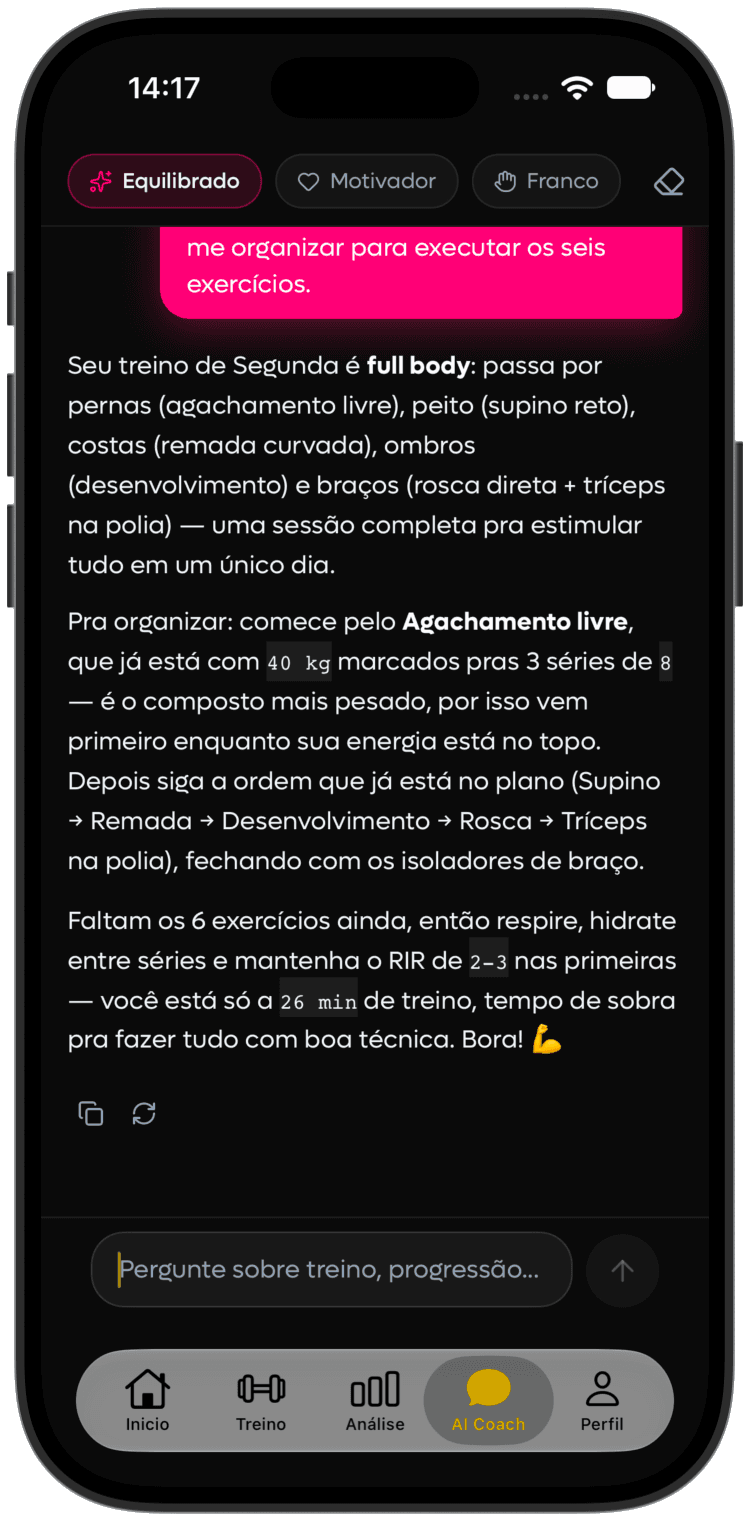
The AI Coach steps in when the week breaks. If you missed back day, if an exercise did not fit or if the shoulder workout keeps suffering because of the week's order, the idea is not abandoning the split. The idea is reorganizing with criteria, without falling back into improvisation.
Finally, the plan library solves a real pain for anyone using this split: routines change. In more stable weeks, you can keep a complete bro split. In busier phases, you can use a 4-day version or another leaner structure without losing history or organization. That is especially useful for anyone who wants to keep training with method instead of restarting from zero. To understand this ecosystem better, it also makes sense to check Pricing.
Frequently asked questions
- Is the bro split good for natural lifters?It can work for natural lifters. The criterion is not natural status, but the ability to perform productive volume, progress, recover and sustain the routine without accumulating unproductive sets.
- Can I do a 4x-per-week bro split?Yes. Just adapt the split, for example: chest, back, legs and shoulders + arms. If that format interests you more, review the 4-day workout split.
- Can beginners use the bro split?They can, but there are usually splits that fit better at the start, like full body or upper/lower — the full body workout is a good entry point.
- Can I train abs and calves on this split?Yes. Add short blocks on days that least interfere with main exercises. Frequency depends on volume, effort and recovery, not a fixed rule.
- Is the bro split better than push pull legs?Not absolutely. It depends on your goal, routine, preference and recovery capacity — the full comparison is in the push/pull/legs guide.
A well-designed bro split remains a valid and useful hypertrophy option. Weekly volume, sound execution, progression, recovery and consistency determine the outcome. SelfShapeAI makes the logic clearer and easier to adjust. Explore AI training, see the features, compare Pricing and open SelfShapeAI to build or refine your split.
Sources and references
- Source: Schoenfeld BJ, Grgic J, Krieger J. How many times per week should a muscle be trained to maximize muscle hypertrophy? A systematic review and meta-analysis. J Sports Sci, 2019. — Journal of Sports Sciences (PubMed)
- Source: Ramos-Campo DJ et al. Efficacy of split versus full-body resistance training on strength and muscle growth: a systematic review with meta-analysis. J Strength Cond Res, 2024. — Journal of Strength and Conditioning Research (PubMed)
- Source: Currier BS et al. Resistance training prescription for muscle function, hypertrophy, and physical performance in healthy adults: ACSM position stand. Med Sci Sports Exerc, 2026. — American College of Sports Medicine (PubMed)
Reviewed by the SelfShapeAI research team using strength-training guidelines and studies.
Take this method to the app

Create your plan with AI, log check-ins and use the AI Coach to adjust training with context.
Share
SelfShapeAI Team
SelfShapeAI technical and editorial team.
Keep learning

Recommended next article
Upper/lower split: what it is, how to build it and when this split makes sense
Build an upper/lower split for hypertrophy by matching volume, recovery and progression to your routine.
Continue →