Push pull legs: what it is, how to build it and when the split pays off for hypertrophy
Understand the contexts where push/pull/legs tends to work well, when it truly makes sense and how SelfShapeAI helps adjust this structure to your context.

Push/pull/legs stays strong because it solves a real problem in lifting: how to organize the week in a logical, productive, easy-to-repeat way. Instead of thinking of training as completely loose or as one day per muscle, you separate the routine by movement patterns that already make sense together. That gives each session clarity, improves volume distribution and usually makes progression more readable.
That is exactly why so many people like PPL. It is also why so many get it wrong. The problem is usually not the split. The problem is using the split badly: sessions that run too long, sloppy rotation, inflated volume and little execution reading. PPL does not work because it has a reputation as an "advanced" split. It works when it talks to your real frequency, your recovery and your ability to repeat good weeks for a long time. If you are still comparing structures, cross this article with Full body vs. split training and the 3-day workout split.
In SelfShapeAI, the goal is not treating PPL as a pretty sheet. The goal is turning this structure into practical execution: a plan that is born from your routine, makes sense on paper and stays useful when the week tightens, when an exercise does not fit or when progression starts to stall — the thinking behind AI training.
Contents
- 1. The short answer
- 2. What is push/pull/legs?
- 3. Where PPL tends to deliver
- 4. Who this split tends to suit best
- 5. Which version of PPL makes sense for you
- 6. PPL on 3 days
- 7. PPL on 4 days
- 8. PPL on 5 days
- 9. PPL on 6 days
- 10. A PPL routine example for hypertrophy
- 11. Push
- 12. Pull
- 13. Legs
- 14. How to progress on PPL without wrecking the week
- 15. 1. Do not inflate volume just because the split looks organized
- 16. 2. Use rep ranges that make sense
- 17. 3. If you miss a workout, keep the rotation turning
- 18. 4. Log the execution for real
- 19. 5. Do not skip warm-ups and rest
- 20. Common PPL mistakes
- 21. When another split might fit better
- 22. PPL or upper/lower?
- 23. PPL or bro split?
- 24. PPL or a more open 5-day split?
- 25. How to use PPL more intelligently inside SelfShapeAI
- 26. What to take from this
- 27. Frequently asked questions
The short answer
Push/pull/legs can suit people who want clearly focused sessions at a frequency that fits their schedule. Higher-frequency versions help distribute volume; three-day versions concentrate each pattern into one session. It loses value when used to inflate workouts, ignore recovery or overlook rotation.
- If you want a split with simple logic and good separation by movement pattern, PPL can be a very good choice.
- If you train 3, 5 or 6 days and like a routine organized by movement pattern, it tends to fit well.
- If you prefer a fixed 4-day calendar, an upper/lower structure may be more direct.
- If you want total focus on one muscle per session, the bro split may talk better to your style.
Turn understanding into a workout you can follow
SelfShapeAI uses your routine and goal to build an explained plan, log every session and guide the next adjustment.




Download for free. Annual: R$ 299,90/year, equivalent to about R$ 25/month; monthly: R$ 39,90/month. See how AI training works.
What is push/pull/legs?
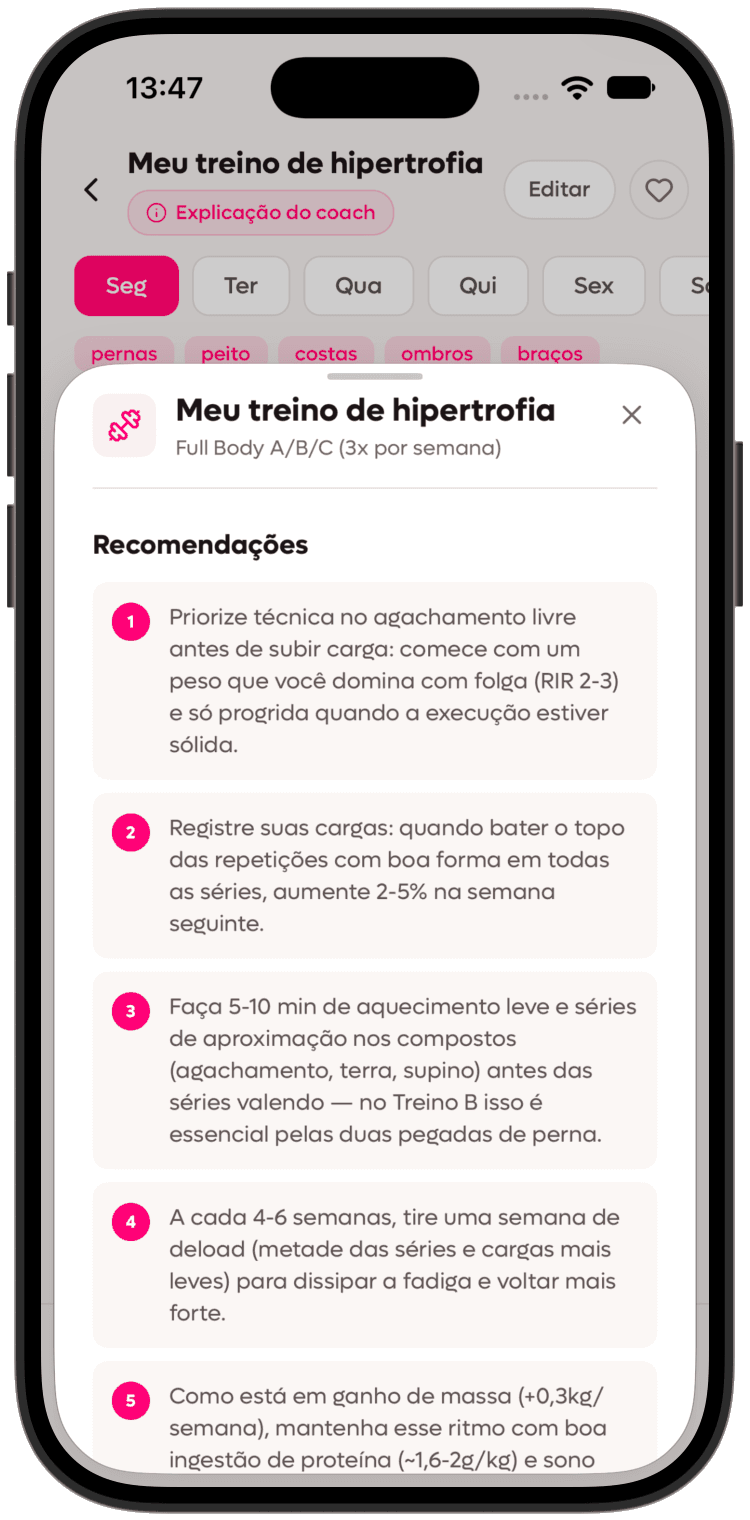
Push/pull/legs organizes the week into three types of session. Instead of thinking of training as a collection of isolated muscles, you think in groups that already collaborate in pushing, pulling and leg movements.
- Push: chest, shoulders and triceps.
- Pull: back, biceps, rear delts and the pulling muscles.
- Legs: quads, hamstrings, glutes, calves and, depending on the case, abs.
This approach groups collaborating muscles. Push shares pressing between chest, anterior deltoids and triceps; pull involves back, biceps and posterior deltoids. This makes overlap visible without eliminating it: presses contribute to triceps and shoulders, rows to biceps, and hip exercises may fatigue the back before legs. Account for indirect work. Compare Upper/lower split and Bro split.
Where PPL tends to deliver
PPL tends to deliver for four reasons that truly matter in practice: it groups muscles that already work together, distributes the week's volume better, gives each session a clear identity and makes progression on the main lifts easier to read.
- It avoids part of the conflict between exercises that compete too much with each other.
- It reduces the chance of concentrating a group's whole stimulus in one chaotic session.
- It makes it easier to compare performance on important patterns across the weeks.
- It often suits people who enjoy compound exercises and training organized by movement patterns.
That does not mean PPL is automatically better than everything. It means it is usually very efficient when the goal is hypertrophy with an organized routine, good volume distribution and progression you can track with criteria. This reasoning pairs very well with training volume, hypertrophy, progressive overload and the RPE scale.
Who this split tends to suit best
- Anyone who likes training by movement pattern rather than fully isolated muscles.
- People who want clearly focused sessions and can manage overlap between assisting muscles.
- Anyone who trains 3, 5 or 6 days and can respect the rotation's logic.
- Anyone who likes compounds and wants to compare progress better on bench presses, rows, pulldowns, squats and variations.
- Anyone who wants hypertrophy with more structure and less improvisation.
PPL does not mean six workouts or require an advanced level. What matters is whether your version distributes volume within your recovery capacity. With three days, each pattern appears once weekly; with four or five, rotation can cross weeks; with six, consecutive training days need care. See Three-day training split and From beginner to results.
Which version of PPL makes sense for you
Not every PPL has to look the same. The mistake is assuming the fullest version of the week is automatically the right one. The version that makes sense is the one your routine can sustain without wrecking recovery, set quality and adherence.
PPL on 3 days
For many people, this is a very viable way to start with PPL. You do one push session, one pull and one legs per week, usually with rest days between them.
- Monday: push.
- Wednesday: pull.
- Friday: legs.
This can work for people who prefer themed sessions and follow them consistently, but the consequence matters: chest, back and legs each receive one direct session per week. As a muscle's volume rises, concentrating it into one day can lengthen sessions and reduce later-set quality. With three days, full body or full body plus upper/lower often distributes work better; PPL remains valid when preference and execution justify that trade-off. Compare Three-day training split.
PPL on 4 days
A continuous cycle works well: keep four training days and resume the next session in sequence each time. One week may finish with push and the next begin with pull. No pattern gets dropped; distribution simply extends beyond a single week. If you prefer fixed sessions on fixed days and weekly upper/lower balance, Upper/lower split or a Four-day training split is usually simpler.
PPL on 5 days
On 5 days, PPL usually works better as a continuous rotation. In other words: you do not think only in closed weeks. You think in continuity.
- Week 1: push / pull / legs / push / pull.
- Week 2: legs / push / pull / legs / push.
The example uses five training days and two rest days, resuming the cycle where it stopped. This prevents repeatedly leaving legs or pulling behind. Understand frequency across several weeks, not one Monday-to-Sunday snapshot. For a five-day calendar that resets weekly, a PPL plus upper/lower hybrid may be more predictable. Compare Five-day training split.
PPL on 6 days
- Monday: push.
- Tuesday: pull.
- Wednesday: legs.
- Thursday: push.
- Friday: pull.
- Saturday: legs.
This version involves more gym visits, not necessarily more weekly volume. It divides each pattern across two sessions and can vary emphasis—chest and quadriceps in the first cycle; shoulders, hamstrings and glutes in the second. The benefit is distributing work, not doubling it. If six consecutive days hurt performance, joints or adherence, rest after each three-session cycle and allow the calendar to become asynchronous.
A PPL routine example for hypertrophy
Here is a practical way to think about a PPL for hypertrophy. There is no obligation to copy the list below exactly. What has to exist is coherence between the day's focus, the total volume, the exercises you tolerate well and your training reality.
Push
- Flat barbell bench press.
- Incline dumbbell press.
- Dumbbell or machine shoulder press.
- Lateral raise.
- Cable fly.
- Rope or overhead triceps extension.
Pull
- Pull-up or lat pulldown.
- Bent-over row or machine row.
- Seated cable row.
- Straight-arm pulldown.
- Face pull.
- Barbell or incline curl.
Legs
- Back squat or hack squat.
- Romanian deadlift.
- Leg press or lunge.
- Leg extension.
- Lying leg curl.
- Standing or seated calf raise.
The goal is not completing every listed exercise for multiple sets. Preserve the logic and manage the dose: coherent presses and accessories on push, pulls and rows on pull, and knee- and hip-dominant work on legs. When rotating PPL twice, you can vary exercises and emphasis while preserving weekly volume. See AI training and How to use SelfShapeAI.
How to progress on PPL without wrecking the week
Training PPL does not produce results by itself. What produces results is the combination of good structure, good execution and coherent progression.
1. Do not inflate volume just because the split looks organized
A push stuffed with too many presses and isolation can tire shoulders and triceps too early. An exaggerated pull can become a rowing marathon. And a badly built legs day can concentrate too much fatigue in one block. If training is running too long, the problem is often not the split. It is the volume. This point connects strongly with training volume and supersets.
2. Use rep ranges that make sense
- Main compounds: 5 to 10 reps.
- Intermediate exercises: 8 to 12 reps.
- Isolation: 10 to 20 reps.
These ranges are practical references, not biological boundaries. Light and heavy loads can both produce hypertrophy with appropriate effort and execution; choose a range that supports technique, the target muscle and progression. Pair this with the Practical RPE and RIR guide.
3. If you miss a workout, keep the rotation turning
This is one of the most important points of PPL. If you missed the week's legs day, it often makes more sense to continue the rotation than to try to cram everything into the next day without criteria. Instead of acting on impulse, look at context, fatigue and the week's priority.
4. Log the execution for real
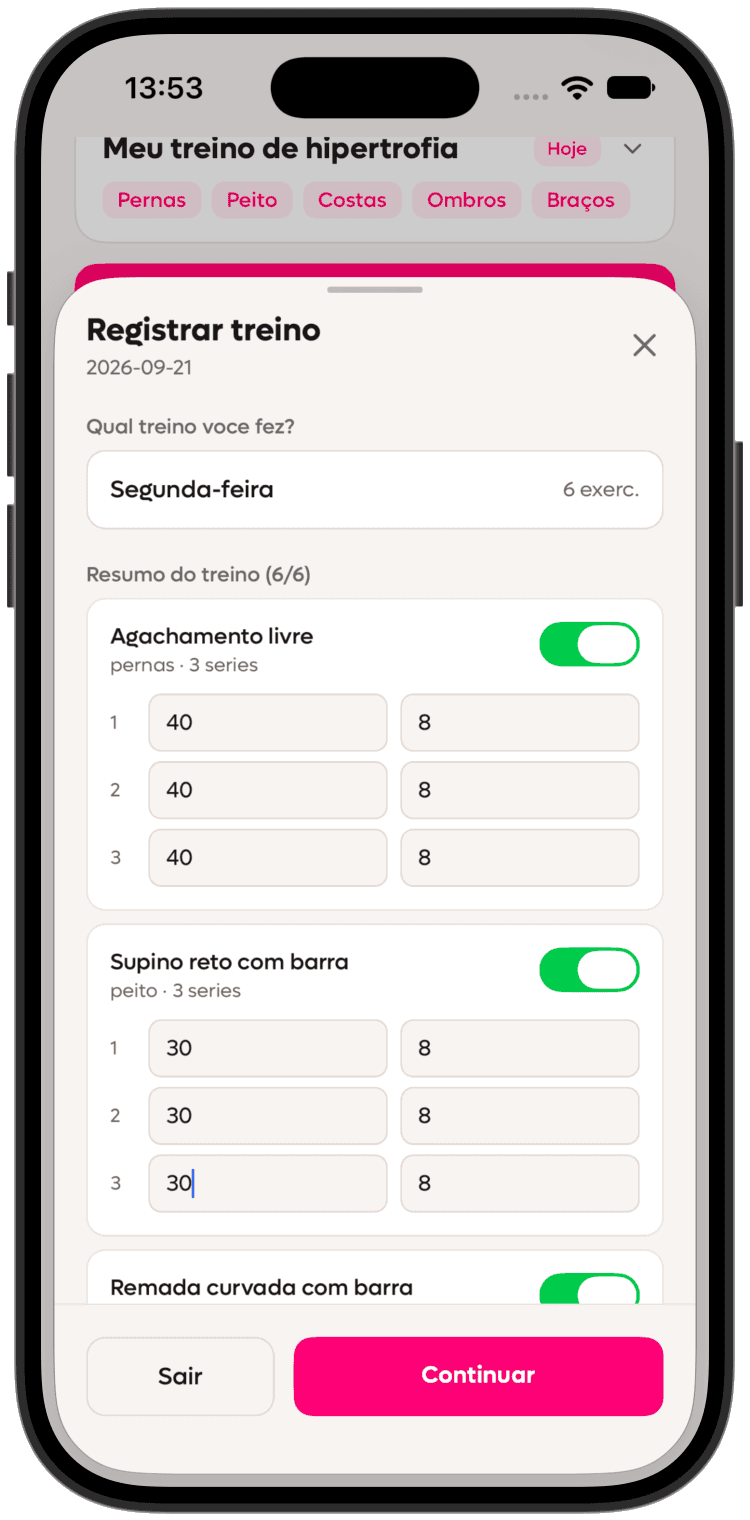
Progression gets clearer when you track load, reps, session feel and real adherence. That is where workout logging, session notes and per-exercise progress reading come in.
5. Do not skip warm-ups and rest
PPL depends on main-exercise quality. That requires specific warm-ups and enough rest to sustain performance, especially because triceps, biceps and lower back accumulate indirect work. Review Warm-up sets and Rest between sets.
Common PPL mistakes
- Turning push into an endless chest, shoulder and triceps day with no volume criteria.
- Using PPL 5x as a fixed calendar and forgetting the week-to-week rotation.
- Trying to compensate for a missed workout by scrambling the week's whole order.
- Confusing more days with more results, even when recovery is poor.
- Logging little of the execution and then trying to adjust the plan on feeling alone.
That last point weighs more than it seems. Many people abandon PPL not because the split is bad, but because they spend weeks without knowing whether the problem is the volume, the day order, the execution or simply adherence. When everything becomes a vague feeling, every adjustment gets worse.
When another split might fit better
PPL or upper/lower?
If you want a four-day routine with a more stable, easy-to-visualize calendar, an upper/lower structure often fits more directly. PPL tends to make more sense when you like continuous rotation or want to separate movement patterns better.
PPL or bro split?
If you enjoy focusing fully on one muscle group per session, a Bro split may fit better. PPL groups assisting muscles and, with more frequent cycles, distributes volume over more sessions. The split alone does not determine results: volume, effort, recovery and consistency remain central.
PPL or a more open 5-day split?
If you want more specificity but are not sure whether you prefer PPL, upper/lower 5x or a classic split, compare with the 5-day workout split.
How to use PPL more intelligently inside SelfShapeAI
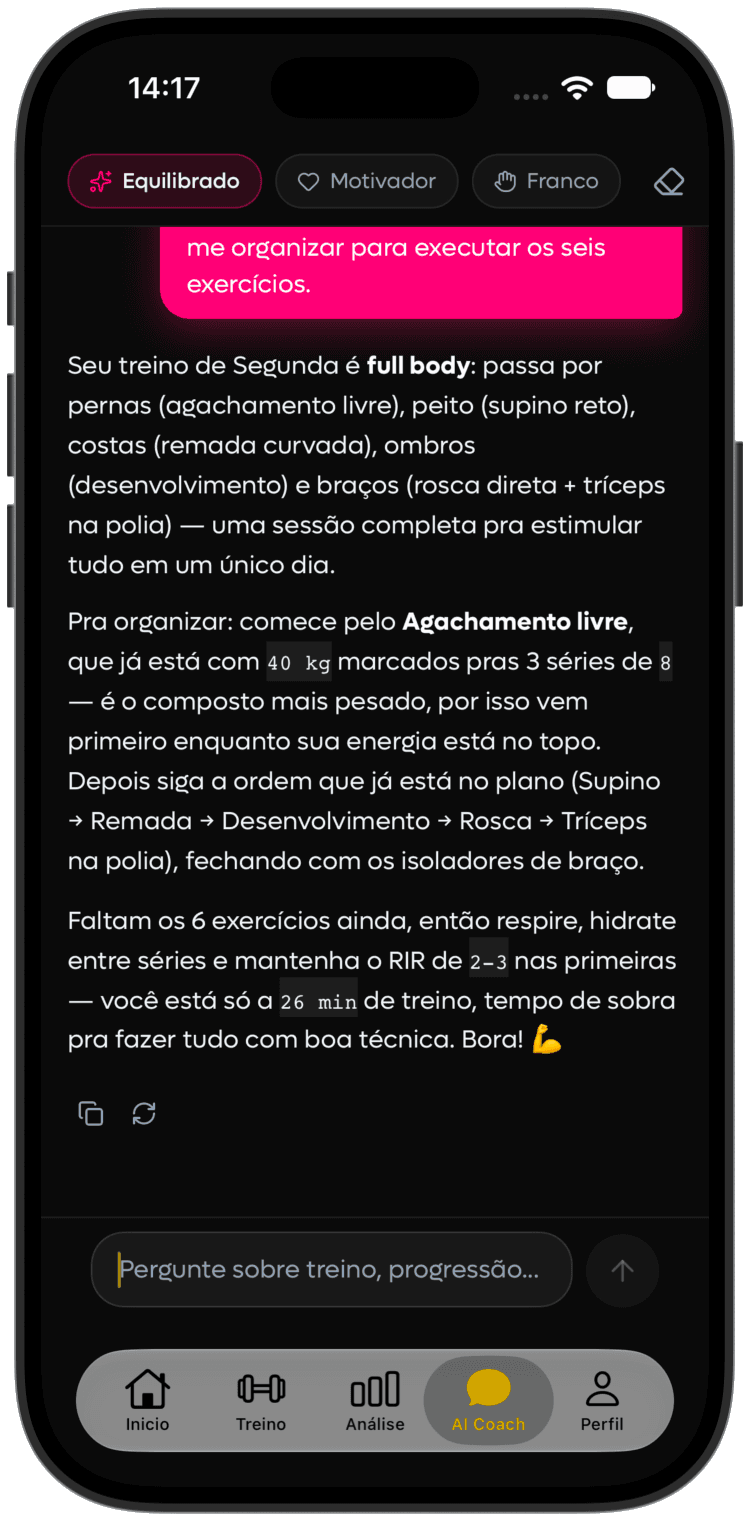
This is where SelfShapeAI stops being talk and becomes a practical tool. The plan's starting point is already born from your reality: how many days you can train, what your goal is, what limitations exist and what makes sense for your routine now. That matters because a good PPL depends on your real week, not the idealized one.
Then the plan can be built and refined with more context, instead of being born as a generic sheet. That makes the split more coherent with your moment, the equipment you have and the kind of week you can actually execute. To understand the product's general proposal, review AI training and features.
Another important point is the training explanation. When the week's logic gets clear, it becomes much easier to understand why there is a heavier push, a pull more focused on lats or a legs day with more hamstring emphasis. That reduces autopilot execution and improves consistency.
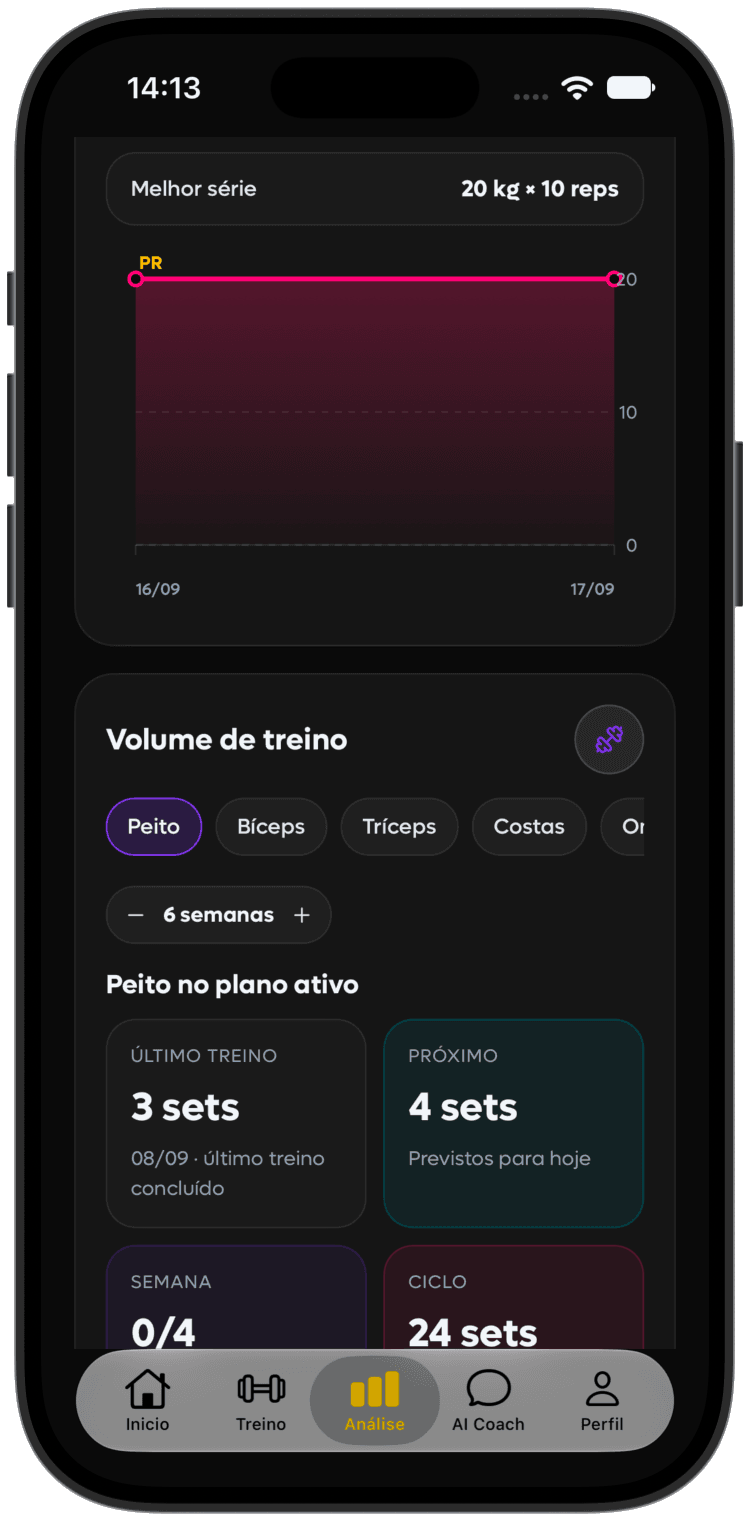
In daily practice, workout logging and session notes become real context. You do not just save that you trained. You save how you trained. And that changes the reading of your progress. When that context reaches the analysis, SelfShapeAI helps you see frequency, most-trained muscle groups, load progress, max weight per session and planned versus performed sets.
- Real training frequency.
- Most-trained muscle groups.
- Per-exercise load progress.
- Max weight per session.
- Planned versus performed sets.
- A short AI summary of the moment.
That set is especially useful in PPL because the split depends on regularity. If push is strong but legs keeps falling behind, the analysis starts showing the problem before it becomes a vague feeling. SelfShapeAI's AI steps in best when the routine goes off track. Missed a day? Changed gyms? Shoulder did not sit well on the press? Instead of improvising, you can ask for help adapting an exercise, reorganizing the rotation or recalibrating the plan with more criteria. To see the offering as a whole, explore Pricing and features.
Finally, keeping more than one version of the plan solves a problem many people ignore: you do not have to live locked into a single structure all year. You can keep a 3x PPL as a base, use a 5x PPL in better-schedule phases and even alternate with an upper/lower in other moments. That makes the strategy more flexible without throwing away your history.
What to take from this
- Push/pull/legs is strong because it organizes the week with simple logic.
- The version of PPL that makes sense is not always the densest one.
- Three-day PPL concentrates each pattern into one session; six-day PPL can divide the same volume across two.
- With four or five days, resume the rotation where you stopped, even across weeks.
- If training is running too long, the problem is usually badly distributed volume.
- SelfShapeAI helps generate, explain, log and adjust the split with real context.
Frequently asked questions
- Is push/pull/legs good for beginners?It can be, if movement-pattern organization helps adherence and volume is appropriate. With three days, however, each pattern appears once weekly; full body usually gives beginners more movement practice. Compare From beginner to results.
- Is PPL 6 days always better for hypertrophy?No. It can work very well for anyone who recovers well, but it is far from mandatory. For many people, a more sustainable version fits better.
- I train 4 days. PPL or upper/lower?It depends on your profile. If you want a fixed calendar and a simple weekly reading, upper/lower is usually more direct. If you like rotation and want to separate movement patterns better, PPL can work. Compare with the 4-day workout split.
- What if I miss a legs workout?In most cases, it pays more to keep the rotation's logic than to compensate chaotically on impulse. The best adjustment depends on the week's context, and SelfShapeAI's AI can help reorganize it.
- How do I know my PPL is working?Look at real frequency, set quality, load progress, max weight per session, planned versus performed sets and the week's adherence. If you only feel that you trained but cannot read the process, deciding the next step gets hard.
Push/pull/legs is one way to organize your week. It makes sense when rotation remains clear, volume fits recovery and the structure fits your routine. Explore AI training, see the features, compare Pricing and open SelfShapeAI when you are ready.
Sources and references
- Source: Schoenfeld BJ, Grgic J, Krieger J. How many times per week should a muscle be trained to maximize muscle hypertrophy? A systematic review and meta-analysis. J Sports Sci, 2019. — Journal of Sports Sciences (PubMed)
- Source: Ramos-Campo DJ et al. Efficacy of split versus full-body resistance training on strength and muscle growth: a systematic review with meta-analysis. J Strength Cond Res, 2024. — Journal of Strength and Conditioning Research (PubMed)
- Source: Currier BS et al. Resistance training prescription for muscle function, hypertrophy, and physical performance in healthy adults: ACSM position stand. Med Sci Sports Exerc, 2026. — American College of Sports Medicine (PubMed)
Reviewed by the SelfShapeAI research team using strength-training guidelines and studies.
Take this method to the app

Create your plan with AI, log check-ins and use the AI Coach to adjust training with context.
Share
SelfShapeAI Team
SelfShapeAI technical and editorial team.
Keep learning
Recommended next article
Upper/lower split: what it is, how to build it and when this split makes sense
Build an upper/lower split for hypertrophy by matching volume, recovery and progression to your routine.
Continue →