Supersets: what they are, how to use them and when they make sense in training
Understand when supersets save time and improve the session's flow, and when they only hurt technique, load and fatigue.


Some training techniques get used just because they make the session more painful, when the main advantage may be something else: organizing the workout better, saving time and increasing density without turning everything into a rush. That is exactly where supersets come in.
In practice, supersets are a way of pairing two exercises in sequence, with little or no rest between them. But using them well is not stringing together any two movements. The difference between an intelligent superset and a badly built workout lies in the pairing, the intention and the context.
That is why this topic speaks so well to SelfShapeAI. Intelligent training is not just choosing exercise, sets and reps. It is also knowing how to organize effort, time, fatigue and session flow. If you want to see that logic inside the brand's proposal, follow up with AI training, what SelfShapeAI delivers and Intelligent AI-powered training.
Contents
- 1. The short answer
- 2. What supersets really are
- 3. Superset or bi-set: do the names matter?
- 4. Why so many people use supersets
- 5. The types that make the most sense
- 6. 1. Opposing muscles
- 7. 2. Isolation with isolation
- 8. 3. Same muscle or pre-exhaustion
- 9. 4. Different body segments
- 10. 5. Two compounds: greater systemic demand
- 11. When supersets make a lot of sense
- 12. When supersets can get in the way
- 13. The most common mistake: pairing exercises that compete too much
- 14. How to bring supersets into your routine
- 15. Step 1: see what actually pairs well
- 16. Step 2: adjust the rest realistically
- 17. Step 3: reduce the load when needed
- 18. Are supersets good for hypertrophy?
- 19. Do supersets work for beginners?
- 20. Where SelfShapeAI comes in, in practice
- 21. Simple application examples
- 22. 1. Arms in a crowded gym
- 23. 2. Chest and back
- 24. 3. When it is probably not worth it
- 25. Common superset mistakes
- 26. Frequently asked questions
- 27. Supersets are not haste. They are structure.
The short answer
Supersets are a technique in which you do two exercises in a row, with little or no rest between them, resting normally only after the pair is finished.
- They help save time and increase the session's density.
- They work best when the exercises are well matched.
- Not every exercise pairs well in a superset.
- Very technical or very heavy exercises demand more judgment. To avoid confusing intensity with rushing, review the practical RPE and RIR guide and Simple progression: when to add weight.
- Doing supersets is not just training more tired. It is training with a different logic.
- In SelfShapeAI, this makes sense when the goal is organizing the session better without losing execution clarity or turning training into improvisation.
Turn understanding into a workout you can follow
SelfShapeAI uses your routine and goal to build an explained plan, log every session and guide the next adjustment.




Download for free. Annual: R$ 299,90/year, equivalent to about R$ 25/month; monthly: R$ 39,90/month. See how AI training works.
What supersets really are
A superset is when you take two exercises and perform one right after the other, with minimal or no rest between them. Only after both are done do you rest before repeating the round.
- barbell curl
- rope pushdown
- rest
That already counts as a superset. The main point is that you are not merely rushing through the workout. You are reorganizing the session to concentrate more work in less time. Done well, it improves flow. Done badly, it wrecks technique, hurts load and turns training into haste.
Superset or bi-set: do the names matter?
Everyday terms such as superset and bi-set describe two exercises performed consecutively. Research offers more useful categories: agonist–antagonist pairs, noncompeting segments and biomechanically similar pairs that overlap muscles. The label matters less than how much fatigue transfers between exercises.
In SelfShapeAI, the aim is understanding whether the pairing fits your goal, equipment and time. See AI training and what SelfShapeAI offers.
Why so many people use supersets
The most obvious reason is time. For anyone training on a tight schedule, in a crowded gym, with short windows or a session squeezed between other responsibilities, supersets can be a very intelligent way to keep training alive without cutting half of it.
- increase the session's density
- reduce idle time
- keep the workout more dynamic
- fit more work into fewer minutes
- organize accessory blocks better
- make the session feel less fragmented
For people juggling training with real life, this weighs a lot. Most people do not need more suffering. They need more efficiency. And that speaks directly to what we show in Best workout tracking app in 2026.
The types that make the most sense
1. Opposing muscles
- barbell curl + rope pushdown
- flat bench press + seated row
- leg extension + lying leg curl
This usually works well because one group works while the other rests, relatively speaking.
2. Isolation with isolation
- lateral raise + hammer curl
- overhead triceps extension + machine fly
- seated calf raise + cable crunch
This format usually fits very well at the end of the session or in accessory blocks.
3. Same muscle or pre-exhaustion
- incline bench press + cable fly
- lat pulldown + barbell curl
- leg press + leg extension
These pairs accumulate fatigue in the same group and usually reduce second-exercise performance. The latest meta-analysis found lower volume load with biomechanically similar supersets. They can be an occasional technique but should not be presented as automatically increasing hypertrophy.
4. Different body segments
- machine chest press + lying leg curl
- seated cable row + standing calf raise
- dumbbell shoulder press + leg extension
This type can be interesting to keep the workout moving without immediately overloading the same muscle group. If you are thinking about how this fits your week, review Full body vs. split training.
5. Two compounds: greater systemic demand
- Romanian deadlift + goblet squat
- flat bench press + bent-over row
- lunge + stiff-leg deadlift
This is the most demanding format. Even without overlapping target muscles, breathing, grip, torso and conditioning can limit rounds. A 2024 trial found sessions nearly halved in duration but some impairment of strength gains in pulldowns and rows. Use it when time savings justify the cost, not when maximum lift performance is the priority.
When supersets make a lot of sense
- you have little time to train
- the workout has many accessory moves
- the gym is crowded and you need to organize the session better
- the goal is to increase density
- the paired exercises do not fight each other
- you want to make the session more dynamic without losing its logic
In practice, they pair very well with arm, shoulder, chest-and-back blocks, machine-based hamstrings and quads and moderate metabolic finishers. For anyone chasing a better physique with consistency, this can be a good ally when well dosed. If that is your focus, complement it with How to build more muscle.
When supersets can get in the way
- the exercise demands a lot of technique
- the load is very high
- fatigue between the movements wrecks your execution
- you start rushing instead of training
- the main goal is maximum performance in one specific lift
- the pairing was badly thought out
This point matters: a superset is not a synonym for better training. It is just a tool. In some sessions it helps a lot. In others, it hurts more than it helps.
The most common mistake: pairing exercises that compete too much
A classic example: bent-over row and front squat. In theory, they look like exercises for different groups. In practice, lower back, core, posture and stability can arrive too limited at the second movement.
Another example: heavy overhead press and then heavy bench press. It may look like a good way to intensify, but it might just reduce the quality of both.
Intelligent training is not building pairs that look aggressive. It is building pairs that stay functional. That kind of reading connects strongly with the practical RPE and RIR guide and Simple progression: when to add weight, because badly distributed effort usually becomes chaos disguised as intensity.
How to bring supersets into your routine
Step 1: see what actually pairs well
- do these two exercises compete too much?
- will the technique of one get worse because of the other?
- does this pairing help the session or just make everything more chaotic?
- am I trying to save time or just suffer more?
Good combinations usually have a very clear logic.
Step 2: adjust the rest realistically
- exercise A
- short transition
- exercise B
- full rest before the next round
Rest after the pair should restore each muscle's ability to perform. Although A-to-B time is short, the interval between sets of the same exercise includes its partner plus post-round rest. Excessively short rests do not make training superior; see Rest between sets.
Step 3: reduce the load when needed
- lower the weight a little
- reduce reps
- control RPE better
- accept that the second exercise will come with more accumulated fatigue
That does not make the workout worse. It adapts the tool to the context.
Are supersets good for hypertrophy?
They can be. Available evidence shows similar average hypertrophy adaptations to traditional sets when work is well organized. The most consistent benefit is less time; higher perceived effort is a common cost. Explore How to build more muscle and From beginner to results.
The detail is simple: if the superset makes you lose too much technique, cut too much useful load or turn every block into cardio-respiratory chaos, it stops serving the main goal.
Do supersets work for beginners?
They do, but with judgment. Someone starting out does not need to use this technique everywhere. The ideal is usually to learn execution well, understand rest, develop a sense of effort and use simpler supersets, with guided or isolation exercises.
- A better example for beginners: barbell curl + rope pushdown.
- A worse example for beginners: free squat + heavy Romanian deadlift.
- The point is not to forbid. It is to respect the stage. That pairs very well with From beginner to results.
Where SelfShapeAI comes in, in practice
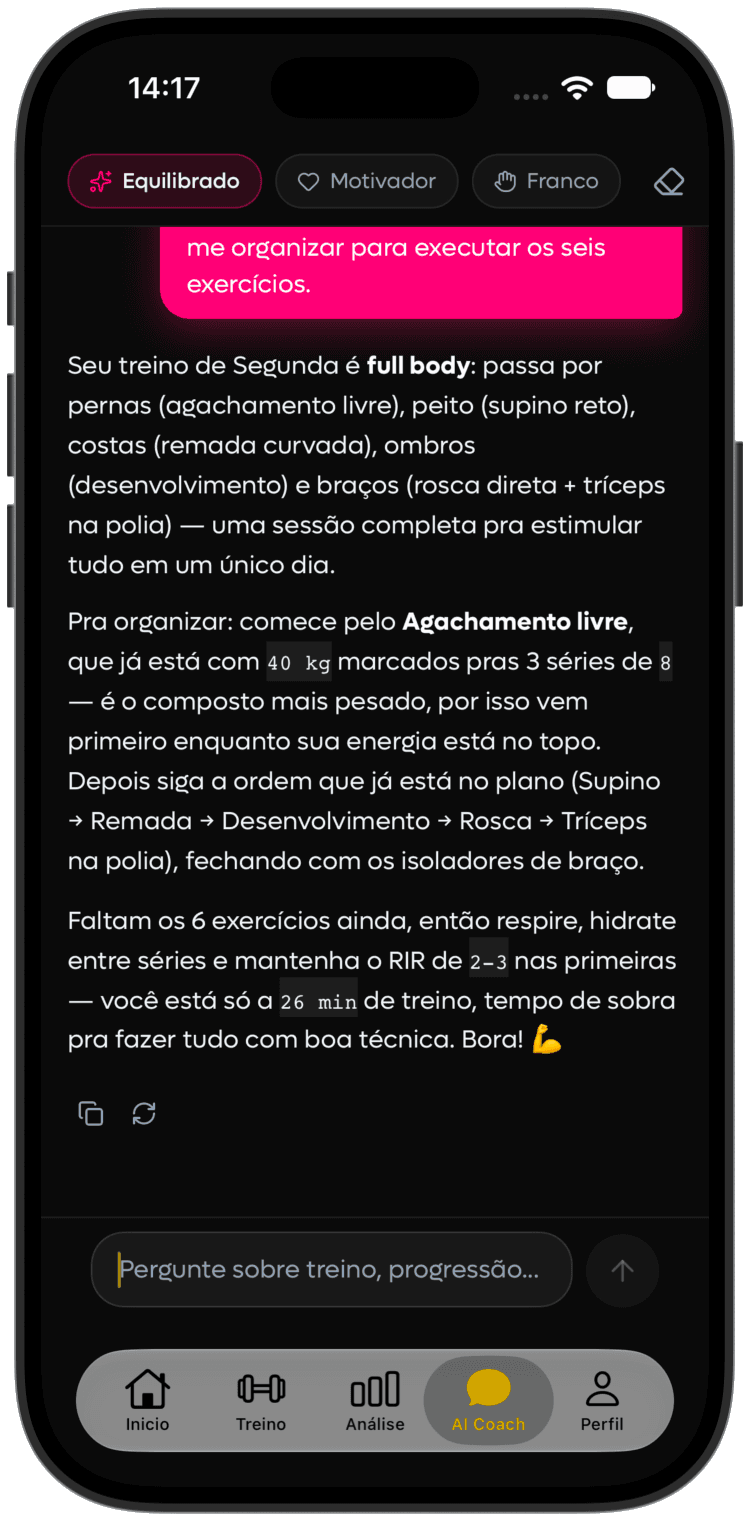
This topic speaks strongly to SelfShapeAI because a superset is not just an isolated technique. It is a structural decision. In practice, SelfShapeAI helps answer questions like: is a superset worth it in this workout? Do these exercises pair well or will they compete too much? Am I trying to save time or making execution worse? Should this block focus more on strength, hypertrophy or session flow? How do I adjust load and effort in this format?
Log load, reps, effort and notes to check whether denser work preserved planned quality. AI Coach can discuss adjustments in active-plan context without treating a technique as universal. See AI training, what SelfShapeAI offers, Communities and the blog.
Simple application examples
1. Arms in a crowded gym
- barbell curl
- rope pushdown
- rest
Here the superset can make the session more fluid, save time and keep the workout interesting without sacrificing performance too much.
2. Chest and back
- machine chest press
- seated cable row
- rest
This pairing usually works well because it distributes the demand between pushing and pulling.
3. When it is probably not worth it
- heavy free squat
- heavy Romanian deadlift
Here the fatigue in the trunk, core, lower back, grip and stability can grow too much and steal quality. It is not forbidden. But for many people, it may not be the smartest choice.
Common superset mistakes
- pairing exercises that compete too much
- using supersets in lifts that demand maximum technical quality
- resting so little that execution falls apart
- turning everything into a race
- keeping unrealistic loads out of ego
- using supersets in everything, without judgment
- forgetting that the session's intention still matters
Frequently asked questions
- Is a superset the same thing as a circuit?No. A superset normally involves two exercises. A circuit usually involves three or more done in sequence. To see how different methods enter the training's logic, visit AI training.
- Do supersets help save time?Yes. That is one of the most practical advantages of the technique, especially for anyone living a tight routine or a crowded gym. It also connects with the broader logic of Best workout tracking app in 2026.
- Can I superset any exercise?You can, but that does not mean you should. Some exercises pair much better than others. To interpret that choice better, the practical RPE and RIR guide helps.
- Are supersets better for hypertrophy?Current evidence suggests similar average hypertrophy to traditional sets. The most consistent advantage is saving time, with higher perceived effort. See How to build more muscle.
- Do I need supersets to get results?No. A superset is a resource. It is not mandatory. It serves when it improves the session, not when it complicates it. If you want to train with more clarity about what makes sense now, combine this with what SelfShapeAI delivers and Pricing.
Supersets are not haste. They are structure.
Supersets work well when they make training more efficient, more intelligent and more coherent with your reality. They can save time, increase density and organize the session better. But that only happens when the pairing respects technique, fatigue and goal.
Random pairing makes training rushed; thoughtful pairing gives it rhythm. SelfShapeAI treats techniques as part of a session that must fit your body, day and real life. For more method, clarity and practical adaptation, start your training plan.
Sources and references
- Source: Iversen VM et al. No Time to Lift? Designing Time-Efficient Training Programs for Strength and Hypertrophy: A Narrative Review. Sports Med, 2021. — Sports Medicine (PubMed)
- Source: Zhang X et al. Superset Versus Traditional Resistance Training Prescriptions: A Systematic Review and Meta-analysis Exploring Acute and Chronic Effects. Sports Med, 2025. — Sports Medicine (PubMed)
- Source: Iversen VM et al. Efficacy of Supersets Versus Traditional Sets in Whole-Body Multiple-Joint Resistance Training: A Randomized Controlled Trial. J Strength Cond Res, 2024. — Journal of Strength and Conditioning Research (PubMed)
Reviewed by the SelfShapeAI research team using strength-training guidelines and studies.
Take this method to the app

Create your plan with AI, log check-ins and use the AI Coach to adjust training with context.
Share
SelfShapeAI Team
SelfShapeAI technical and editorial team.
Keep learning
Recommended next article
Myo-reps: how to do them, when to use them and whether they save time
Learn how to perform myo-reps, how long to rest, when to stop and which exercises suit this time-saving technique.
Continue →