Abdominal bracing: how to do it and why it matters in strength training
Learn to stiffen your trunk before loading it, understand the difference between bracing and drawing your belly button in, and match tension to the exercise.


How do you brace your core? Before the repetition, position your trunk, inhale without raising your shoulders and tighten the muscles around your waist as if expecting a tap on your abdomen. Aim to create pressure and stiffness in front, at the sides and behind, maintaining your position as you move.
Bracing is not a traditional abdominal exercise and does not require maximal contraction in every exercise. It provides a base: a stable trunk tends to make force transfer between your arms, legs and the load more predictable. That base must work alongside range of motion, controlled tempo and a load compatible with your technique.
Contents
- 1. What is abdominal bracing?
- 2. Bracing is not drawing your belly button inward
- 3. How to learn bracing without a load
- 4. How much tension should you use?
- 5. Using it in squats, deadlifts and other exercises
- 6. Bracing and breathing: do you need to hold your breath?
- 7. Does bracing help lower-back pain?
- 8. Turning bracing into a trainable skill
- 9. Common bracing mistakes
- 10. Frequently asked questions
- 11. Sources and scientific reading
- 12. Create enough stiffness for the task, rather than tension out of habit
What is abdominal bracing?
Abdominal bracing is voluntary coactivation of the trunk muscles. The rectus abdominis, obliques, transverse abdominis and back muscles work together to stiffen the area. The goal is to provide a stable base while your hips, knees, shoulders and elbows produce the planned movement, rather than moving the spine.
In small laboratory studies, bracing increased intra-abdominal pressure and calculated stability more than abdominal hollowing. This does not make it superior for every task or mean more pressure is always better. It means contracting the trunk as a whole produces a different mechanical response from drawing the abdomen inward.
Stiffness does not require freezing your whole body. In a squat, the trunk can lean while maintaining its relationship with the pelvis; in a deadlift, the hips and knees change angle while the trunk resists the load. Technique serves the exercise. The machines or free weights guide explains why stabilization demands vary between equipment.
Turn understanding into a workout you can follow
SelfShapeAI uses your routine and goal to build an explained plan, log every session and guide the next adjustment.




Download for free. Annual: R$ 299,90/year, equivalent to about R$ 25/month; monthly: R$ 39,90/month. See how AI training works.
Bracing is not drawing your belly button inward
Pulling your belly button toward your spine is a cue associated with abdominal hollowing. It aims to emphasize deep muscles and may be used in motor-control work. Bracing has a broader aim: create tension around the whole waist without deliberately narrowing the abdomen.
| Strategy | Main cue | Expected effect |
|---|---|---|
| Abdominal bracing | Tighten the trunk in 360 degrees without drawing the belly inward | Greater overall coactivation, pressure and stiffness to resist load |
| Abdominal hollowing | Gently draw the abdominal wall inward | Emphasis on deep-muscle control with lower overall pressure |
| Holding your breath | Close the glottis and retain air during effort | Raises internal pressures, but also increases the cardiovascular response |
| Maximal abdominal contraction | Use maximum tension regardless of the task | May create more fatigue and stiffness than the exercise requires |
A simple cue is to imagine your waist becoming a firm cylinder. The front, sides and back all participate. If the abdomen draws inward, you probably performed hollowing; if your ribs flare and your lower back changes position, you created pressure without organizing the trunk.
How to learn bracing without a load
Learn the sensation outside a difficult set. Start standing or lying on your back with knees bent. Lying down reduces other demands; standing is closer to most lifting exercises. Choose a position in which you can feel your trunk without pain or reflexively holding your breath.
- Position your ribs and pelvis comfortably, without forcing your lower back into the floor or exaggerating its arch.
- Take a moderate breath and let your lower trunk expand in front, at the sides and behind.
- Tighten your waist as if expecting a light tap, without pulling your belly button inward.
- Maintain the position and use a short exhalation or small breaths without releasing all the tension.
- Relax completely, repeat and check whether the second attempt feels more even than the first.
- Transfer the skill to a simple movement such as a bird dog, bodyweight squat or lifting a light dumbbell.
This practice develops coordination, not exhaustion. You do not need long sets until your abs shake before every workout. Warm-up sets provide a better opportunity to test whether you can create and maintain a brace as load increases.
How much tension should you use?
Tension should match the challenge. A light, stable exercise needs enough contraction to keep movement organized, rather than an effort to crush your own trunk. As load, speed or instability increases, your brace can become firmer.
| Context | Bracing demand | Signs it is appropriate |
|---|---|---|
| Stable machine or isolation exercise | Low to moderate | The trunk does not sway and breathing stays comfortable |
| Row, overhead press or unilateral exercise | Moderate | The load moves without unintended rotation or compensation |
| Squat or deadlift with a working load | Moderate to high | Trunk position stays repeatable throughout the set |
| Very heavy attempt | High and task-specific | The strategy has been practiced and does not cause loss of control or dizziness |
| Lower-back pain or pelvic symptoms | Do not determine this on your own | Technique is adapted after professional assessment |
If maximal contraction makes you lose position before the set starts, bracing has become a source of fatigue. If the load disrupts your trunk on the first rep, tension may be insufficient, the load too heavy or the exercise insufficiently practiced. The RPE and RIR guide helps distinguish target-muscle effort from a set limited by technique.
Using it in squats, deadlifts and other exercises
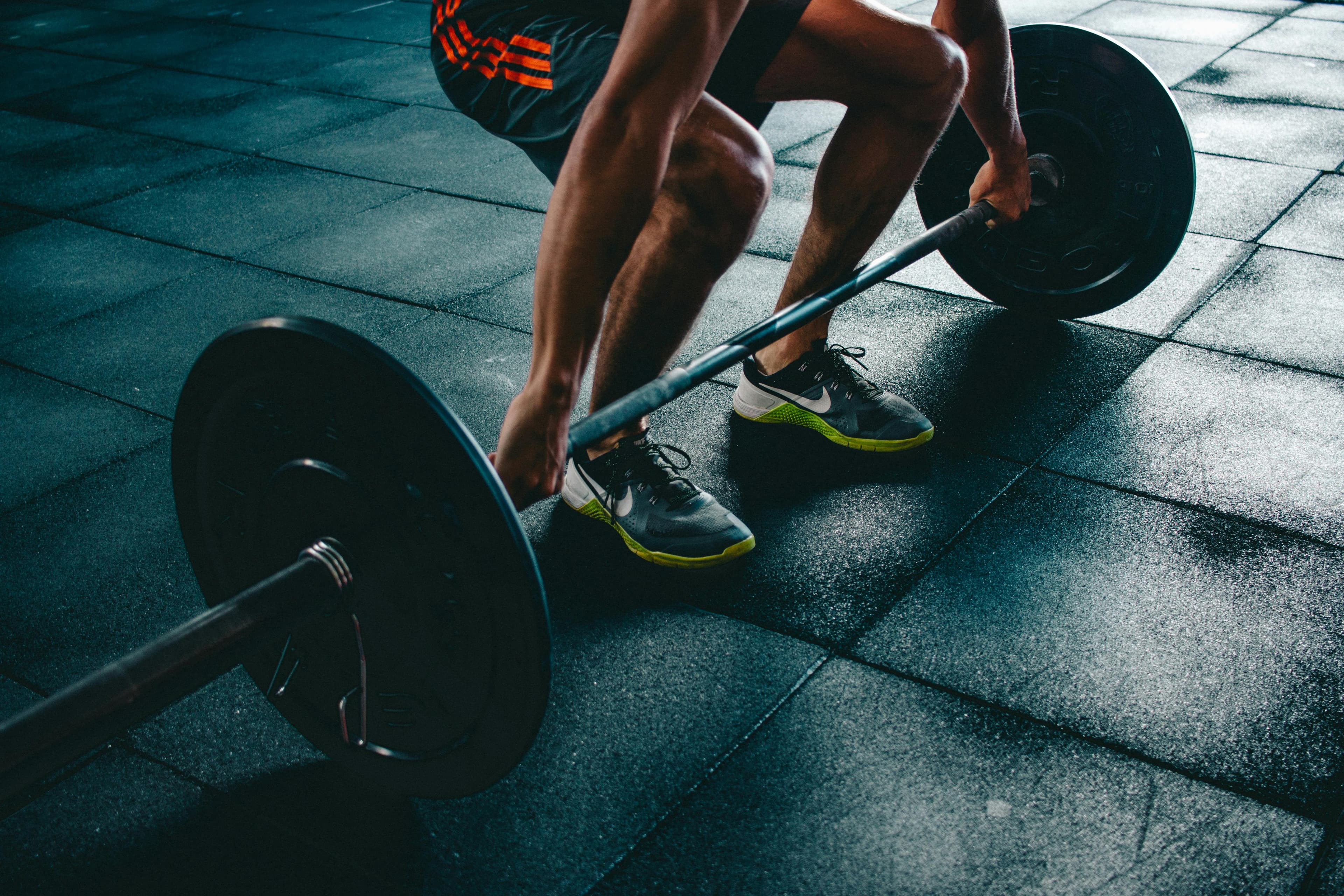
In a squat, brace before descending and keep your trunk organized until you regain a stable position at the top. In a deadlift, set your feet and grip, organize your trunk and then take the slack out of the bar. In both, pressure comes before the load leaves its support, not after position has already changed.
In leg training, this cue can help with squats, stiff-legged and Romanian deadlifts, and loaded lunges. In a 5x5 workout, it becomes important because main sets use heavy loads and depend on comparable repetitions. Bracing does not justify continuing when technique deteriorates.
- Squat: brace before unlocking your knees and hips; reset at the top when needed.
- Deadlift or stiff-legged deadlift: create tension before lifting from the floor or starting the descent.
- Standing overhead press: avoid turning each rep into increasing trunk extension.
- Bent-over row: maintain your chosen torso angle without using the lower back to swing each rep.
- Unilateral exercises: resist rotation without restricting your hips and shoulders more than necessary.
- Supported machines: use only the tension needed to maintain contact and position.
As fatigue rises, bracing may be the first detail to break down. This matters especially near muscular failure: finishing a set on a stable machine has a different technical cost from failing under a free barbell. Rest between sets also needs to let breathing, concentration and control recover.
Bracing and breathing: do you need to hold your breath?
Not on every repetition. Bracing contracts the trunk; holding air against a closed glottis is the Valsalva maneuver. They may occur together during very high effort, but are not the same. With light and moderate loads, many people can maintain enough stiffness while exhaling in a controlled way or taking small breaths between repetitions.
A study in healthy adults found that the diaphragm continued to participate during lifting with bracing and continuous breathing. By contrast, studies of Valsalva during resistance exercise show greater blood-pressure responses. Do not copy a maximal-lifting strategy for every set in your plan.
- In light sets, practice maintaining tension while breathing in a controlled way.
- In conventional sets, reset your breath and brace between repetitions when your position allows.
- Do not prolong breath-holding if you experience dizziness, visual changes, headache or feeling unwell.
- If you have a cardiovascular condition, are pregnant or have pelvic-floor symptoms, seek individual guidance before holding your breath under load.
Does bracing help lower-back pain?
Bracing should not be presented as an automatic treatment for lower-back pain. A classic study found delayed transverse abdominis activation in a small group with low-back pain, but pain has many contributing factors and this finding cannot diagnose a weak core in everyone. Contracting harder does not, by itself, resolve the cause of a symptom.
If pain occurs during an exercise, reduce the demand and check whether position, range or load changed. Persistent or radiating pain, tingling, loss of strength, or changes in bladder or bowel control require medical assessment. The app can help record what happened, but does not replace diagnosis.
Turning bracing into a trainable skill
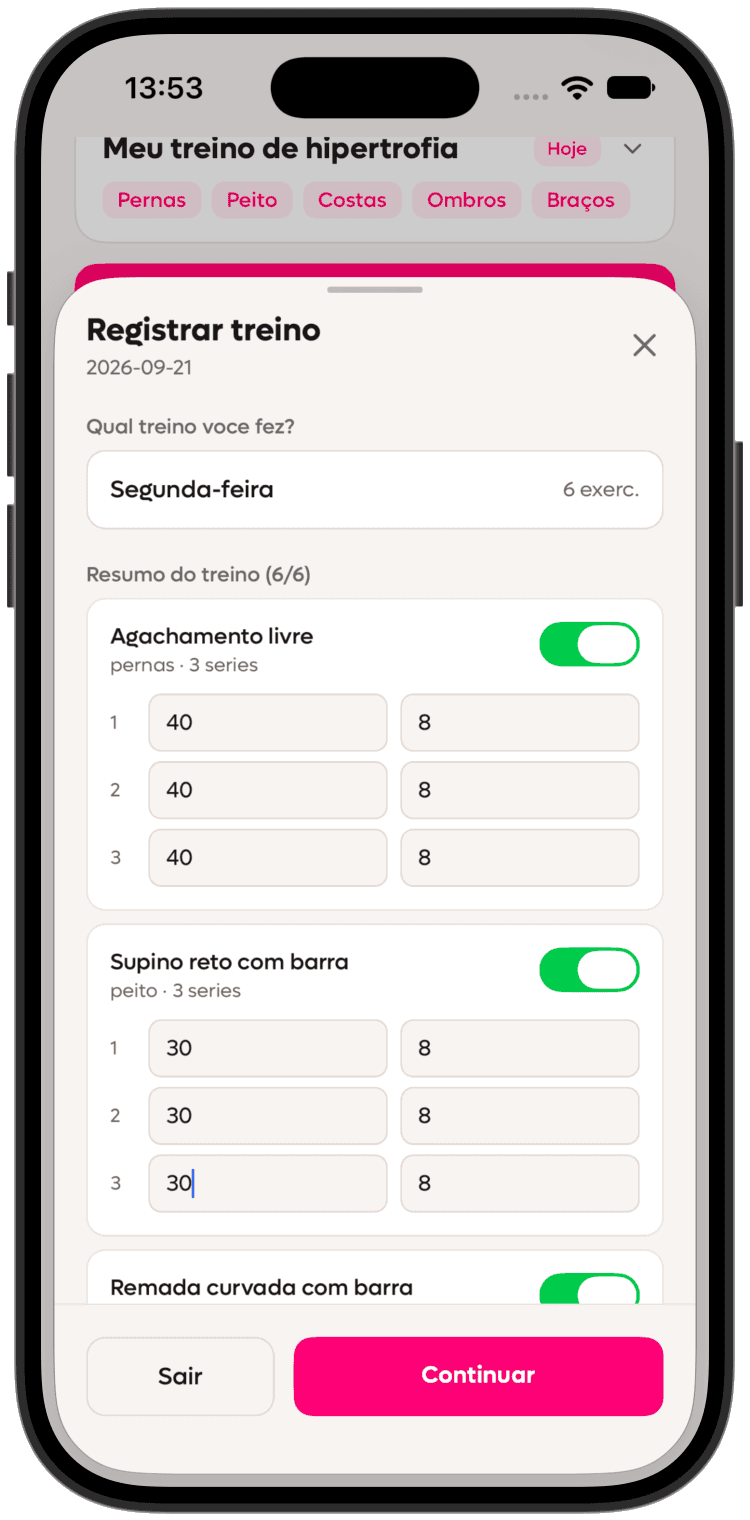
Choose a simple cue, practice during warm-ups and keep the exercise consistent long enough to compare sessions. Afterwards, log load, repetitions, effort and a short note when position changes. Deciding when to increase load becomes more honest when the technique used to move it is part of the comparison.
In SelfShapeAI, organize a plan around your context, log sessions and track progress without relying on memory. AI training helps structure exercises; tracking features turn execution into history; and the SelfShapeAI user guide covers the complete workflow.
Bracing is one part of execution, not the whole training goal. Volume, effort, recovery and consistency still shape results. To connect these variables, see how to build more muscle and the path from beginner to results.
Common bracing mistakes
- Drawing your belly button inward and calling every contraction a brace.
- Inhaling until your ribs lose position and your lower-back arch increases.
- Using maximal tension in exercises that need only moderate stability.
- Holding your breath through a long set without need or preparation.
- Bracing only after the load has started shifting your trunk.
- Assuming a belt replaces coordination, progression and appropriate load selection.
- Using the technique to mask pain or continue a set after losing control.
The best cue produces a stable, repeatable repetition, rather than making your abdomen look more contracted. If movement changes with every attempt, reduce variables and restart with less load. Consistent technique comes before rushing progression.
Frequently asked questions
- Is bracing the same as contracting your abs?It is a specific form of contraction. The aim is to coactivate muscles around the trunk to create 360-degree stiffness, rather than simply squeezing the rectus abdominis or drawing your belly inward.
- Do I need to brace in every exercise?Your trunk participates in almost every exercise, but deliberate intense contraction is not always necessary. Match tension to the load, equipment stability and movement complexity.
- Should I hold my breath during squats?There is no universal answer. Light and moderate sets allow controlled breathing; very high efforts may use brief breath-holding. Because it increases cardiovascular responses, it requires experience and individual care.
- Does bracing make your waist smaller?There is no basis for treating bracing as a way to reduce waist size locally. It trains trunk coordination and tension; circumference changes depend on body composition, anatomy and other factors.
- Does a lifting belt replace bracing?No. A belt provides a surface against which your trunk can create pressure, but still requires an active strategy. Its use fits specific contexts and does not fix poor technique or inappropriate loading.
- Can I practice bracing with lower-back pain?It may form part of an individual plan, but should not be self-prescribed as a cure. Persistent pain or neurological symptoms require professional assessment before continuing under load.
Sources and scientific reading
Studies used in this review
- Source: Quantification of lumbar stability by using 2 different abdominal activation strategies — Archives of Physical Medicine and Rehabilitation
- Source: Intra-abdominal Pressure and Trunk Muscular Activities during Abdominal Bracing and Hollowing — International Journal of Sports Medicine
- Source: Trunk muscle activities during abdominal bracing: comparison among muscles and exercises — Journal of Sports Science & Medicine
- Source: The effect of abdominal bracing on respiration during a lifting task: a cross-sectional study — BMC Sports Science, Medicine and Rehabilitation
- Source: Effect of breathing techniques on blood pressure response to resistance exercise — British Journal of Sports Medicine
- Source: Inefficient muscular stabilization of the lumbar spine associated with low back pain — Spine
Editorial review by the SelfShapeAI team
Create enough stiffness for the task, rather than tension out of habit
A good brace makes repetitions more predictable without taking all your attention away from the exercise. Learn it without load, test it in warm-up sets and increase tension as demand rises. When your trunk loses position, treat that as information for adjusting, rather than a reason to grit your teeth and push on.
In SelfShapeAI, context comes before the plan, the plan explains its logic and each session becomes data for the next adjustment. Download SelfShapeAI for free.
Take this method to the app

Create your plan with AI, log check-ins and use the AI Coach to adjust training with context.
Share
SelfShapeAI Team
SelfShapeAI technical and editorial team.
Keep learning
Recommended next article
Warm-up sets: what they are, how to do them and when to use them
Learn what warm-up sets are, how to build a load ramp and when to use them for performance without tiring yourself before working sets.
Continue →