Training to muscular failure: is it necessary for hypertrophy?
Getting close to failure helps ensure effort, but taking every set to the limit is not compulsory and can cost more fatigue than it delivers in results.


Do you need muscular failure to build muscle? No. Current evidence does not show that failing every set is necessary for hypertrophy. At the same time, stopping too early may provide insufficient effort, especially beyond the beginner stage.
The useful question is how close to your limit you need to get in that exercise, set and phase of the plan. First distinguish muscular failure from discomfort, poor technique and simply wanting to stop.
Contents
- 1. Short answer: failure is a tool, not an obligation
- 2. What RIR and RPE have to do with failure
- 3. Why getting close to the limit can help
- 4. Why failing every set can be counterproductive
- 5. The exercise changes failure's cost
- 6. Should only the final set reach failure?
- 7. Calibrate RIR without guessing
- 8. Make effort part of the plan
- 9. Common failure-training mistakes
- 10. Frequently asked questions
- 11. Sources and scientific reading
- 12. Enough effort, purposeful fatigue
Short answer: failure is a tool, not an obligation
Reviews comparing failure with stopping short generally find similar hypertrophy. A 2024 meta-regression, however, observed a tendency toward greater growth when sets ended closer to failure. Both can be true: approaching the limit appears relevant, while exactly zero reps in reserve has not proved essential.
A more recent 2026 review also found no significant hypertrophy advantage for failure and a small dynamic-strength advantage for non-failure training. Failure is not useless; it should justify its fatigue cost instead of appearing automatically in every set.
| Situation | What happened | How to interpret it |
|---|---|---|
| Set far from failure | Several more reps with the same technique were possible | May be warm-up, practice or deliberately light work |
| Technical failure | Another rep would require changing the defined standard | A useful limit when preserving execution is the priority |
| Momentary concentric failure | You try but cannot complete the lifting phase with the intended technique | The definition most often used in scientific comparisons |
| Stopping because of discomfort | Burning, breathing, grip or discomfort ends the set | The target muscle may or may not have reached its limit |
Turn understanding into a workout you can follow
SelfShapeAI uses your routine and goal to build an explained plan, log every session and guide the next adjustment.




Download for free. Annual: R$ 299,90/year, equivalent to about R$ 25/month; monthly: R$ 39,90/month. See how AI training works.
What RIR and RPE have to do with failure
RIR estimates repetitions remaining before failure. Zero RIR means no further complete rep; 1 RIR means one remaining, and 3 RIR about three. RPE expresses a similar idea on an effort scale: RPE 10 corresponds to failure, RPE 9 usually to 1 RIR, and so on.
These are estimates that improve with practice, not laboratory instruments. The RPE and RIR guide explains using them without pretending impossible precision. Distinguish a challenging set from one clearly far from the limit, rather than expecting perfect predictions every time.
Why getting close to the limit can help
As a set progresses, each rep requires more effort. With moderate or light loads, approaching failure helps ensure the target muscle was challenged. This informs the popular idea of effective repetitions, although no biological counter makes only the last five reps count and discards all earlier ones.
The firm point is simpler: very easy sets provide less stimulus per set. The uncertain point is the exact distance that maximizes hypertrophy. Available meta-regression suggests a benefit from getting closer, but its authors note that study RIR values were estimated and the precise relationship remains unknown.
One to three RIR is therefore a practical range for many hypertrophy sets, not a rigid scientific boundary. Some exercises and people tolerate zero RIR often; others perform better stopping earlier. Useful training volume and overall recovery must be considered.
Why failing every set can be counterproductive
Failure usually increases performance loss, perceived effort and post-session fatigue markers. It may reduce subsequent repetitions, worsen technique and extend recovery. The question becomes how much the last rep cost the rest of the workout, beyond whether it stimulated the muscle.
- A first set to failure can reduce performance in later sets.
- Technique becomes more vulnerable when you push beyond technical failure.
- Extra fatigue may make planned weekly volume harder to sustain.
- Heavy free-weight exercises require more attention to support, position and safety.
- Always failing makes productive effort harder to distinguish from insufficient recovery.
The cost also depends on set count. If your plan already approaches your recoverable limit, adding failure everywhere can turn useful volume into excess. Review how many sets build muscle before treating intensity and volume as independent additions.
The exercise changes failure's cost
Failing a machine lateral raise differs from failing a barbell squat. Greater stability, technique, coordination and systemic-recovery demands generally increase the cost. Available safeties, supports or a trained spotter also matter.
| Context | Practical distance from failure | Why |
|---|---|---|
| Heavy free-weight compound exercise | Often 1 to 3 RIR | Preserves technique, performance and a safety margin |
| Stable machine for hypertrophy | Often 0 to 2 RIR | The guided path may reduce some technical demands |
| Simple isolation exercise | Often 0 to 2 RIR | Failure tends to have a lower systemic impact |
| Beginner learning the movement | Stop before losing technique | First establish a reference for execution and effort |
| Recovery week or return to training | More repetitions in reserve | Reduce demand and rebuild tolerance |
The comparison of machines and free weights explains stability differences. Range matters too: shorter reps and altered posture may mean technical failure has been exceeded. The article on full and partial range explains why unrecorded movement changes can create false progression.
Should only the final set reach failure?
Using failure only on the last set of selected exercises is one possible strategy. It preserves earlier performance and offers a clearer reference for your limit at the end. It is neither compulsory nor a reason to fail the final set of every exercise.
- Choose stable exercises with a safe stopping setup.
- Keep earlier sets close to failure without reaching it.
- Stop when the defined technique cannot be repeated.
- Compare set performance and recovery before the next session.
- Remove failure if it excessively reduces the rest of the workout or week.
Supersets, drop sets and myo-reps also increase density or extend near-limit work. They need not be combined with failure in every exercise. Advanced methods without dose control often create more exhaustion than clarity.
Calibrate RIR without guessing
Choose an exercise you can safely stop and a familiar load. Estimate RIR after a set. On a planned occasion, continue to technical failure and compare your estimate with reality. This test calibrates perception and is not needed every session.
- Use the same range and technical standard in every repetition.
- Do not count reps achieved only through swinging or unplanned assistance.
- Record load, reps and RIR immediately after the set.
- Check whether estimated RIR fits the performance decline in the next set.
- Recalibrate when changing exercise, rep range or technique.
Preparatory sets are poor failure tests: they should leave you ready, not tired. See how to perform warm-up sets. For progression, preserve your standard and apply progressive overload using the criteria for increasing load.
Make effort part of the plan
Before the session, choose which exercises can approach failure and which need a margin. Then log what happened. If reps, load and technique improve while recovery remains adequate, the plan provides useful information. If everything collapses after the first set, intensity may be poorly distributed.
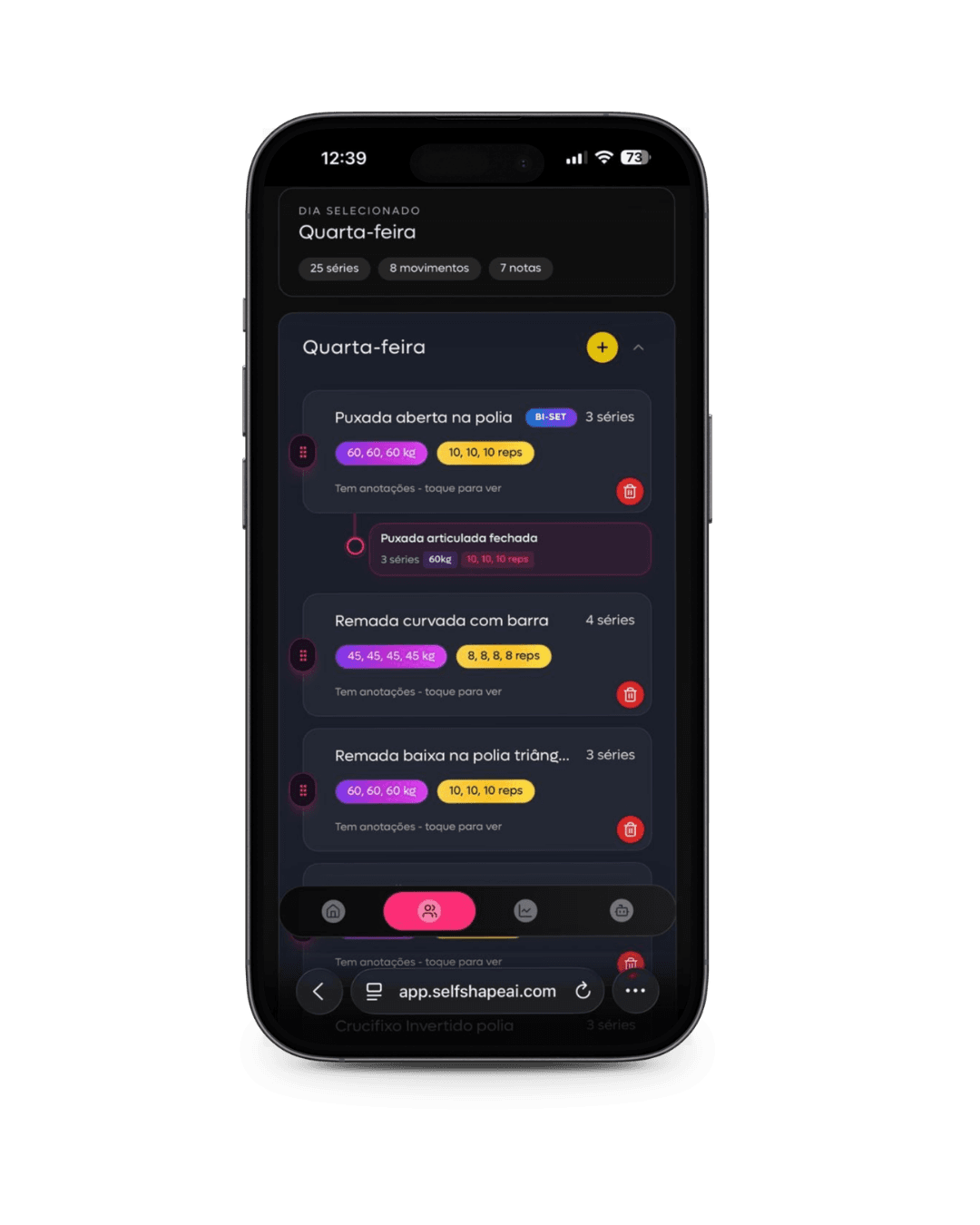
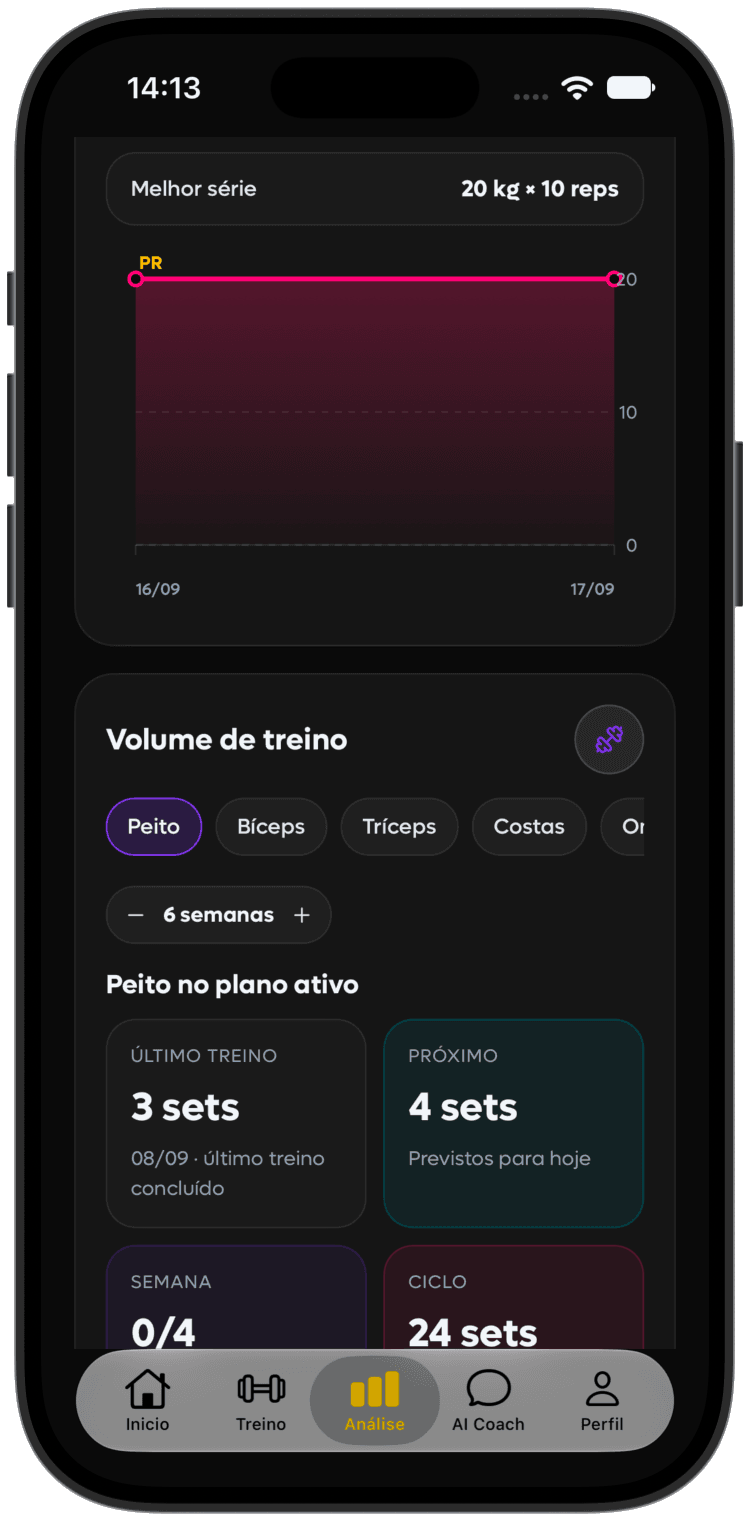
In SelfShapeAI, organize training, log load, repetitions, perceived effort and notes, and follow progress per exercise. Connect effort and results without relying on memory. Explore AI workout creation, tracking features or how to use SelfShapeAI.
Common failure-training mistakes
- Confusing burning, breathlessness or discomfort with target-muscle failure.
- Taking every set to the limit while ignoring declining performance.
- Changing range and technique just to record another rep.
- Applying the same RIR to every exercise regardless of cost.
- Using failure to compensate for a plan without progression or consistency.
- Seeking failure in free-weight exercises without safeties, support or technical control.
Failure does not replace fundamentals. Hypertrophy still depends on tension, volume, progression and recovery across weeks. The muscle-building guide organizes these factors without making one variable the secret to results.
Frequently asked questions
- Must every set reach failure to build muscle?No. Training relatively close to failure can produce hypertrophy without reaching the limit in every set. The right distance depends on exercise, load, volume and recovery.
- How many reps should I leave in reserve?About one to three is a practical reference for many hypertrophy sets, not a universal rule. Stable exercises may tolerate fewer RIR; demanding movements may need more margin.
- Is muscular failure dangerous?Risk depends on the exercise, technique, equipment and available support. Failing on a machine with safeties differs from failing under a free barbell. Plan a safe exit and stop for pain.
- Should beginners train to failure?They do not need to. While learning execution, stopping before technique breaks down usually provides a better reference. RIR perception can be calibrated gradually in safe exercises.
- Are technical and muscular failure identical?Not exactly. Technical failure means another rep would require changing the defined standard. Momentary muscular failure means you try but cannot finish the lifting phase using that technique.
Sources and scientific reading
Studies used in this review
- Source: Effects of resistance training performed to repetition non-failure on exercise performance in healthy adults: a systematic review and meta-analysis — BMC Sports Science, Medicine and Rehabilitation
- Source: Exploring the Dose-Response Relationship Between Estimated Resistance Training Proximity to Failure, Strength Gain, and Muscle Hypertrophy — Sports Medicine
- Source: Influence of Resistance Training Proximity-to-Failure on Skeletal Muscle Hypertrophy: A Systematic Review with Meta-analysis — Sports Medicine
- Source: Effects of Resistance Training to Muscle Failure on Acute Fatigue: A Systematic Review and Meta-Analysis — Sports Medicine
Editorial review by the SelfShapeAI team
Enough effort, purposeful fatigue
You do not need to choose between training too lightly and failing everything. Get close enough to create a stimulus, preserve a margin where costs are high and use failure when it serves a clear purpose.
In SelfShapeAI, effort becomes more than an impression: it enters your session log and helps inform the next adjustment. Download SelfShapeAI for free.
Take this method to the app

Create your plan with AI, log check-ins and use the AI Coach to adjust training with context.
Share
SelfShapeAI Team
SelfShapeAI technical and editorial team.
Keep learning

Recommended next article
How many sets to build muscle? How to get your volume right without overshooting or falling short
Find out how many sets make sense for hypertrophy, how to think about weekly volume per muscle and how to adjust the right dose without overdoing it or training below what you need.
Continue →