Lifting tempo: how fast should you move for hypertrophy?
Controlling each rep supports technique and comparison, but deliberately slow movement does not automatically build more muscle.


What is the best tempo for hypertrophy? For most sets, the practical answer is to lower with control, transition without losing position and lift with the intention of producing force. You do not need a rigid count for every rep, or to let the weight fall to finish faster.
Tempo describes time spent in each phase of a repetition. It helps organize technique but does not work in isolation. Load, effort, range of motion, stability and progression still determine what a set represents.
Contents
- 1. Short answer: control matters more than a stopwatch
- 2. How to read a 3-1-1 tempo
- 3. Must the lowering phase last two to four seconds?
- 4. Fast lifting does not mean uncontrolled lifting
- 5. Tempo by exercise type
- 6. Does more time under tension mean more hypertrophy?
- 7. Tempo and range of motion work together
- 8. Without comparable technique, progression can be misleading
- 9. Does tempo change near failure?
- 10. When changing tempo makes sense
- 11. Record tempo without complicating training
- 12. Common tempo mistakes
- 13. Frequently asked questions
- 14. Sources and scientific reading
- 15. Control that makes progress visible
Short answer: control matters more than a stopwatch
A meta-analysis of repetition duration found similar hypertrophy across a broad range of about 0.5 to 8 seconds per rep. Extremely slow reps above 10 seconds may be less efficient, although this finding comes from few studies and requires caution.
A more recent review focused on eccentric duration also found no clear, meaningful muscle-growth difference between shorter and longer lowering phases. Controlling the descent is sound technique guidance; assuming four seconds always builds more muscle than two is not.
| Execution | What may happen | Practical interpretation |
|---|---|---|
| Fast and uncontrolled | Momentum, bouncing and inconsistent range | Hard to tell whether real progression occurred |
| Controlled | Repeatable path and range | A better reference for training and comparisons |
| Deliberately very slow | Less load or fewer reps, with more discomfort | Does not guarantee a superior stimulus |
Turn understanding into a workout you can follow
SelfShapeAI uses your routine and goal to build an explained plan, log every session and guide the next adjustment.




Download for free. Annual: R$ 299,90/year, equivalent to about R$ 25/month; monthly: R$ 39,90/month. See how AI training works.
How to read a 3-1-1 tempo
Numbers represent seconds in different repetition phases. The order can vary between coaches and apps, so writing “3-1-1” is not enough: identify which number means lowering, pausing and lifting.
| Phase | Example | What to notice |
|---|---|---|
| Eccentric | 3 seconds | The muscle lengthens as you control the load |
| Lengthened transition | 1 second | Stable pause without relaxing or bouncing |
| Concentric | 1 second | The muscle shortens to overcome resistance |
| Shortened transition | 0 seconds | Begin the next repetition without an additional pause |
In a barbell curl, lifting is concentric and lowering is eccentric. In a pulldown, bringing the bar toward you is concentric and returning it is eccentric. Think about the muscle's action, beyond whether the equipment moves up or down.
Must the lowering phase last two to four seconds?
Two to four seconds can help someone learning the movement path or habitually dropping the weight. The source material presents this range as a cue to reinforce control and reduce momentum. Treat it as a reference, not a law of hypertrophy.
In practice, a controlled lowering phase of roughly one to three seconds works well in many exercises. Exact timing varies with load, range, machine and goal. A heavy squat need not look identical to a light lateral raise, but both should preserve their planned path.
Accentuated eccentric methods are different: the lengthening phase receives a specific overload or emphasis. They are a training strategy, not evidence that every ordinary set needs the slowest possible negative.
Fast lifting does not mean uncontrolled lifting
Try to produce force concentrically while maintaining position. With a heavy load or near the end of a set, the weight may move slowly even when you intend to accelerate. That differs from swinging your torso, reducing range or transferring work to another body part.
Speed describes how fast the weight actually moves; intention describes how hard you try to accelerate it. A forceful lift can remain technically controlled. Momentum generates energy before the part meant to challenge the muscle and makes reps less comparable.
Tempo by exercise type
No count is perfect for every movement. Use these references to guide decisions, not replace individual adjustments. Pain, loss of position or specific professional guidance takes priority over counting.
| Exercise | Practical tempo | Main consideration |
|---|---|---|
| Squat and leg press | Controlled descent, stable transition and forceful ascent | Do not bounce at the bottom or shorten the range |
| RDL and stiff-legged deadlift | Controlled descent to your technical limit and a firm return | Keep the spine and hips organized |
| Bench press and overhead press | Controlled approach and an intention to accelerate upward | Do not drop the load into the transition |
| Rows and pulldowns | Firm pull and controlled return | Avoid swinging the torso |
| Raises, curls and extensions | Continuous path with an optional peak pause | Do not turn a pause into relaxation |
Machines and free weights have different stability demands. The comparison of machines and free weights for hypertrophy helps choose equipment without confusing a guided path with automatic technique.
Does more time under tension mean more hypertrophy?
Not automatically. Time under tension describes how long the muscle works, but increasing it may reduce load, total repetitions or sustainable effort. Two 40-second sets can be completely different.
Mechanical tension depends on force produced by fibers throughout the movement. A stopwatch alone cannot measure it or identify which muscle limited the set. More burn from slower reps is not the same as more stimulus.
If controlled tempo helps maintain the target muscle, range and stability, it solves a real problem. If you slow down only to chase burning and lose load, repetitions and progression without a reason, you may have traded measurable performance for a sensation.
Tempo and range of motion work together
A slow, short rep is not automatically better than a controlled rep through an appropriate range. Define movement boundaries before counting seconds and maintain them between sets. The range-of-motion guide explains when partials are planned and when they merely conceal fatigue.
Pauses also need a purpose. A pause in the lengthened position can remove bouncing and make the start more consistent; a peak pause can improve awareness in some isolation exercises. Neither is compulsory everywhere, and fully relaxing during a pause can change the expected stimulus.
Without comparable technique, progression can be misleading
You added weight but sped up the descent, used more momentum and shortened the range. The number increased; the demand on the intended muscle may not have. Progressive overload requires a sufficiently stable reference.
- Compare the same exercise through a similar range.
- Keep a recognizable tempo, even without timing each phase.
- Log load, repetitions and perceived effort.
- Treat a large tempo change as a new variation.
- Reduce load if the new execution is more demanding.
The criteria for increasing load still apply: confirm repetitions and technique first, then progress. If tempo changes only in the final reps, use RIR and the RPE and RIR guide to distinguish high effort from a lost technical standard.
Does tempo change near failure?
Near failure, the concentric phase tends to slow even if you keep trying to move forcefully. That is expected. The stopping signal is not an exact number of seconds, but the point at which another rep would require abandoning your defined technique.
The article on training to muscular failure explains this distinction. Technical failure and a slow effortful rep are different; slower speed does not necessarily mean lost control. A valid path can remain intact as speed falls.
When changing tempo makes sense
- To learn an exercise and feel each phase more clearly.
- To reduce momentum or bouncing at a specific point.
- To standardize technique before increasing load.
- To use a pause or eccentric phase for a defined purpose.
- To adapt an exercise to a limitation under appropriate guidance.
A tempo change may initially reduce the weight you can move. That is a change in the task, not regression. Comparing the new number directly with a faster version and concluding you lost strength is the mistake.
Record tempo without complicating training
You do not need a metronome for every set. For most people, a short cue such as “lower with control, no bouncing; lift forcefully” is more sustainable. Use numbers when duration is part of the method or a phase needs special attention.
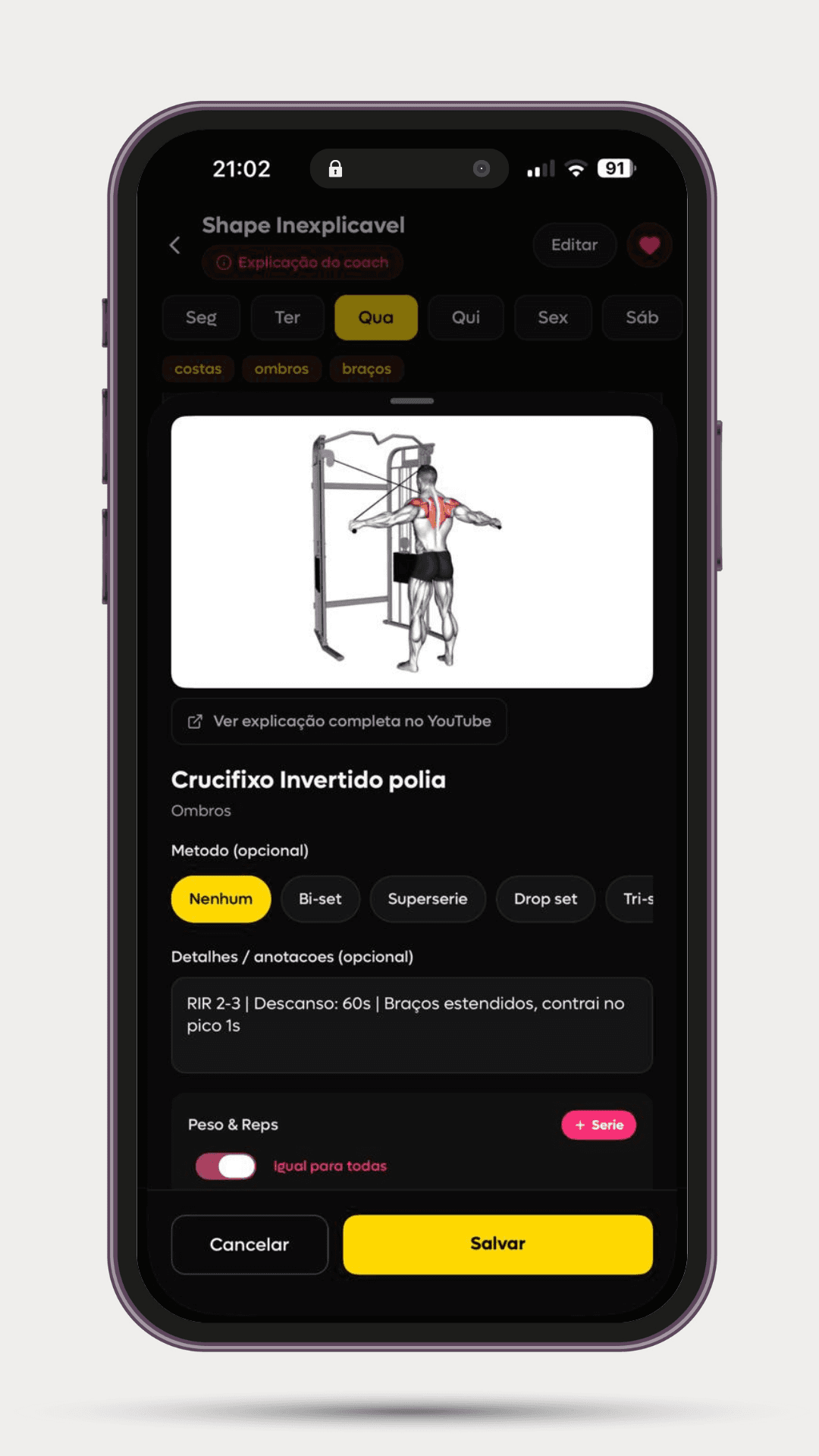
In SelfShapeAI, technique guidance can sit beside the exercise, while load, repetitions, RIR and session notes stay linked to the plan. Interpret progress with context, beyond the weight alone. Explore tracking features and AI workout creation.
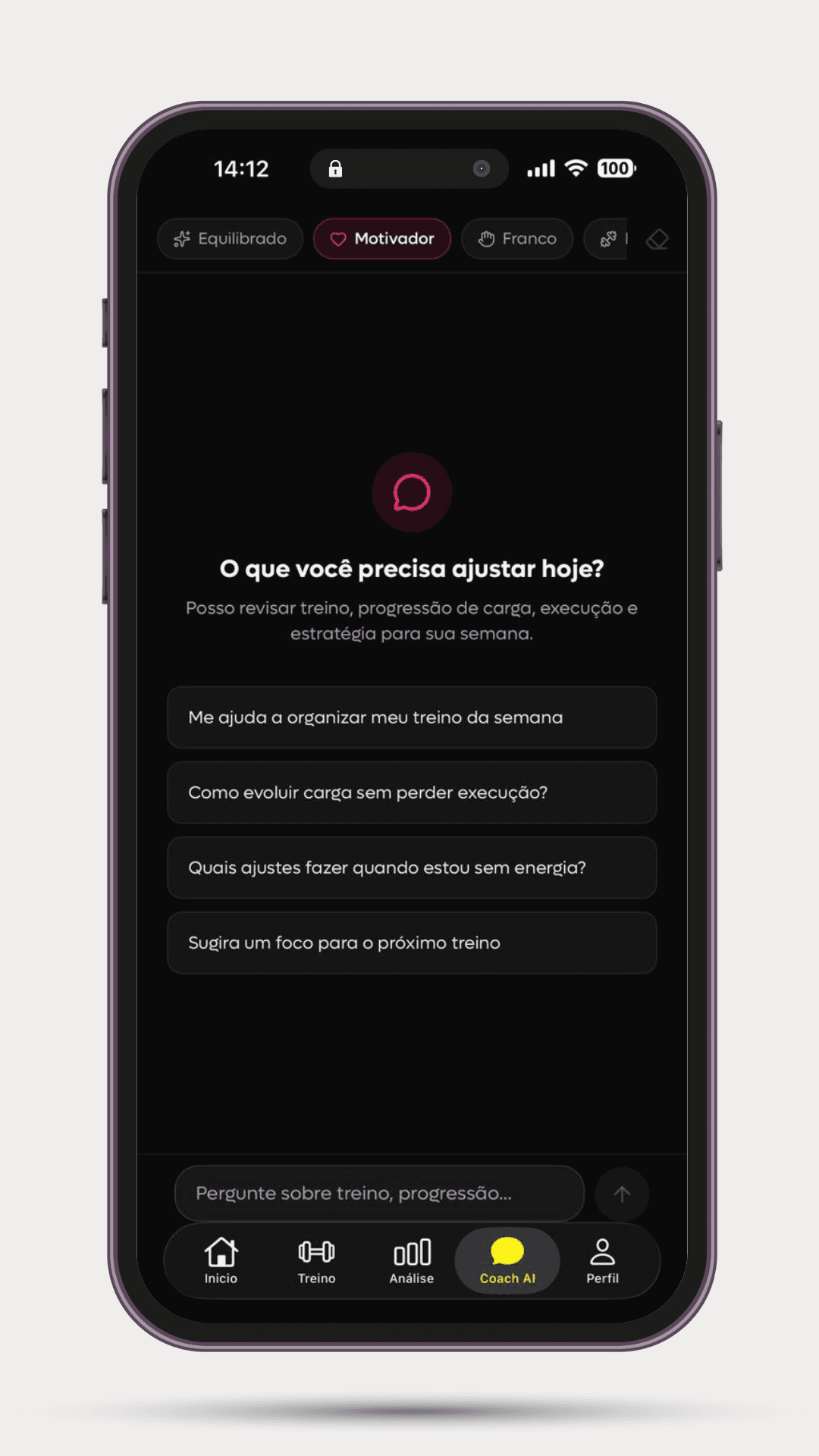
AI Coach can help interpret adjustments within the active plan, and history shows what happened in your sessions. For the full workflow, read how to use SelfShapeAI.
Common tempo mistakes
- Assuming slower repetitions always produce more hypertrophy.
- Counting seconds while ignoring range, movement path or pain.
- Letting the weight drop and calling it a fast eccentric phase.
- Using momentum to claim progression that technique cannot support.
- Changing tempo every week and losing your comparison point.
- Adding long pauses without adjusting load, repetitions and recovery.
Tempo is one part of training, not the whole plan. To connect effort, volume and progression, see how to build more muscle and how many sets to perform.
Frequently asked questions
- What is the best tempo for hypertrophy?No single tempo is superior. A practical reference is to control the descent, keep the transition stable and lift with forceful intent while preserving range and technique.
- Do I need to count three seconds on the way down?No. Counting can help with learning or a specific method, but evidence shows no clear hypertrophy advantage from a longer descent. Control and consistency matter more than a rigid number.
- What does 3-1-1 tempo mean?Usually three seconds in one phase, a one-second pause and one second in the next phase. Because conventions vary, the plan should explicitly identify lowering, pausing, lifting and the transition.
- Can I lift explosively?You can intend to accelerate while preserving position and movement path. That does not mean throwing the weight, swinging or losing range.
- Do slow reps increase time under tension?They increase repetition duration but do not guarantee more hypertrophy. They can also reduce load and reps. The outcome depends on tension, effort, range, volume and progression together.
Sources and scientific reading
Studies used in this review
- Source: Effect of Repetition Duration During Resistance Training on Muscle Hypertrophy: A Systematic Review and Meta-Analysis — Sports Medicine
- Source: The Effect of Eccentric Phase Duration on Muscle Hypertrophy in Resistance-Trained Individuals: A Systematic Review and Meta-Analysis — Journal of Strength and Conditioning Research
- Source: Hypertrophic Effects of Concentric vs. Eccentric Muscle Actions: A Systematic Review and Meta-Analysis — Journal of Strength and Conditioning Research
- Source: Effects of Advanced Resistance Training Systems on Muscle Hypertrophy and Strength in Recreationally Trained Adults — Journal of Functional Morphology and Kinesiology
Editorial review by the SelfShapeAI team
Control that makes progress visible
The best tempo lets you challenge the muscle, repeat valid technique and recognize progress. Control does not require slowness; it means knowing what you are comparing.
In SelfShapeAI, execution, effort and progress are part of the same plan. Download SelfShapeAI for free.
Take this method to the app

Create your plan with AI, log check-ins and use the AI Coach to adjust training with context.
Share
SelfShapeAI Team
SelfShapeAI technical and editorial team.
Keep learning

Recommended next article
Range of motion in strength training: full or partial for hypertrophy?
Understand when to use full range, what lengthened partials are and how to distinguish planned technique from cheating a repetition.
Continue →