Range of motion in strength training: full or partial for hypertrophy?
Full range is a strong starting point, while lengthened partials can be useful when planned with purpose, technique and progression.


Which produces more hypertrophy: full or partial repetitions? Full range remains a useful reference, but is not the only valid approach. Recent studies indicate that partials performed in a more lengthened muscle position can also produce good results in specific exercises.
This does not make every short rep an advanced technique. Deliberately choosing a defined portion of movement differs greatly from letting execution shrink as load increases. Understand range of motion and its relationship to partial repetitions before choosing a method.
Contents
- 1. Short answer: use full range as a foundation, not a dogma
- 2. What full range really means
- 3. Why lengthened positions attracted attention
- 4. A planned partial is not a cheated rep
- 5. When full range makes more sense
- 6. When to try lengthened partials
- 7. Practical examples without a universal prescription
- 8. Test it without disrupting progression
- 9. Common range-of-motion mistakes
- 10. Frequently asked questions
- 11. Sources and scientific reading
- 12. The best range remains clear in your plan
Short answer: use full range as a foundation, not a dogma
When full range is controlled, painless and preserves the exercise's purpose, it is a simple, reliable choice. Moving through more of the range develops strength there and avoids having to choose partial start and end points.
Lengthened partials can be a planned variation. They emphasize the region where the target muscle is relatively longer under load. Recent literature is promising, but results depend on muscle, exercise, study design and the range compared. The responsible conclusion is that they can also work, rather than always work better.
| Strategy | How it works | Most appropriate use |
|---|---|---|
| Full range | Covers the exercise's comfortable, controllable range | A training foundation and strength development across a wider range |
| Lengthened partial | Emphasizes the muscle's more lengthened region | A planned variation when the position is stable and tolerable |
| Planned shortened partial | Emphasizes the more shortened muscle position | Specific uses, without general evidence of a hypertrophy advantage |
| Lost range | Movement unintentionally shortens with load or fatigue | A signal to review load, technique, effort or progression criteria |
Turn understanding into a workout you can follow
SelfShapeAI uses your routine and goal to build an explained plan, log every session and guide the next adjustment.




Download for free. Annual: R$ 299,90/year, equivalent to about R$ 25/month; monthly: R$ 39,90/month. See how AI training works.
What full range really means
Full range does not mean forcing every joint to its anatomical limit. It means using the exercise's useful range with intended technique, no substantial compensation and no pain. Body structure, mobility, injury history, equipment setup and movement goals can make it differ between people.
Two people may squat to different depths with good execution. Shoulder position and a comfortable dumbbell-bench path also vary. Range should serve the movement; there is no reward for extra centimeters that disrupt position.
The same applies when choosing machines or free weights. A machine may constrain the path while dumbbells allow freedom. Equipment labels alone do not decide: fit, stability, technique and progression still matter.
Why lengthened positions attracted attention
Some studies found good results from emphasizing longer muscle lengths. This generated interest in long-muscle-length training: exercises or portions where a muscle works relatively lengthened while receiving meaningful tension.
A conceptual example is doing preacher curls near the more extended elbow position instead of limiting them to the top. In a leg curl, the hamstrings' lengthened region depends on the machine and hip position. Do not copy the appearance alone; identify the target muscle and where it is longer in that exercise.
Available review evidence suggests larger ranges are a robust choice and lengthened partials may approach those results. Data are still insufficient to declare a universal advantage. Average effects are small, and regions within the same muscle may respond differently.
A planned partial is not a cheated rep
A planned partial has defined boundaries and a reason. You know the range, maintain it across sets and record the method. Unplanned shortening instead appears as weight increases, reps shrink and other joints compensate, making the logged number look better although the task changed.
- Planned: define the movement range before the set.
- Repeatable: repetitions cover a similar region from beginning to end.
- Comparable: compare load and reps only with sets using the same standard.
- Intentional: have a technical or programming reason for the partial.
- Tolerable: maintain the position without pain or compensations.
Increasing load while range shrinks does not necessarily mean gaining strength in the same exercise. Apply the criteria for increasing load and keep effort comparable using the RPE and RIR guide.
When full range makes more sense
- You are learning the exercise and need a simple technical reference.
- Your goal includes strength across a broad movement range.
- Full range is comfortable, stable and painless.
- You cannot yet maintain a standardized partial range between sets.
- The exercise offers useful tension through the movement and clear progression.
For beginners, fewer decisions can help. A simple plan with stable exercises and consistent range makes technique and progress easier to learn. The path from beginner to results organizes these priorities before adding specialized methods.
When to try lengthened partials
- You know the technique and can identify the target muscle's lengthened region.
- The chosen range stays stable, comfortable and easy to compare between sessions.
- The technique belongs to a planned block, rather than an improvised response to fatigue.
- Load, repetitions and effort will be recorded separately from the full-range version.
- You have time to observe the response without changing the exercise weekly.
Use the variation in dedicated sets or, with experience, a defined part of training. Adding partials after every full-range set is unnecessary and increases fatigue and volume, potentially impairing recovery. Review how many sets build muscle before adding work and preserve the rest of the week's quality.
Practical examples without a universal prescription
| Exercise | Generally lengthened region | Main consideration |
|---|---|---|
| Preacher curl | Near elbow extension | Do not relax or force the joint at the end |
| Cable lateral raise | Arm nearer the torso, depending on cable position | Maintain tension and avoid swinging |
| Seated or lying leg curl | More extended knee; hip position changes muscle length | Align the machine axis and maintain support contact |
| Calf raise | Heel below the support within controlled mobility | Do not bounce at the bottom or seek a painful range |
| Pulldown or assisted pull-up | Arms more elevated with controlled shoulder blades | Do not turn this portion into passive shoulder relaxation |
In leg training, respect knee, hip and trunk stability. In shoulder training, cable position and path affect tension. For pulls and rows, apply back and biceps training principles without confusing extra reach with lost scapular control.
Test it without disrupting progression
Choose one exercise, keep the rest of the plan reasonably stable and write down the range. Log load, repetitions, effort and discomfort. Because full and partial versions travel different paths, treat them as separate variations in your history.
- Define the range using visual landmarks or equipment settings.
- Reduce load if needed: the lengthened position can be demanding with less weight.
- Keep effort comparable: match RIR, beyond repetition count.
- Observe for weeks instead of judging a single session's sensation.
- Stop for pain: persistent joint discomfort warrants professional assessment.
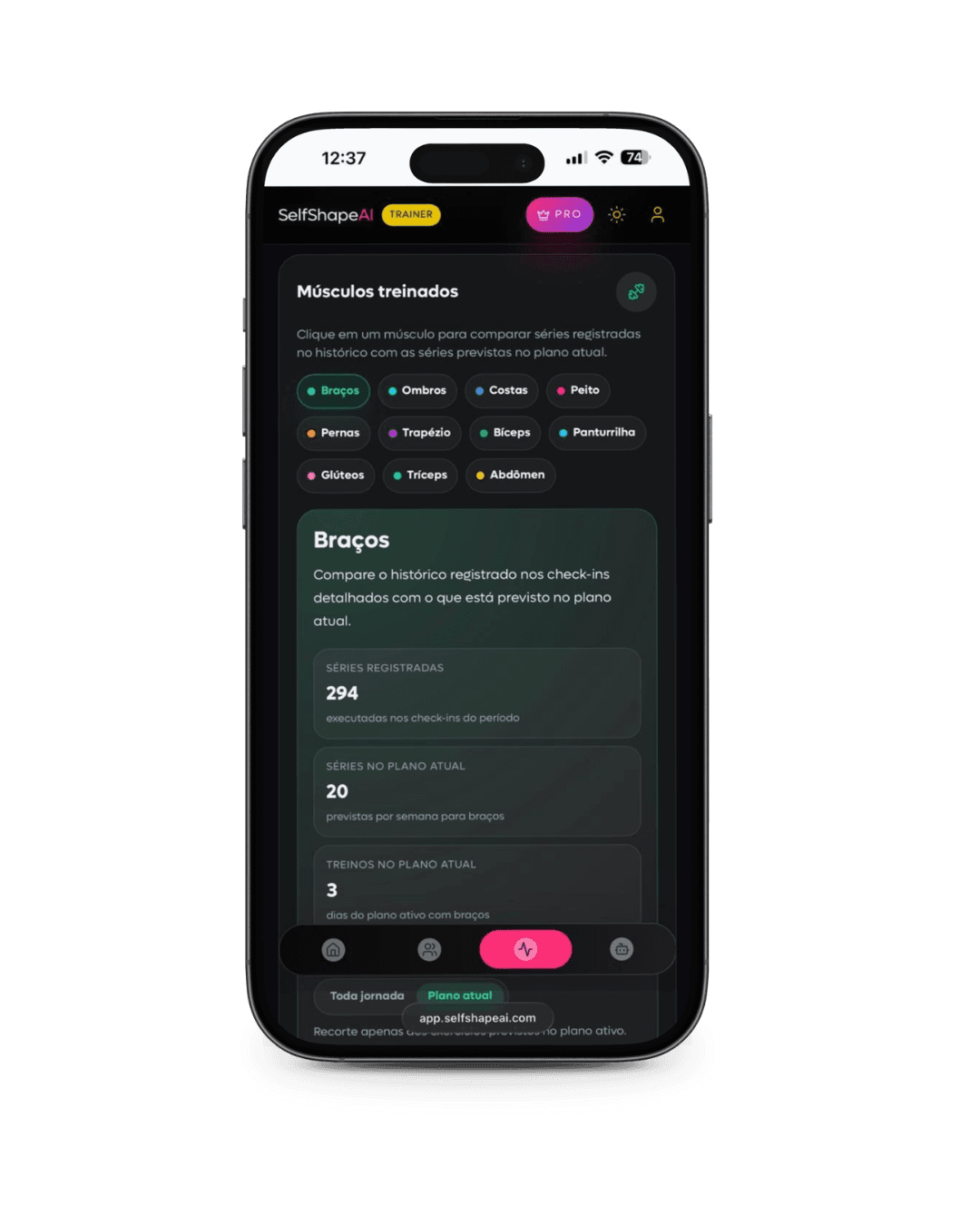
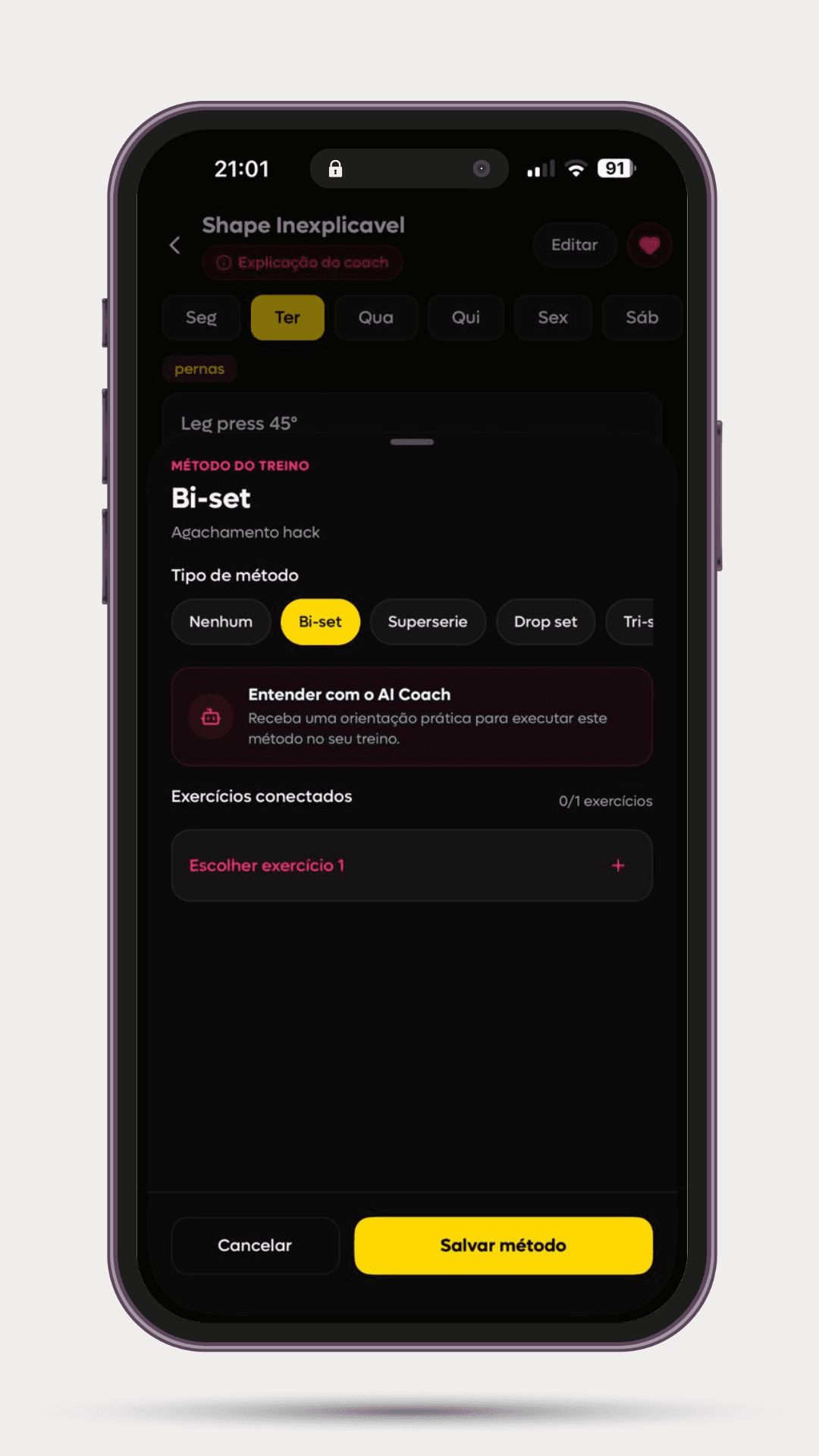
In SelfShapeAI, organize exercises and methods, add technique notes and log load, repetitions and effort after the session. Context, planning and recorded execution help evaluate a technique across a block. Explore AI workout creation, tracking features and how to use SelfShapeAI.
Common range-of-motion mistakes
- Increasing load and shortening reps without recording the change.
- Seeking maximum stretch despite pain or lost stability.
- Copying a partial from another exercise without identifying the muscle's lengthened position.
- Adding techniques to every set and ignoring extra fatigue.
- Changing range every session and then trying to compare performance.
- Using stretch sensation or pump as the sole measure of effectiveness.
Range is one variable among several. Hypertrophy also needs appropriate effort, recoverable volume, progression and consistency. The muscle-building guide connects them; warm-up sets prepare demanding positions without creating early fatigue.
Frequently asked questions
- Is full range always better for hypertrophy?No. It is a robust starting point, but lengthened partials produced similar results in some studies. The best choice depends on exercise, muscle, technique and individual tolerance.
- Are partial reps only for advanced athletes?They are not exclusive to advanced lifters, but need clear range references and good control. Beginners usually benefit from simple, consistent execution before adding variations.
- Can I do partials after reaching full-range failure?It is possible, but increases effort, fatigue and set volume. It need not be a rule and should be planned with attention to technique and recovery.
- Less range allows more weight. Does that mean more tension?Not necessarily. Leverage and distance change, making weight-only comparisons misleading. Execution, the region trained and effort must remain comparable.
- How do I know my range is appropriate?Look for a comfortable, controlled, repeatable range where the target muscle participates without substantial compensation. Record your technique or seek professional assessment if unsure, especially with pain.
Sources and scientific reading
Studies used in this review
- Source: Partial Vs Full Range of Motion Resistance Training: A Systematic Review and Meta-Analysis — International Universities Strength and Conditioning Association
- Source: Lengthened partial repetitions elicit similar muscular adaptations as full range of motion repetitions during resistance training in trained individuals — PubMed
- Source: Full versus lengthened partial biceps brachii range of motion training and regional hypertrophy — PubMed
- Source: Does Muscle Length Influence Regional Hypertrophy? A Systematic Review and Multilevel Meta-Analysis — PubMed
Editorial review by the SelfShapeAI team
The best range remains clear in your plan
Full range and lengthened partials need no absolute winner. Full range organizes the foundation; partials can be useful when there is a reason, a reference and tracking. Unnoticed technique changes disguised as progress are the problem.
In SelfShapeAI, your context comes before the plan, the plan clarifies intent and each session informs the next adjustment. Download SelfShapeAI for free.
Take this method to the app

Create your plan with AI, log check-ins and use the AI Coach to adjust training with context.
Share
SelfShapeAI Team
SelfShapeAI technical and editorial team.
Keep learning

Recommended next article
Machines or free weights for hypertrophy: what actually changes?
Learn when machines, dumbbells and barbells make sense for hypertrophy and how to combine them without turning preference into a rule.
Continue →