Rest between sets: how long for muscle growth and strength?
For hypertrophy, around two minutes is a useful starting point, but exercise, load and performance loss tell you when to rest more or less.


How long should you rest between sets? For hypertrophy, start with about two minutes. Use two to three minutes for compound exercises or demanding sets and one to two minutes for stable isolation movements. If repetitions or technique decline more than expected, increase the interval.
This is more useful than insisting hypertrophy requires 30, 60 or 90 seconds. Rest between sets is there to restore enough performance for the next set, not to create a burning sensation. Shortening the clock changes training density, but does not guarantee a better muscular stimulus.
Contents
- 1. Short answer: use the clock as a reference, not a verdict
- 2. Why short rests can reduce the next set's stimulus
- 3. Rest for hypertrophy: preserve productive sets
- 4. Rest for strength: more time often protects quality
- 5. Compound and isolation exercises do not need identical rest
- 6. How to tell whether you have recovered enough
- 7. When deliberately shorter rests make sense
- 8. A simple protocol for finding your rest interval
- 9. Turn the interval into information, rather than a habit
- 10. Common rest-interval mistakes
- 11. Frequently asked questions
- 12. Sources and scientific reading
- 13. Rest enough to give the next set a purpose
Short answer: use the clock as a reference, not a verdict
A 2024 meta-analysis found a small hypertrophy benefit from intervals longer than 60 seconds. Above 90 seconds, however, it detected no appreciable differences between durations. This does not prove 91 seconds is ideal or that longer rest is useless; the effect lies on a continuum and depends on how rest changes the work you can perform.
In practice, two minutes is a simple anchor. Increase the interval as load, complexity, proximity to muscular failure or loss of repetitions rises. It can decrease when an exercise is stable, less demanding and performance stays on target.
| Context | Starting point | What to watch |
|---|---|---|
| Strength in a heavy compound exercise | 3 to 5 minutes | Speed, technique and the ability to repeat heavy loads |
| Hypertrophy in a compound exercise | 2 to 3 minutes | Planned repetitions and effort in subsequent sets |
| Hypertrophy in an isolation exercise or stable machine | 1 to 2 minutes | Loss of repetitions and target-muscle involvement |
| Warm-up set or technique practice | Enough to feel ready | No unnecessary fatigue before the working set |
| Superset or high-density technique | Defined by the method | Time savings without losing the exercises' purpose |
Turn understanding into a workout you can follow
SelfShapeAI uses your routine and goal to build an explained plan, log every session and guide the next adjustment.




Download for free. Annual: R$ 299,90/year, equivalent to about R$ 25/month; monthly: R$ 39,90/month. See how AI training works.
Why short rests can reduce the next set's stimulus
Starting too soon can cost repetitions, force a load reduction or change technique before the target muscle gets its planned work. A session may feel more intense because your heart rate and muscle burn rise, but feeling challenged is not the same as accumulating more useful training volume.
In a trial with trained men, three-minute rests produced greater strength gains and some larger hypertrophy measures than one-minute rests. With only 21 participants, it should not become a universal rule. It does challenge the idea that short rest is necessarily better for growth.
Another experiment, in young women performing five leg-press sets, found more volume with three minutes than with one. Two and three minutes did not differ on that measure. The practical lesson is contextual: longer rest tends to help until performance is sufficiently restored.
Rest for hypertrophy: preserve productive sets
For hypertrophy, rest needs to let you accumulate challenging sets with repeatable technique. If the first set ends at 10 reps with 2 RIR and the next falls to six unexpectedly, rest may have been too short. Before adding work, review how many sets to build muscle and distinguish sets on paper from truly productive ones.
The closer you get to your limit, the greater the usual recovery demand. The article on training to muscular failure explains why zero RIR can cost more in subsequent sets. If you are still calibrating effort, use the practical RPE and RIR guide to compare the intended set with what happened.
Rest for strength: more time often protects quality
Heavy sets require high force output and technical control. Three to five minutes is often a more appropriate range, especially for heavy squats, presses, deadlifts and rows. The goal is to begin the next attempt able to handle the planned load safely, rather than letting yourself cool down.
Rest must also fit the structure. In 5x5 training, rushing between sets can turn a strength exercise into a conditioning test. For a curl or lateral raise, however, five minutes often adds little and unnecessarily lengthens the session.
Compound and isolation exercises do not need identical rest
Compound exercises involve more muscle mass, coordination and stabilization. With heavy loads, they usually require longer intervals. Isolation movements on machines or cables tend to allow shorter recovery, particularly when reaching failure creates no technical or safety problem.
This does not mean every machine needs 60 seconds or every free-weight exercise needs five minutes. The comparison of machines and free weights for hypertrophy shows how stability and goals change a set's demands. Load, repetition range, range of motion and experience still matter.
- Increase rest when the load is heavy and technique requires concentration.
- Increase it when near-failure sets cause excessive declines in later sets.
- Gradually reduce it in stable exercises if performance remains intact.
- Do not use the same number out of habit for every exercise.
- Keep rest comparable when evaluating progression over several weeks.
How to tell whether you have recovered enough
Normal breathing helps, but is not the only signal. You can catch your breath without being ready to repeat the load and repetitions. Useful recovery means you can get into position, stabilize the movement and reasonably expect the next set to stay within its target.
- Your breathing lets you organize your position and technique.
- Acute discomfort from the previous set no longer dominates your attention.
- You can repeat the movement without deliberately shortening its range.
- Expected load and repetitions match the set's goal.
- Performance declines in previous sets have stayed within the expected pattern.
Keeping range of motion and lifting tempo relatively consistent makes this assessment more honest. If you compensate for short rests with shorter or faster reps, load and repetition counts no longer tell the same story.
When deliberately shorter rests make sense
Short rest is not a mistake when it is part of the method. Supersets can save time by alternating well-chosen exercises. Drop sets extend a set through load reductions, while myo-reps use micro-rests to concentrate work close to failure.
In these cases, extra fatigue is deliberate. The mistake is rushing every set without recognizing that the workout's goal has changed. Density techniques suit particular contexts; they do not replace full intervals when preserving strength, technique or performance is the priority.
A simple protocol for finding your rest interval
- Start with two minutes for conventional hypertrophy sets.
- Use two to three minutes for compounds and one to two for isolation exercises as initial ranges.
- Log load, repetitions, RIR and any relevant technique changes.
- Add 30 to 60 seconds if performance falls more than planned.
- Reduce rest only if the next set still meets its target with good technique.
- Keep the adjustment for several sessions before judging whether it worked.
Preparatory sets serve a different purpose: get you ready without causing early fatigue. The warm-up sets guide separates preparation from working sets. Pair consistent intervals with clear criteria for when to increase load so you do not confuse rushing with a plateau.
Turn the interval into information, rather than a habit
You do not need to time every second forever. A stopwatch provides a reference; your log shows whether it works. If otherwise similar sets have very different outcomes, review rest, effort and execution before concluding you lost strength. Progressive overload requires reasonably consistent comparisons.
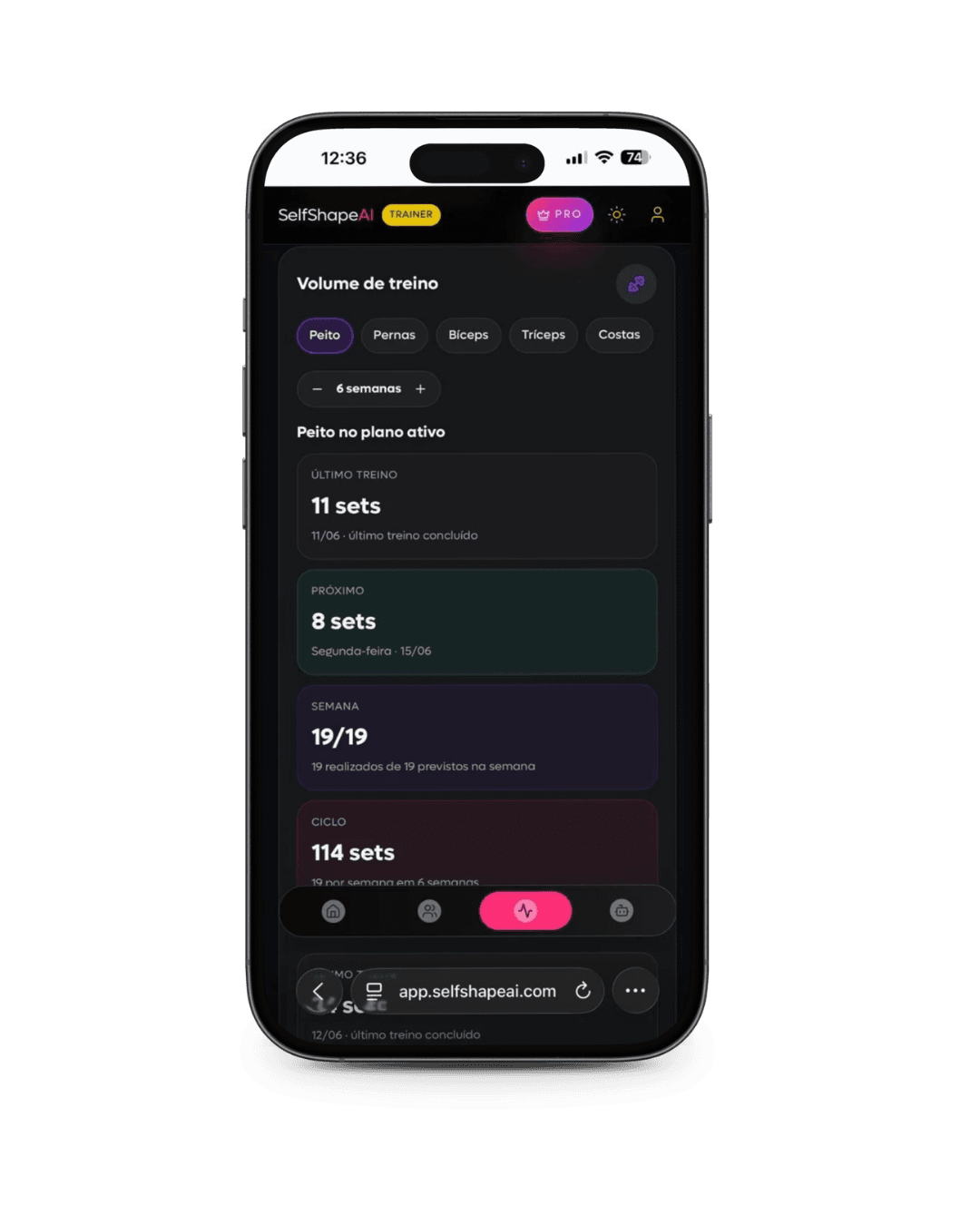
In SelfShapeAI, start with your context, organize your plan and log load, repetitions, perceived effort and notes during the session. Progress insights then help you see whether training is advancing or just accumulating fatigue. Explore AI workout creation, tracking features and how to use SelfShapeAI.
Common rest-interval mistakes
- Assuming more sweat and breathlessness automatically mean more hypertrophy.
- Using 60 seconds for every exercise because it sounds like a muscle-building rule.
- Resting too little, losing repetitions and compensating with indiscriminate extra sets.
- Resting so long that you lose focus, equipment or rhythm without a performance benefit.
- Changing rest every session and then comparing loads as though the context were identical.
- Timing rest while ignoring technique, RIR and recovery across the week.
Rest is a planning variable, not a test of discipline. The best workout distributes effort and recovery to sustain good weeks, rather than merely returning you to the bar fastest. To organize the whole picture, see how to build more muscle.
Frequently asked questions
- Is one minute enough rest for hypertrophy?It may be enough for stable, less demanding or isolation exercises when repetitions and technique stay on target. For compounds and near-failure sets, one minute often reduces performance more.
- Are two or three minutes better for muscle growth?Two minutes is a good starting point. Three may help for compounds, heavy loads or persistent performance drops. Evidence does not establish one superior interval for every person and exercise.
- Does resting five minutes hurt hypertrophy?Not by itself. Five minutes may preserve performance in heavy sets. The cost is a longer session and potentially lost focus; use it when it genuinely improves the next set.
- Do I need a stopwatch for every set?Not necessarily. It helps maintain consistency and notice unintentionally short or long intervals. With experience, you can combine it with readiness and performance signals.
- Does rest change when I train to failure?Usually. Failure sets create more fatigue and may require longer intervals to preserve the next set. It is also worth considering whether failure was necessary for that exercise.
- Can I rest while changing plates or setting up another exercise?Yes. Setup time counts toward the interval, provided you can begin the next set with the intended position, technique and effort. In supersets, consider each muscle's recovery, beyond total elapsed time.
Sources and scientific reading
Studies used in this review
- Source: Give it a rest: a systematic review with Bayesian meta-analysis on the effect of inter-set rest interval duration on muscle hypertrophy — Frontiers in Sports and Active Living
- Source: Longer Interset Rest Periods Enhance Muscle Strength and Hypertrophy in Resistance-Trained Men — Journal of Strength and Conditioning Research
- Source: The effects of short versus long inter-set rest intervals in resistance training on measures of muscle hypertrophy: A systematic review — European Journal of Sport Science
- Source: Does rest interval between sets affect resistance training volume, density, and rating of perceived exertion in young women? — Journal of Sports Medicine and Physical Fitness
- Source: Short inter-set rest blunts resistance exercise-induced increases in myofibrillar protein synthesis and intracellular signalling in young males — Experimental Physiology
Editorial review by the SelfShapeAI team
Rest enough to give the next set a purpose
The ideal interval is neither the shortest you can tolerate nor the longest that fits the session. It preserves the next set's purpose without turning training into waiting. Start with a simple range, observe performance and adjust based on your sessions.
In SelfShapeAI, context comes before the plan, the plan makes its logic clear and each workout informs the next adjustment. Download SelfShapeAI for free.
Take this method to the app

Create your plan with AI, log check-ins and use the AI Coach to adjust training with context.
Share
SelfShapeAI Team
SelfShapeAI technical and editorial team.
Keep learning

Recommended next article
How many sets to build muscle? How to get your volume right without overshooting or falling short
Find out how many sets make sense for hypertrophy, how to think about weekly volume per muscle and how to adjust the right dose without overdoing it or training below what you need.
Continue →