Machines or free weights for hypertrophy: what actually changes?
Both can build muscle. The useful choice depends on the exercise, stability, experience and the purpose of your training block.

Which builds more muscle: machines or free weights? The question often becomes a rivalry, as if barbells meant serious training and machines were only for beginners. Available evidence points to a less dramatic, more useful answer: both can work very well for hypertrophy.
Equipment does not work alone. Results depend on the tension an exercise permits, repeatable technique, set effort, progression over weeks and recovery. Explore these foundations in how to build more muscle, when to increase load and the RPE and RIR guide.
Ask which option best serves that exercise's role in your plan, considering goals, experience, limitations, availability and preference, rather than which equipment wins.
Contents
- 1. Short answer: both work for hypertrophy
- 2. What machines do well
- 3. What free weights do well
- 4. Stability helps but does not decide everything
- 5. Choose according to your goal
- 6. Examples of coherent combinations
- 7. How to tell whether your choice works
- 8. Frequently asked questions
- 9. Sources and scientific reading
- 10. Choose by function, evaluate by results
Short answer: both work for hypertrophy
Meta-analyses and controlled studies found similar muscle growth in machine and free-weight programs. This does not make every exercise interchangeable or every machine suitable for everyone. It means there is no strong basis for declaring either modality universally superior for muscle growth.
For strength in a specific movement, the picture changes. Practicing barbell bench press tends to improve that lift most; training chest press improves that guided pattern. Specificity matters for competition, one-rep-max testing or mastering a skill. For general hypertrophy, accumulated stimulus quality matters more than the equipment's name.
| Criterion | Machines | Free weights |
|---|---|---|
| Path | More guided and predictable | Freer and more dependent on your control |
| Stability | Generally higher | Require more stabilization and coordination |
| Versatility | Depends on available machines | Many variations with little equipment |
| Progression | Simple weight-stack adjustments | Plates and small increments can be used |
| Specific strength | Greater transfer to the trained guided movement | Greater transfer to the trained free-weight lift |
| Best use | When stability helps direct effort | When freedom, skill and access matter more |
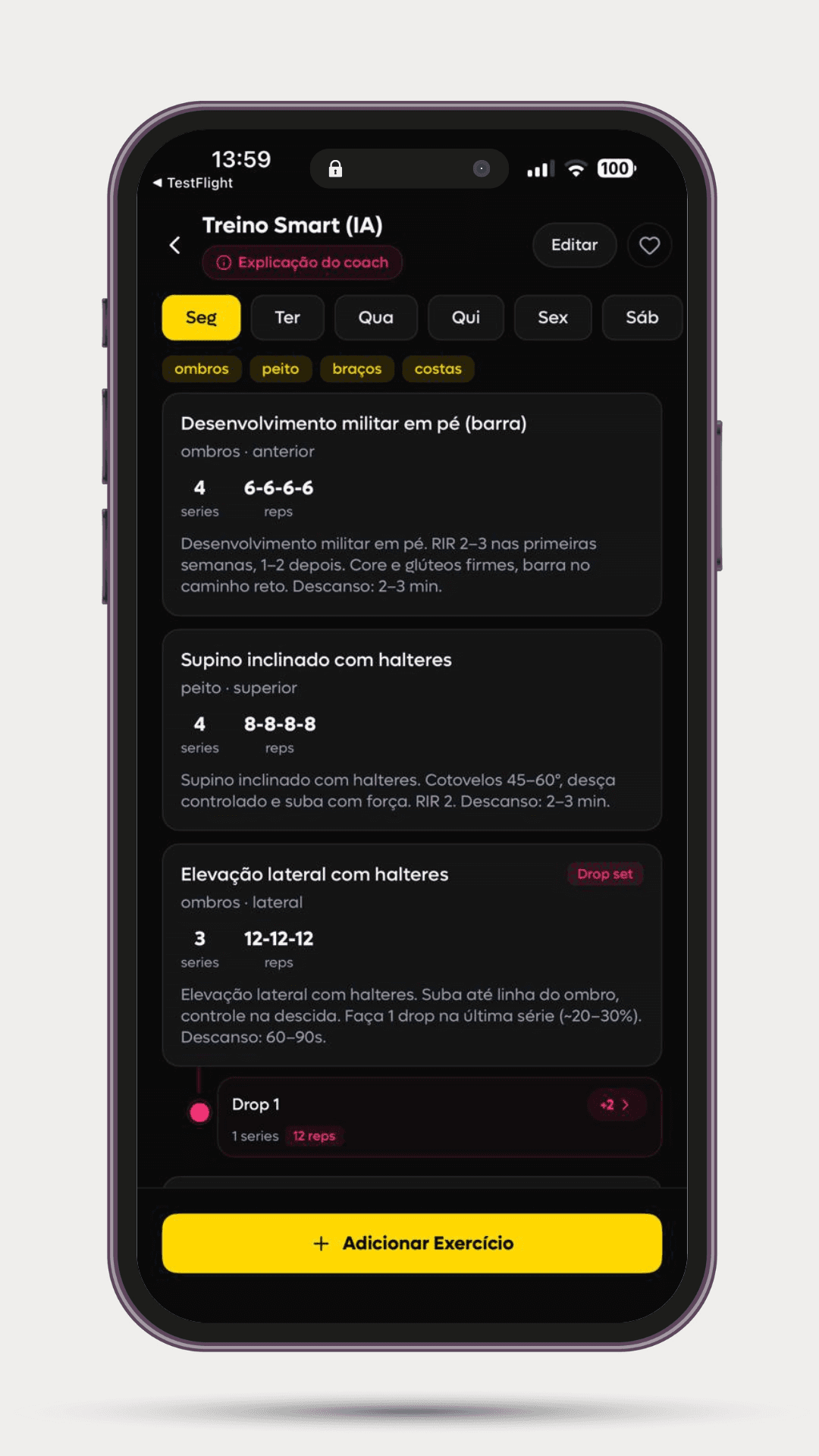
Turn understanding into a workout you can follow
SelfShapeAI uses your routine and goal to build an explained plan, log every session and guide the next adjustment.




Download for free. Annual: R$ 299,90/year, equivalent to about R$ 25/month; monthly: R$ 39,90/month. See how AI training works.
What machines do well
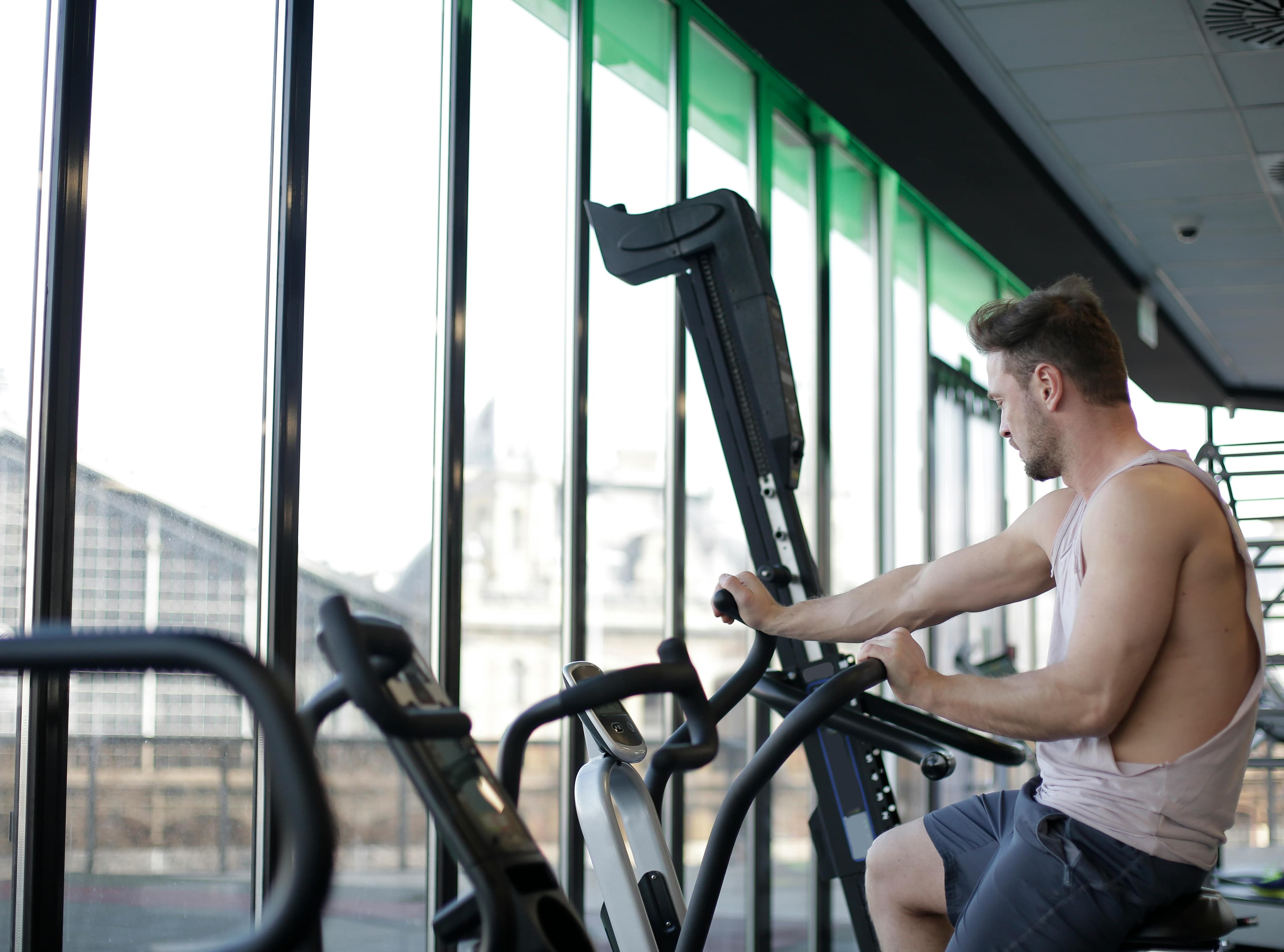
Machines mainly reduce degrees of freedom. A guided path reduces some need to balance the implement, leaving more attention for force production. When stabilization limits a set before the intended muscle, that can be a practical advantage.
- A predictable path can make technique easier to repeat between sets.
- Load adjustments are usually quick, useful in a busy gym or techniques such as supersets.
- Some machines let you approach your limit without having to return a barbell to a rack.
- Stability may direct effort when balance or coordination would otherwise be the bottleneck.
- Well-chosen substitutions can maintain a stimulus when there is discomfort or a free-weight movement does not suit your structure.
Not every machine is automatically comfortable or safe. Its axis, backrest, range and your body proportions must fit. A forced path causing pain, severely reduced range or poor position may make it unsuitable. Persistent pain warrants professional assessment, rather than pushing through.
What free weights do well
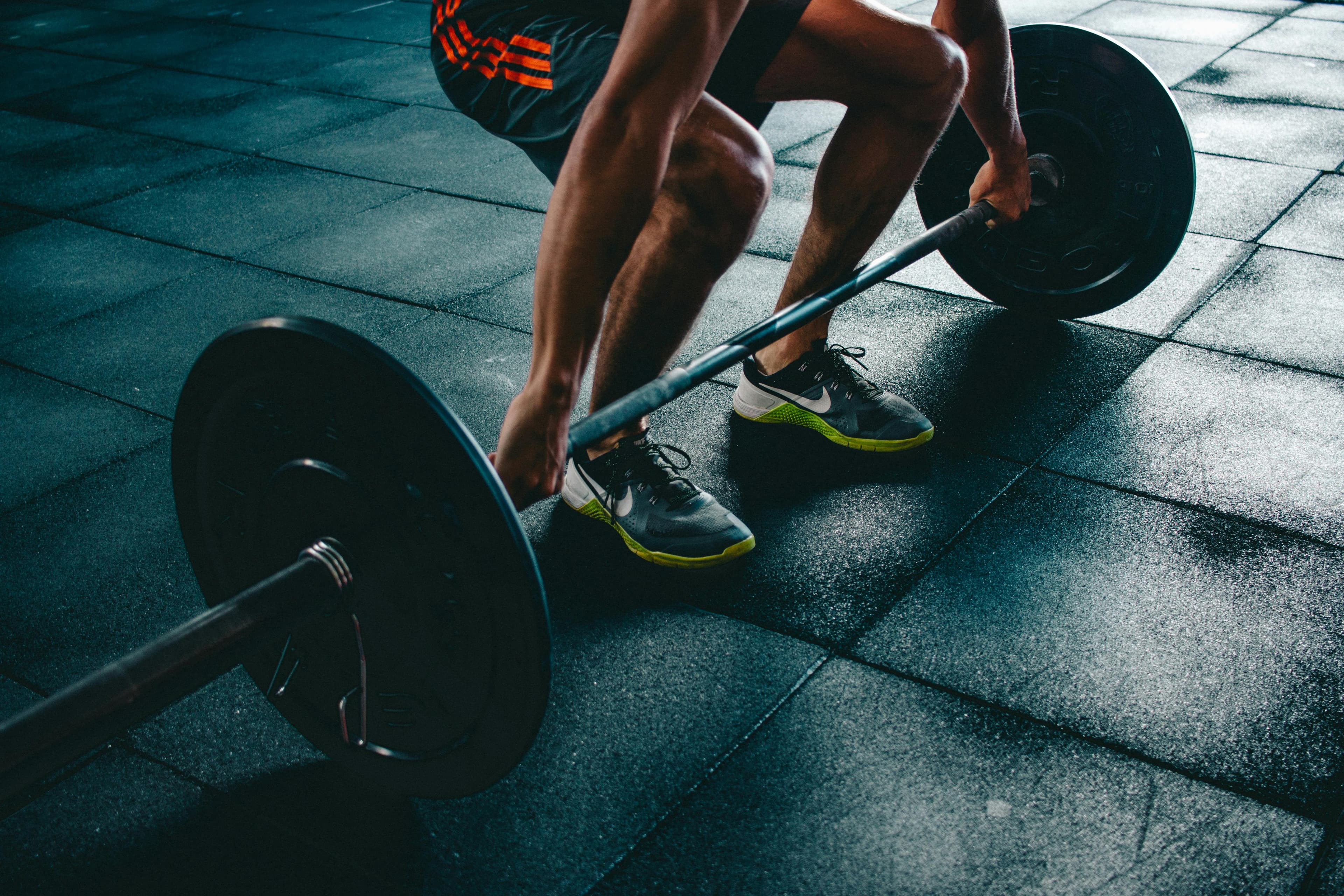
Barbells, dumbbells and kettlebells allow more freedom in the movement path. That raises coordination and stabilization demands while allowing more independent adjustment of position and grip. Versatility can be decisive for home training or small gyms.
- Limited equipment can train the whole body, from a full-body workout to a split routine.
- A free path may better suit someone who does not fit a particular machine's geometry.
- Free-weight movements develop the specific skill of controlling that lift.
- Dumbbells allow independent sides and different grips.
- If your goal is barbell or dumbbell strength, practicing those movements is essential.
The trade-off is that technique and stability may limit the set. That changes learning demands and programming, rather than making the exercise bad. Well-dosed preparatory sets help; see how to perform warm-up sets without wasting energy before the main work.
Stability helps but does not decide everything
More stability can make target-muscle force production easier, but alone does not guarantee more hypertrophy. Comfortable range, progression, effort, recoverable volume and adherence still count. A stable machine you avoid, cannot adjust or dislike is unlikely to beat a free-weight exercise you perform well for months.
Stability also differs from absolute rigidity. Dumbbell bench press uses free weights but provides substantial support. A unilateral machine exercise may demand meaningful trunk control. Observe where the exercise challenges you and whether that challenge fits the set's purpose.
Choose according to your goal
For hypertrophy, seek exercises with comfortable range, planned effort and progression that does not make every rep a balance struggle. Total volume must fit recovery; the guide to how many sets build muscle helps assess weekly dosage.
- To learn a lift, prioritize the specific version you want to master.
- To direct effort to a muscle, try the option where technique and stability do not end the set too early.
- With limited equipment, use free weights and substitutions that preserve the movement pattern.
- To add work after a demanding exercise, a machine may simplify subsequent sets.
- For adherence, consider what you enjoy, can access and repeat confidently.
Choices also vary by region. In leg training, squats, leg presses and hack squats can serve different roles. In shoulder training, dumbbells, cables and machines offer different profiles. Apply the back and biceps training logic: function first, preference next, labels last.
Examples of coherent combinations
| Session focus | Free weight | Machine or cable |
|---|---|---|
| Chest | Barbell or dumbbell bench press | Chest press or machine fly |
| Quadriceps | Squat or lunge | Hack squat, leg press or leg extension |
| Back | Dumbbell row | Pulldown or guided row |
| Shoulders | Dumbbell overhead press | Cable or machine lateral raise |
| Hamstrings | Romanian deadlift | Lying or seated leg curl |
A common approach puts the most skill- and concentration-demanding movement first, then uses stable exercises to complete volume. This order is not compulsory; muscle priorities or limitations may call for another structure. The same principle applies to upper-body exercises and lower-chest training.
How to tell whether your choice works
Do not judge an exercise by one day's pump. Look across weeks: is technique more consistent? Have reps or load increased? Does the target muscle limit the set? Is recovery good? Is discomfort growing? Without a log, assessment becomes selective memory.
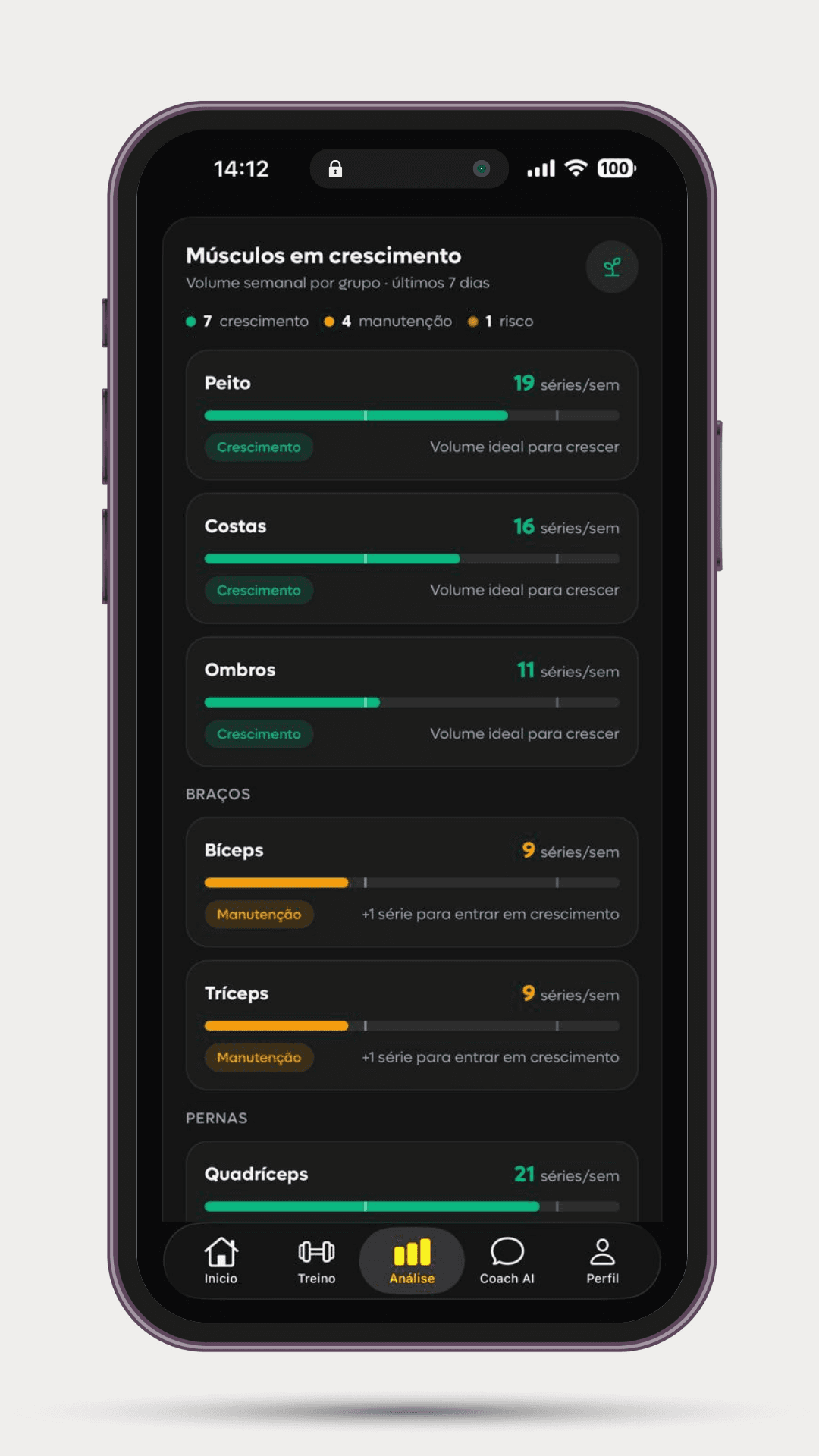
SelfShapeAI connects the plan with load, repetitions, effort and progress logs. Switching from a barbell to a machine, or back again, becomes an observable decision rather than improvisation. Explore AI workout creation, tracking features or how to use SelfShapeAI.
Frequently asked questions
- Can machines build as much muscle as free weights?Yes. Comparative studies and meta-analyses found similar hypertrophy when other variables were well controlled. That makes both valid tools, without making all exercises equivalent.
- Must beginners start only on machines?No. Machines can reduce initial complexity, while free weights teach useful skills. A simple combination with guidance and gradual progression often works well.
- Do free weights activate more stabilizing muscles?In many movements, greater freedom increases stabilization demands. That may help skill and control, but does not automatically prove greater growth of your priority muscle.
- Can I train entirely with machines?Yes, particularly for hypertrophy when available machines fit you well. Variety, preference and desired skills may still justify including free weights.
- Is a Smith machine a free weight?No. Its bar follows a guided path, so it is a machine. That does not make it inherently better or worse; movement fit and its role in the plan remain the criteria.
Sources and scientific reading
Studies used in this review
- Source: Effect of free-weight vs. machine-based strength training on maximal strength, hypertrophy and jump performance: systematic review and meta-analysis — BMC Sports Science, Medicine and Rehabilitation
- Source: Free-Weight and Machine-Based Training Are Equally Effective on Strength and Hypertrophy: Challenging a Traditional Myth — Medicine & Science in Sports & Exercise
- Source: Comparable regional hypertrophy of the knee extensor muscles in response to resistance training with machines versus free weights — Journal of Bodywork and Movement Therapies
Editorial review by the SelfShapeAI team
Choose by function, evaluate by results
Machines and free weights can coexist because they solve different problems. A sound choice comes from the exercise's goal, your execution and the accumulated response to training, rather than tradition or loyalty.
In SelfShapeAI, context comes before the plan: organize training, log what happened and track progress to adjust with clarity. Download SelfShapeAI for free.
Take this method to the app

Create your plan with AI, log check-ins and use the AI Coach to adjust training with context.
Share
SelfShapeAI Team
SelfShapeAI technical and editorial team.
Keep learning
Recommended next article
Range of motion in strength training: full or partial for hypertrophy?
Understand when to use full range, what lengthened partials are and how to distinguish planned technique from cheating a repetition.
Continue →