Upper/lower split: what it is, how to build it and when this split makes sense
Understand how the upper/lower works, who it tends to suit and how SelfShapeAI helps adjust this structure to your context.

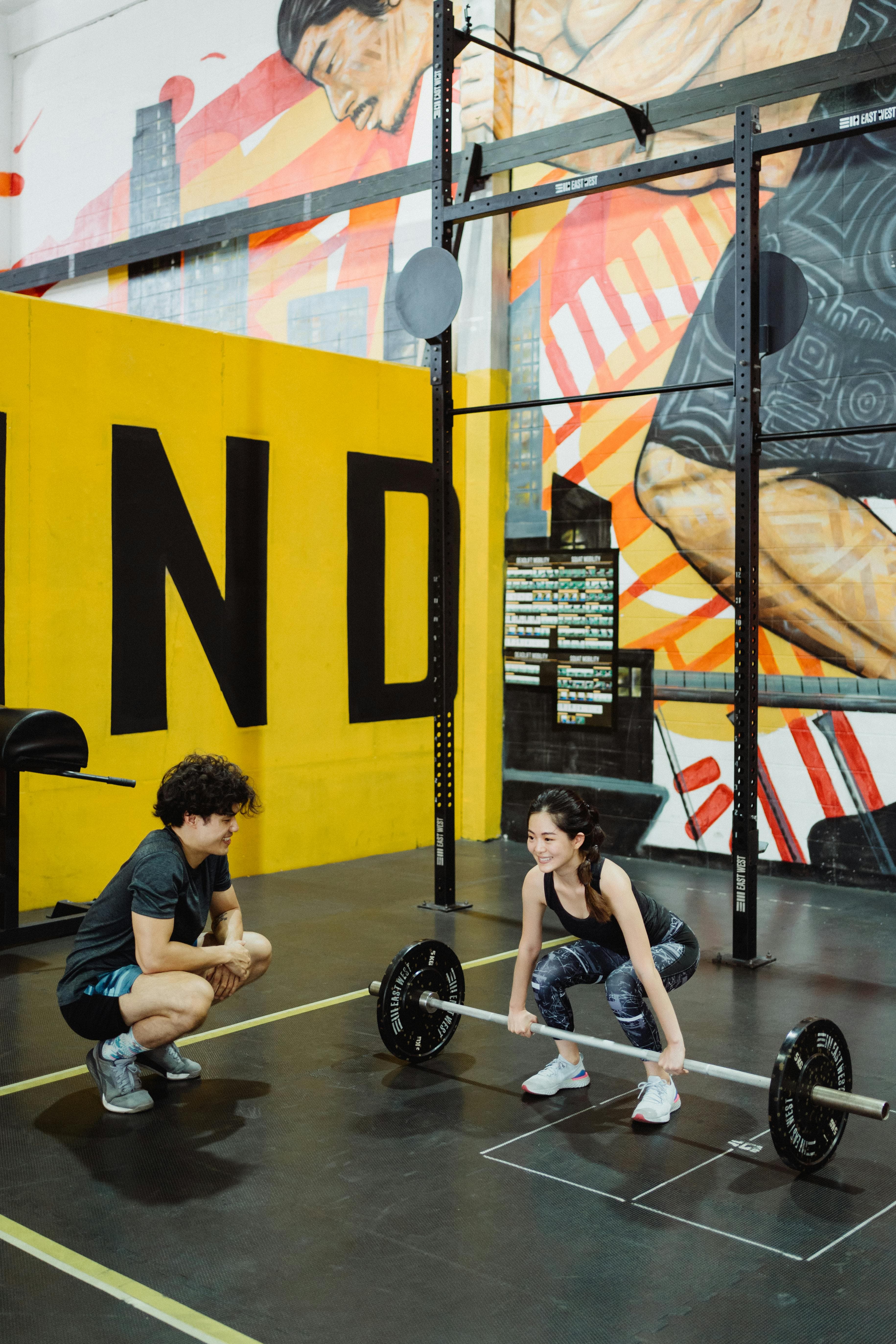
The upper/lower split is a very useful, sustainable way to organize gym training. Instead of separating the week by isolated muscles, you divide workouts between upper body and lower body. That usually allows good per-group frequency, well-distributed volume and a routine that is much easier to sustain over the months.
This is why upper/lower remains popular. Four days provide two weekly opportunities to distribute each half's work without six gym visits. That does not make it inherently superior: when total volume is equal, research does not show a meaningful hypertrophy advantage from frequency or split type alone. Its value is practical fit and set quality. Compare Full body or split and Three-day training split.
In SelfShapeAI, the logic is understanding when an upper/lower makes sense for your routine, your recovery and your goal, and then turning that into a clearer, adjustable plan that stays readable across the weeks — the approach behind AI training.
Contents
- 1. What is the upper/lower split?
- 2. Main advantages of the upper/lower
- 3. 1. Better distribution of weekly volume
- 4. 2. Balance between training and recovery
- 5. 3. Flexibility for different routines
- 6. 4. Great for progression
- 7. Who is the upper/lower for?
- 8. Beginners
- 9. Intermediates
- 10. Advanced lifters
- 11. The classic structure: upper/lower 4x per week
- 12. An upper/lower workout example adapted to SelfShapeAI
- 13. Upper 1
- 14. Lower 1
- 15. Upper 2
- 16. Lower 2
- 17. How to warm up before the workouts
- 18. Before upper
- 19. Before lower
- 20. Rest between sets
- 21. Other ways to build the upper/lower
- 22. Upper/lower on 2 days
- 23. Upper/lower on 3 days
- 24. Upper/lower on 5 days
- 25. Upper/lower on 6 days
- 26. Hybrid model: PPL + upper/lower
- 27. Benefits of the upper/lower in practice
- 28. Is there a downside?
- 29. How to progress on the upper/lower
- 30. Upper/lower or full body?
- 31. Upper/lower or PPL?
- 32. Upper/lower or bro split?
- 33. How long until you see results?
- 34. How to use the upper/lower more intelligently in SelfShapeAI
What is the upper/lower split?
The upper/lower split organizes the week into two types of session: upper for the upper body and lower for the lower body. The classic format is 4 workouts per week, normally with two upper days and two lower days.
- Monday: upper.
- Tuesday: lower.
- Thursday: upper.
- Friday: lower.
This model divides each half's weekly volume across two sessions. You practice important patterns regularly, compare performance and avoid concentrating all of a muscle's sets into one day. Frequency organizes work rather than independently accelerating growth. For a more fragmented split, review Bro split.
Turn understanding into a workout you can follow
SelfShapeAI uses your routine and goal to build an explained plan, log every session and guide the next adjustment.




Download for free. Annual: R$ 299,90/year, equivalent to about R$ 25/month; monthly: R$ 39,90/month. See how AI training works.
Main advantages of the upper/lower
1. Better distribution of weekly volume
- Divide each group's sets across two days.
- Important exercises come before excessive session fatigue.
- It is easier to see whether the second session maintains or improves performance.
This logic connects directly with training volume and hypertrophy in the glossary.
2. Balance between training and recovery
Training four times weekly can be sustainable for beginners, intermediate and advanced lifters when the dose fits their level. Upper/lower creates recovery intervals between sessions for the same half and room to distribute volume. If performance repeatedly falls in the second upper or lower session, review volume, exercise order, effort, sleep and rest before adding work.
3. Flexibility for different routines
Not everyone can train four days every week. One of this split's qualities is that it can also be adapted to 2, 3, 5 or even 6 days, depending on availability and level.
4. Great for progression
The upper/lower works very well with simple progression: keep the exercises for several weeks, hit the rep target with good execution and then add load. That fits perfectly with progressive overload and the RPE and reps in reserve rulers.
Who is the upper/lower for?
The short answer is: for many people, as long as the version matches your level.
Beginners
Beginners can use upper/lower, especially with four short sessions. With only two weekly days, however, one upper and one lower train each half just once; two full-body sessions usually offer more movement practice and more even distribution. Preference, session length and tolerance can still affect the choice. See From beginner to results.
Intermediates
Here is the audience that tends to benefit most from the upper/lower. The 4-day version fits very well for anyone who has been training for a while and wants to progress with organization.
Advanced lifters
More experienced lifters can use the upper/lower with more volume, more stimulus variations or even hybrid models with 5 or 6 weekly sessions, as long as recovery keeps up.
The classic structure: upper/lower 4x per week
- Monday: upper 1.
- Tuesday: lower 1.
- Thursday: upper 2.
- Friday: lower 2.
This arrangement trains each half twice regularly with at least 48 hours between similar sessions. The two upper or lower sessions need not be identical: one upper can start with pushing, the other pulling; one lower can prioritize knees, the other hips. Count weekly volume and exercise overlap. Compare another four-day structure in Four-day training split.
An upper/lower workout example adapted to SelfShapeAI
A practical version can look like this:
Upper 1
- Flat barbell bench press.
- Bent-over barbell row.
- Dumbbell shoulder press.
- Front lat pulldown.
- Cable fly.
- Dumbbell curl.
- Overhead dumbbell triceps extension.
- Face pull.
Lower 1
- Back squat.
- Lying leg curl or glute ham raise.
- Dumbbell lunge.
- Leg curl.
- Standing calf raise.
Upper 2
- Pull-up or lat pulldown.
- Incline dumbbell press.
- Machine shoulder press.
- Straight-arm pulldown.
- Push-ups.
- EZ-bar curl.
- Triceps kickback or rope pushdown.
Lower 2
- Leg press.
- Romanian deadlift.
- Leg extension.
- Seated calf raise.
- Cable crunch or weighted abs.
This list maps movement patterns, not a universal prescription. Upper 1 includes eight exercises; multiple sets of all eight would make sessions long and reduce later-set quality for many people. Start with recoverable volume, count indirect arm and shoulder work and add sets only when your records show a need. See how context becomes an active plan in AI training.
How to warm up before the workouts
Before upper
- 5 minutes of treadmill, bike or jump rope.
- Shoulder, scapula and elbow mobility.
- 2 to 4 warm-up sets on the first main movement.
Before lower
- 5 minutes of light cardio.
- Hip, knee and ankle mobility.
- Progressive warm-up sets on the squat, leg press or Romanian deadlift.
No need to reinvent anything. You need to arrive prepared. For that, revisit warm-up sets in the glossary.
Rest between sets
The smartest logic is not resting a fixed time without thinking. The ideal is resting enough to keep the planned performance in the following sets.
- Heavy compound exercises: 2 to 4 minutes.
- Isolation: 1 to 2 minutes.
- Calves, abs and accessories: 45 to 90 seconds.
Use a timer if helpful, but let performance recovery guide you: start the next set when you can repeat the planned technique and effort. Read Rest between sets and How to get stronger with SelfShapeAI.
Other ways to build the upper/lower
Upper/lower on 2 days
It can suit people who adhere better to separate sessions, but each half receives only one weekly session. With two days to develop the whole body, two full-body workouts usually distribute practice and volume better. Two-day upper/lower is a contextual alternative, not an ideal reduced version for everyone.
Upper/lower on 3 days
Continue the sequence: upper, lower, upper; next week, lower, upper, lower. Opportunities balance across two weeks. Always restarting with the same Monday session gives one half more work. Another option is full body plus upper plus lower, training the whole body first and retaining two specific sessions.
Upper/lower on 5 days
Use a continuous sequence or a four-day structure with one priority session. The fifth workout should not automatically increase volume: redistribute existing work first and use the extra session for a recovered priority area. A hybrid may be clearer. Compare Five-day training split.
Upper/lower on 6 days
Alternating upper and lower for six days creates three sessions per half. This can distribute high weekly volume but does not require or justify more sets by itself. Check session productivity, muscle and joint recovery, and whether three lower sessions affect life outside the gym. Four days is simpler to sustain for most people.
Hybrid model: PPL + upper/lower
- Monday: push.
- Tuesday: pull.
- Wednesday: legs.
- Thursday: upper.
- Friday: lower.
This can suit people who want five sessions with more specific identities. However, push and pull also train muscles used again on upper day, so count indirect volume and consider day order. Combining models does not automatically deliver only their advantages.
Benefits of the upper/lower in practice
- Better volume distribution through the week.
- More set quality by reducing local exhaustion in a single session.
- More consistency because it is an easy split to understand and repeat.
- A good pairing with load progression by repeating exercises at a useful frequency.
- A good reading of adherence, execution and recovery when training is logged.
In SelfShapeAI, this split can get even stronger because you can organize the days clearly, track loads, reps and progress, and adjust the plan based on training feedback.
Is there a downside?
- Upper workouts can run long if the volume is exaggerated.
- The split demands some organization to keep the week's sequence.
- It may not be the best choice in phases of extreme focus on one specific muscle group.
Anyone who wants extreme focus on a specific muscle group may prefer, at some moments, splits with more specialization. If that is your case, compare with the bro split.
How to progress on the upper/lower
A simple, very efficient approach is rep-range progression. You keep the same load until you hit the top of the range in all sets with good execution. When that happens, add a little load and restart the process.
- Base example: bench press for 3 sets of 6 to 10 reps.
- Week 1: 10 / 8 / 7.
- Week 2: 10 / 9 / 8.
- Week 3: 10 / 10 / 9.
- Week 4: 10 / 10 / 10.
- Week 5: add load and return to something like 8 / 7 / 6.
It is simple, objective and works very well. To go deeper on this reasoning, the most useful complements are progressive overload and the RPE scale.
Upper/lower or full body?
Full body often fits two or three days and upper/lower four, but that is an organizational guide, not a results ranking. A 2024 meta-analysis found similar strength and hypertrophy gains with split and full-body routines when volume was matched. Choose the distribution that keeps sessions productive and fits your schedule. See Full body or split.
Upper/lower or PPL?
The upper/lower is usually simpler to organize. PPL can be interesting for anyone who likes training more days and separating movement patterns better. To see this in context, also cross with the push/pull/legs guide and the 5-day workout split.
Upper/lower or bro split?
The upper/lower tends to deliver higher per-group frequency, which for many people is a more practical way to distribute the week's volume. On the other hand, the bro split may please those who like total focus on one muscle per day. To compare that more classic side, review the bro split.
How long until you see results?
Upper/lower has no specific results timeline. Performance may improve before visible changes; pace depends on starting point, productive volume, effort, nutrition, sleep and consistency. Compare several-week blocks using consistent criteria rather than judging one session or its pump.
In SelfShapeAI, that gets clearer because you can observe progress not only in the mirror, but also in the history of loads, volume and plan adherence.
How to use the upper/lower more intelligently in SelfShapeAI
In SelfShapeAI, the upper/lower stops being just a split and becomes a more readable training system. At the start of the process, weekly frequency enters as real context, which helps the split be born aligned with your schedule instead of an idealized routine. From there, the plan can be created with AI, adjusted or built more manually, always with room for extra context and methodology preference.
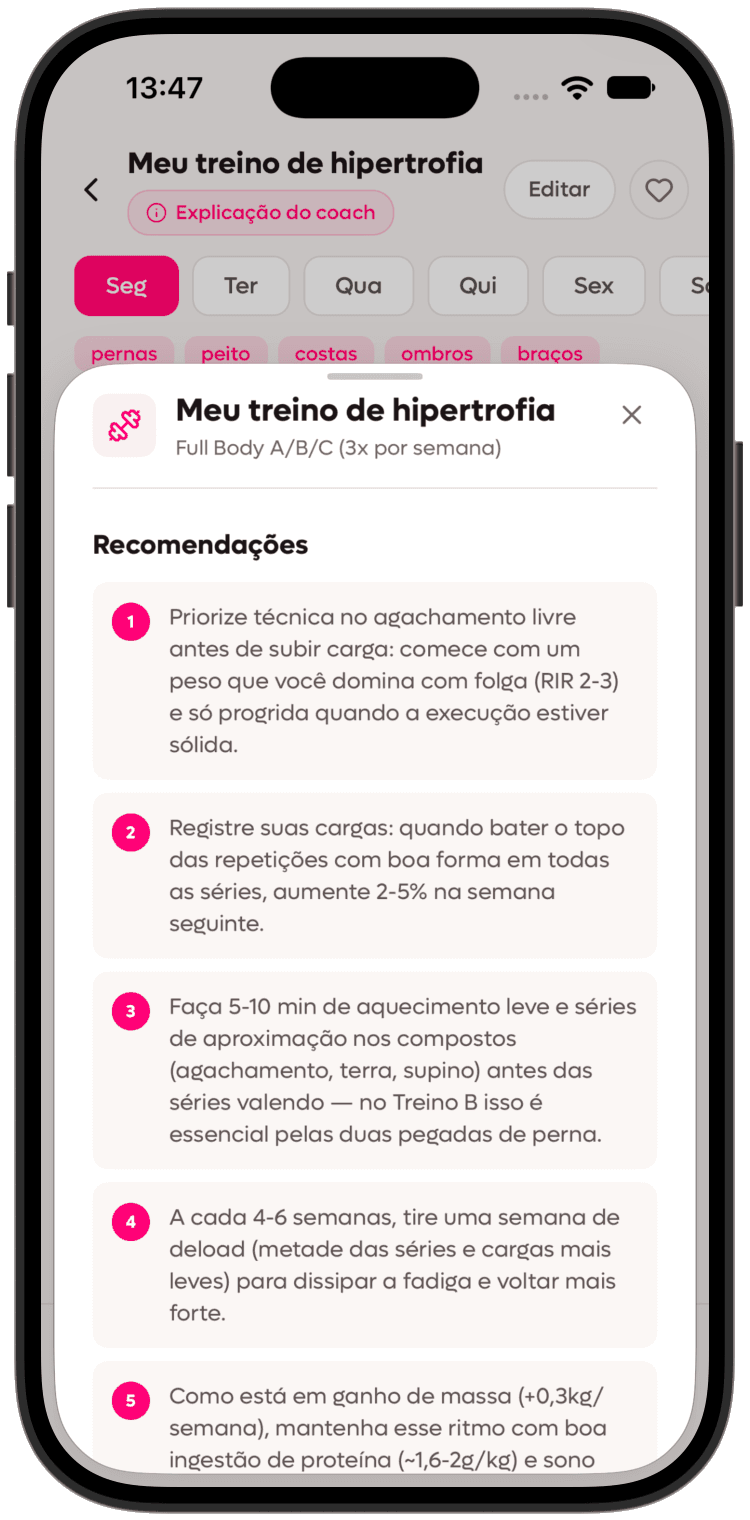
Once the plan is born, the plan explanation shows the chosen split, explains the days' logic and delivers recommendations. That is especially useful on the upper/lower, because this split's quality depends heavily on understanding how the uppers and lowers talk to each other and how the volume was distributed. To see this proposal applied, also visit features.
The next layer is execution. In SelfShapeAI, you can log weights, reps and session notes in the check-in. In an upper/lower, that matters because the split repeats patterns often enough for progress to become more readable. Without logging, you lose exactly one of the model's biggest advantages.
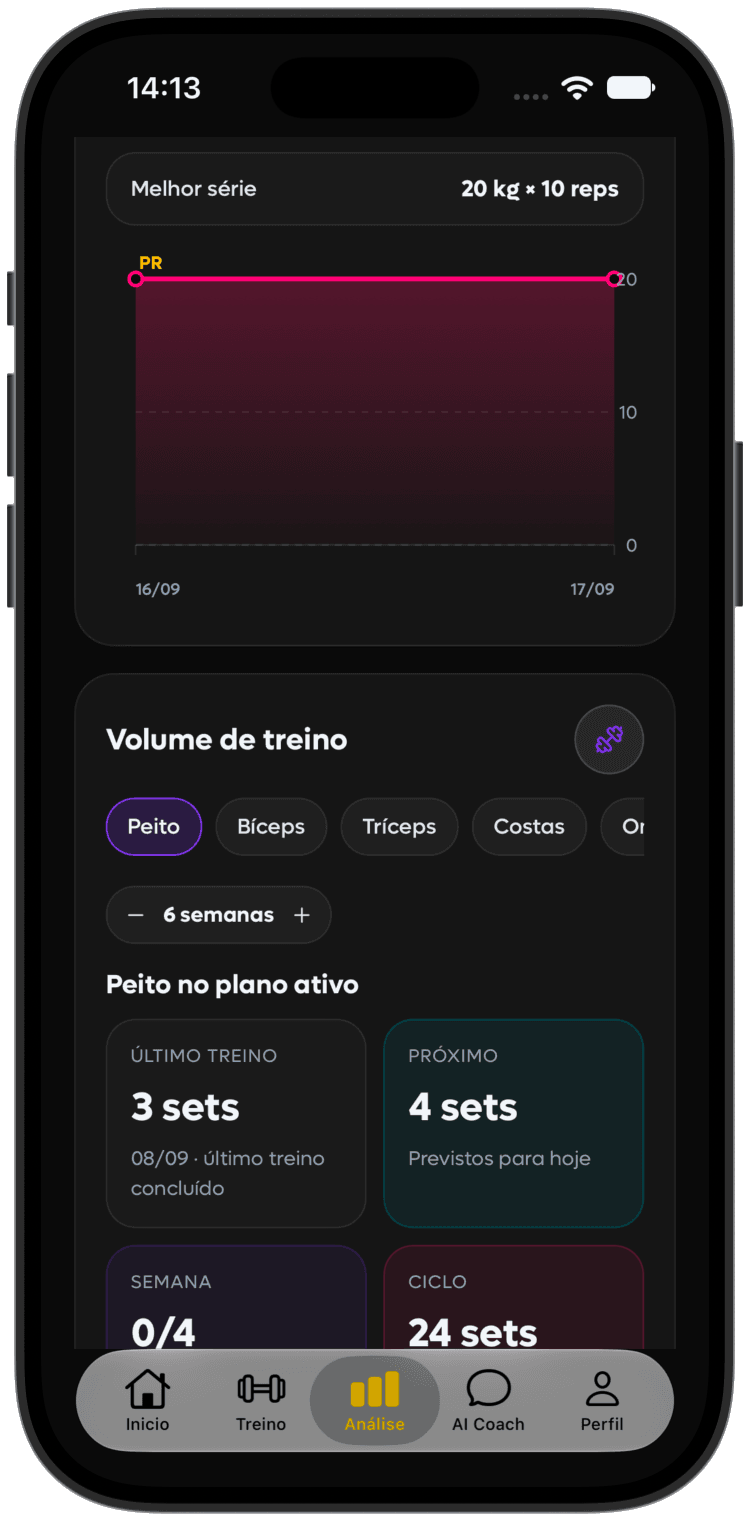
Then comes the training analysis. It is where SelfShapeAI helps you see frequency, most-trained muscle groups, load progress, max weight per session, planned versus performed sets and a short AI insight. That reading answers very practical questions: is my upper running long because the split is bad or because the volume is exaggerated? Is my lower really delivering or does it just feel heavy? Am I progressing on the bench, row, squat and Romanian deadlift or just repeating sessions?
The AI Coach steps in when the week goes off track. If you miss a workout, need to swap an exercise or reorganize the week's focus, the idea is not to dismantle everything. The idea is to adapt with criteria, keeping coherence between upper and lower.
Finally, the plan library helps a lot for anyone using this split across different phases of their routine. You can keep a 4x upper/lower as the main structure, a 3x version for busy weeks or even a hybrid for specific phases without losing history or organization. To understand the ecosystem around this, it also makes sense to check Pricing.
- What is the upper/lower split?It is a training split that separates the days between upper body and lower body. The most common version is done 4 times a week.
- When should I do cardio in an upper/lower routine?It depends on priorities and recovery. Cardio can follow lifting, happen at another time or on a day without resistance training. Avoid doses that repeatedly reduce lower-body performance or impair recovery.
- Is the upper/lower good for beginners?It can be, especially four days with modest volume. With only two available days, beginners generally get more movement practice from two full-body workouts than one upper and one lower. Compare From beginner to results.
- Upper/lower or bro split: when does each make more sense?It depends on the context. The upper/lower usually fits better when the priority is per-group frequency and a more predictable week. The bro split can make more sense when someone prefers total focus on one muscle per session — see the bro split guide.
- Which workout should come first in the week: upper or lower?Both can work. In general, start with what matters most for your current goal. If legs are the priority, start with lower. If chest, back and shoulders are the priority, start with upper.
Upper/lower is useful for consistent frequency, a clear week and room to progress. It makes sense when it fits your schedule, goal and recovery. Explore AI training, see the features, compare Pricing and open SelfShapeAI to put it into practice.
Sources and references
- Source: Schoenfeld BJ, Grgic J, Krieger J. How many times per week should a muscle be trained to maximize muscle hypertrophy? A systematic review and meta-analysis. J Sports Sci, 2019. — Journal of Sports Sciences (PubMed)
- Source: Ramos-Campo DJ et al. Efficacy of split versus full-body resistance training on strength and muscle growth: a systematic review with meta-analysis. J Strength Cond Res, 2024. — Journal of Strength and Conditioning Research (PubMed)
- Source: Currier BS et al. Resistance training prescription for muscle function, hypertrophy, and physical performance in healthy adults: ACSM position stand. Med Sci Sports Exerc, 2026. — American College of Sports Medicine (PubMed)
Reviewed by the SelfShapeAI research team using strength-training guidelines and studies.
Take this method to the app

Create your plan with AI, log check-ins and use the AI Coach to adjust training with context.
Share
SelfShapeAI Team
SelfShapeAI technical and editorial team.
Keep learning

Recommended next article
Three-day hypertrophy training: splits, volume and examples
Build a three-day hypertrophy plan, compare common splits and distribute volume, effort and recovery in context.
Continue →