Upper body exercises: how to build an upper-body workout to gain muscle and strength
Understand how to balance pushing and pulling, choose the right exercises, organize the session order and use SelfShapeAI to track your progress with more clarity.

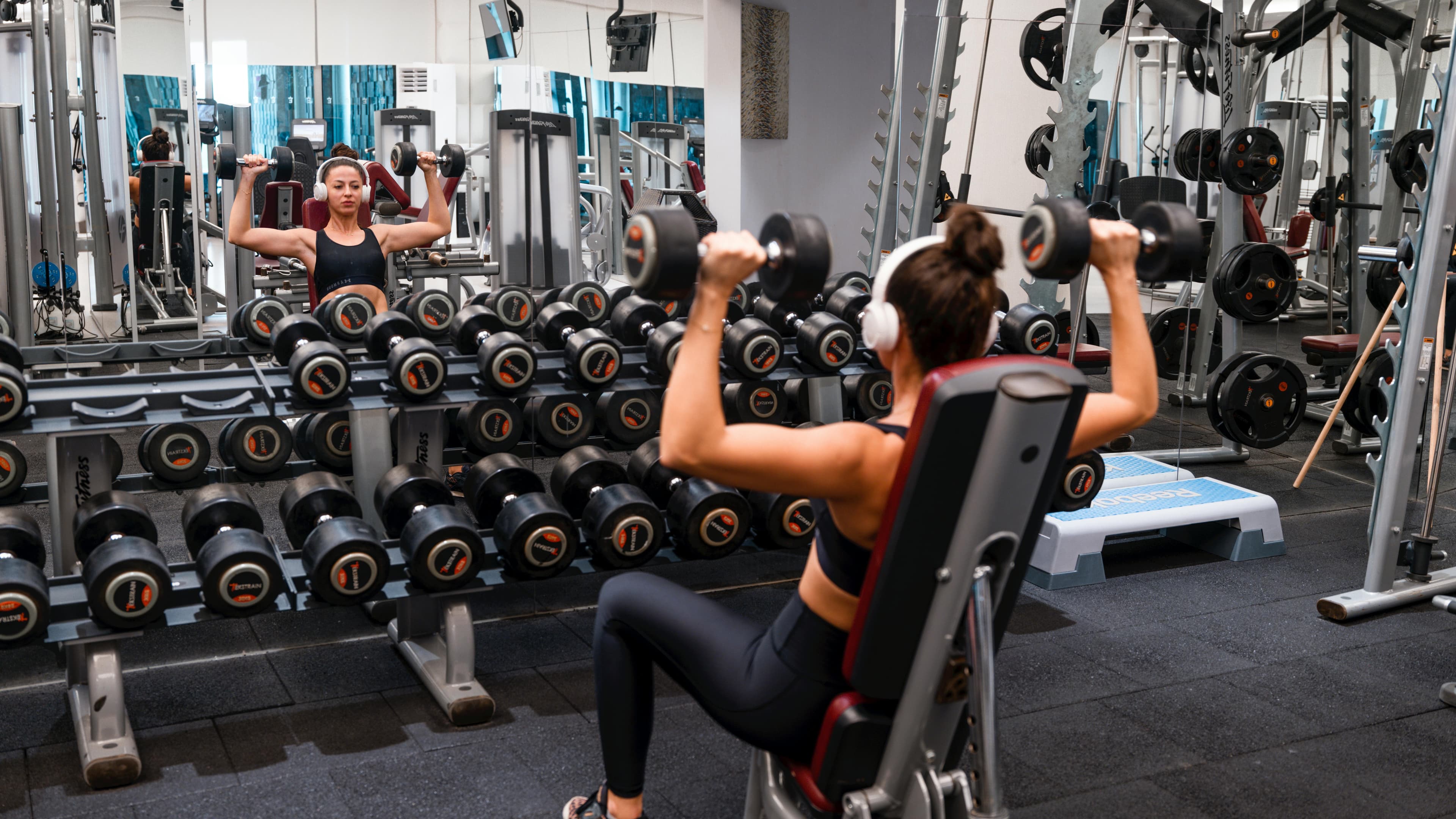
If you have been training for a while, you have probably noticed one thing: doing random exercises for the upper body is not what builds a strong physique. You can feel a pump, tire the arm and leave the gym with a sense of a full workout. But that is not the same as building results.
A well-built upper-body workout is not just about chest, shoulders or arms. It is about understanding how the upper body works in an integrated way, combining stimuli that make sense and repeating that logic for weeks with real progression. That is exactly what separates someone who just "trains upper body" from someone who actually builds muscle and strength. If you are still deciding how to organize the week, cross this text with Full body vs. split training, Upper/lower split and Push/pull/legs.
In SelfShapeAI, this kind of session gets more useful because the workout is not born as a loose list. It is born with context, an explanation of the logic, execution logging and a real reading of what is happening across the weeks. To understand this proposal better, also open Intelligent AI-powered training, What is SelfShapeAI and How to use SelfShapeAI.
Contents
- 1. What really defines an upper-body workout
- 2. Why some workouts work and others do not
- 3. The base: compound exercises
- 4. The refinement: isolation exercises
- 5. What a well-structured upper-body workout looks like
- 6. A practical upper-body example
- 7. Common mistakes in upper-body training
- 8. 1. Training too much chest and arms, too little back
- 9. 2. Turning the session into an exercise festival
- 10. 3. Starting with isolation moves
- 11. 4. Not progressing anything for weeks
- 12. 5. Ignoring warm-up and session preparation
- 13. How to fit upper body into your routine
- 14. What will actually determine your results
- 15. Where SelfShapeAI comes into all this
- 16. How to notice your upper body is working
- 17. Frequently asked questions
What really defines an upper-body workout
When we talk about upper body, we are talking about a session that involves the whole upper body in an integrated way: chest, back, shoulders and arms. But the most important point is not just which muscles come in. It is how they work together.
Horizontal and vertical pushes and pulls form a useful map, not a mandatory list per session. Each emphasizes different muscles and ranges. No universal push-to-pull ratio guarantees posture or shoulder protection; goals, history, comfort and the week determine dosage. Use the RPE and RIR guide to calibrate effort.
Turn understanding into a workout you can follow
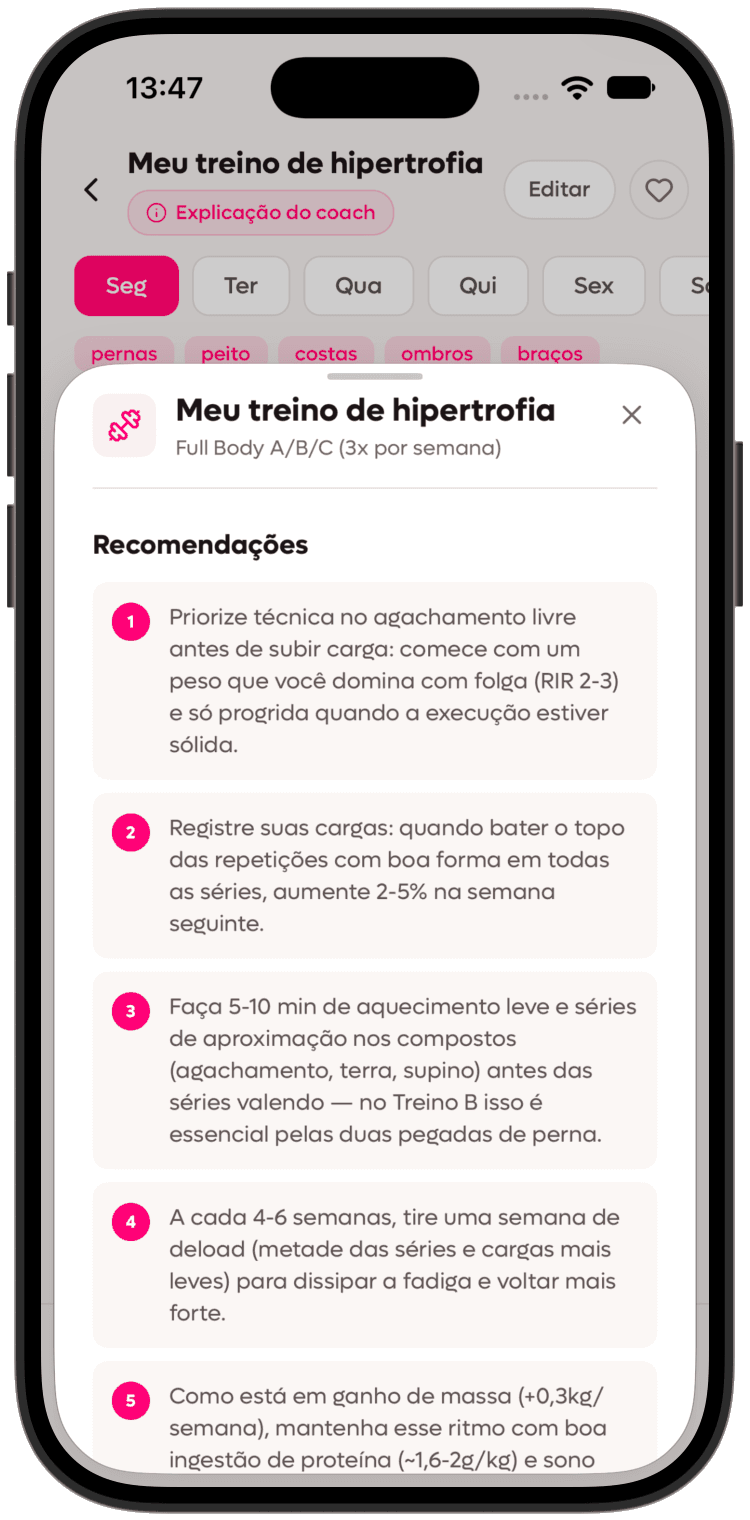
SelfShapeAI uses your routine and goal to build an explained plan, log every session and guide the next adjustment.




Download for free. Annual: R$ 299,90/year, equivalent to about R$ 25/month; monthly: R$ 39,90/month. See how AI training works.
Why some workouts work and others do not
Many people follow a ready-made workout from the internet and then do not understand why they still are not progressing. The problem is almost never an isolated exercise. The problem is usually lack of adaptation.
- Your current level.
- Your recovery capacity.
- Your weekly frequency.
- Your progression over time.
Without that, the session becomes a bunch of "good" exercises thrown into the same day. And a good exercise out of context can still produce a bad workout. That is why today, more than ever, training intelligently makes a difference. Not because the gym changed. But because it became clearer that results come from structure, not improvisation. This reasoning connects very well with How many sets to build muscle and Simple progression: when to add weight.
The base: compound exercises
Compounds train several muscles efficiently when time is limited. They allow progression tracking but require more coordination and can create more fatigue than isolation exercises.
- Flat or incline bench press.
- Bent-over row or machine row.
- Overhead press.
- Lat pulldown or pull-up.
- Chest press and machine pushing variations.
Bench presses, rows, pulls and overhead presses cover substantial muscle mass with few movements. They do not provide all possible hypertrophy work, nor are barbells superior to machines: both can support similar growth. For specific exercise strength, practice that exercise and track it through getting stronger with SelfShapeAI.
The refinement: isolation exercises
Isolation exercises target muscles that compounds may underserve or add dose with lower systemic demand. They need not always come last: priority muscles can appear earlier if compatible with later exercises.
- Lateral raise.
- Chest fly.
- Face pull.
- Barbell or incline curl.
- Rope, overhead or French triceps extension.
Lateral raises, rear-deltoid work, curls and triceps extensions can supplement uneven compound stimulation. Choose by priorities and weekly volume, beyond treating isolation work as mere finishing touches.
What a well-structured upper-body workout looks like
Order should reflect priority. Evidence shows greater strength gains in exercises performed first, whether compound or isolated. Different orders can yield similar hypertrophy, so prioritize the movement whose performance and progression matter most.
- A pushing compound.
- A pulling compound.
- A second complementary push or pull block.
- Shoulder work.
- Finishing with arms or rear delt.
Alternating pushes and pulls can be convenient but is optional. Grouping exercises can also serve priorities. Manage interference: fatigued triceps can limit presses, fatigued biceps can limit pulls and long sessions can reduce later exercise quality.
A practical upper-body example
An upper-body session for hypertrophy and strength might look like this:
- Flat bench press with barbell or dumbbells.
- Bent-over or supported row.
- Lat pulldown or pull-up.
- Overhead press with dumbbells or machine.
- Lateral raise.
- Face pull.
- Barbell curl.
- Rope triceps extension.
This is an illustrative menu, not a requirement to perform eight exercises. Direct and indirect chest, back, shoulder and arm sets must fit weekly volume and available time. Adapt to goals, experience, equipment and tolerance. Compare upper/lower, four-day splits and five-day splits.
Common mistakes in upper-body training
1. Training too much chest and arms, too little back
If back is a goal, always leaving rows and pulls until last may reduce their performance and volume. This does not prove a perfect push-to-pull ratio; order and dose should reflect real priorities.
2. Turning the session into an exercise festival
Upper body does not need twelve exercises to work. When the base is good, the excess usually just reduces quality, hurts progression and turns the session into a workout that is too long.
3. Starting with isolation moves
Starting with arms or deltoids may reduce presses and pulls, but can fit when those muscles are the priority. Decide deliberately which exercise deserves your best performance.
4. Not progressing anything for weeks
A well-built upper body is not the workout that tires you. It is the workout where you can do more with good execution over time. That can show up in load, reps, technique or control. If this point is still unclear, reread Simple progression: when to add weight.
5. Ignoring warm-up and session preparation
Preparatory sets practice the path and prepare working loads without tiring you before productive sets. Review warm-up sets.
How to fit upper body into your routine
Upper-body sessions fit different strategies. Across three days, combine with lower body or full body; across four, form an upper/lower split; other schedules can use adapted PPL or hybrids. Day count alone does not determine the best split.
- Each upper-body muscle needs to get enough stimulus.
- The session cannot become unbalanced.
- Recovery needs to keep up.
- Progression needs to be readable.
If you are starting now and want a simpler structure, also connect this text with From beginner to results and 3-day workout split.
What will actually determine your results
In the end, it is not the isolated exercise that changes everything. It is consistency plus progression.
- Training with good execution.
- Increasing load or reps over time.
- Keeping adequate frequency.
- Not dismantling the session with improvisation.
The problem is that doing this alone, without reading, takes time and error. Sometimes you think the workout is strong, but it is badly distributed. Sometimes you think the problem is lack of chest, when in fact it is lack of pulling, rest or consistency. This kind of reading is what separates a full workout from a useful one.
Where SelfShapeAI comes into all this
Most people still train by trial and error. SelfShapeAI helps reduce that. First, the workout can be born better. Instead of copying a ready-made session without context, you can build a plan from your frequency, goal and available equipment. That matters because a good upper body depends a lot on real fit, not just a nice list of exercises. If you want to understand this start, the best companion remains How to use SelfShapeAI and AI training.
The plan explains movement priority, direct and indirect set distribution and omitted exercises. Order then becomes a contextual decision rather than an unexplained rule.
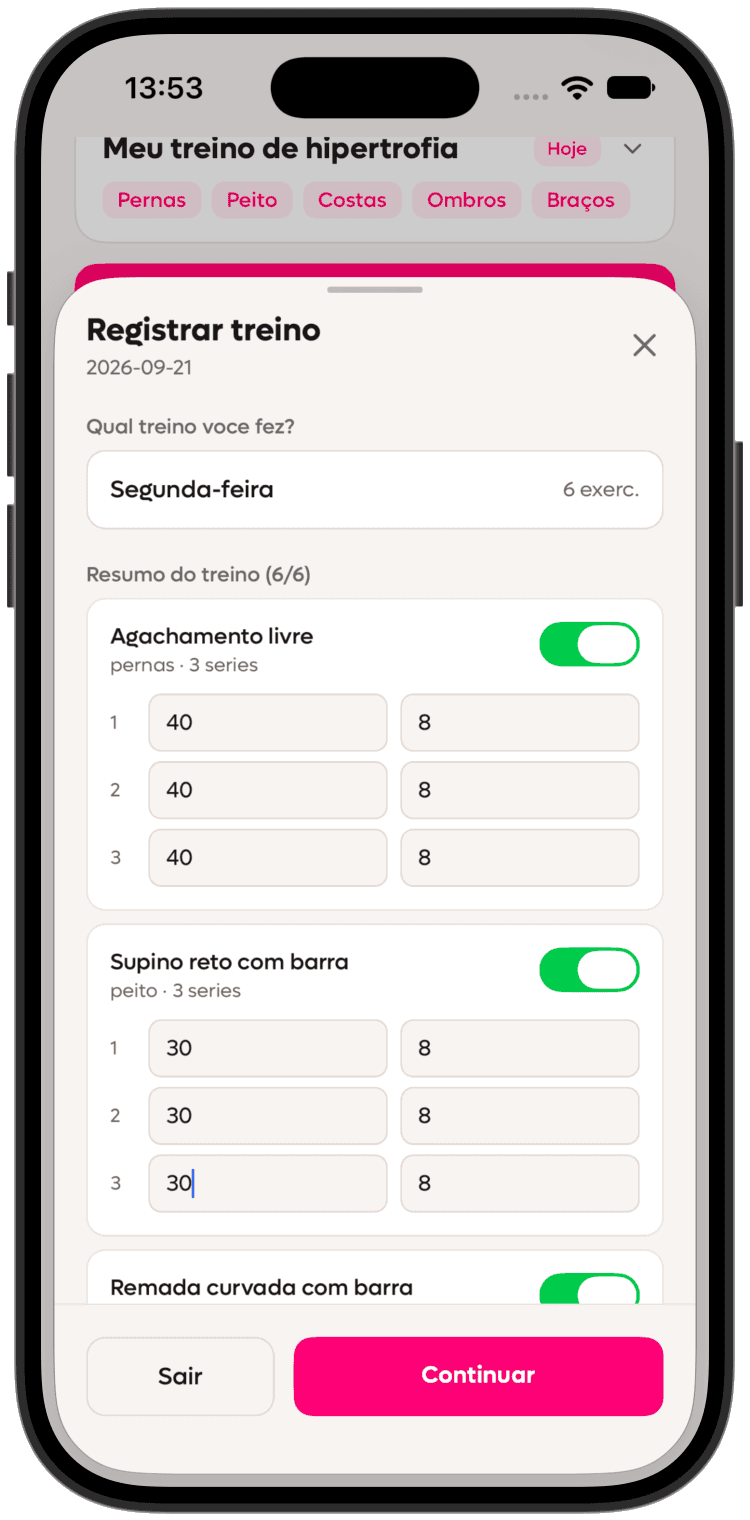
In the session itself, logging and check-ins make a difference. You can save real loads, reps and notes, which helps understand whether the session is actually progressing or just looks good that day. This kind of reading gets even better when you combine it with How to get stronger with SelfShapeAI.
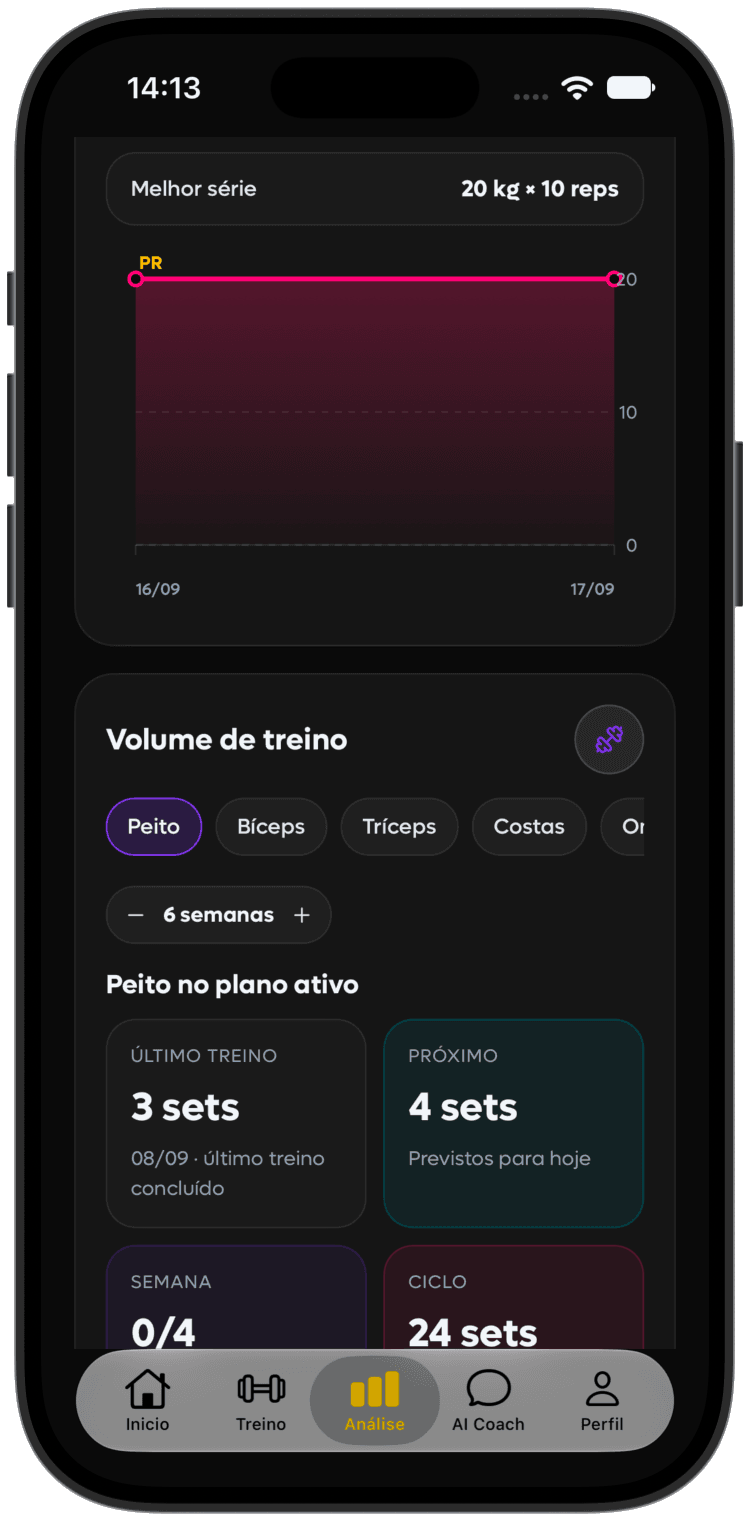
In analysis, SelfShapeAI helps you see the most-worked muscle groups, load progress, top weight per session and planned versus executed sets. In an upper body, this is especially useful because it answers important questions: are you training back with the same seriousness as chest? Is the session turning into real execution? Is the shoulder and arm volume helping or just filling the workout? If you like this reading, follow up with Best workout tracking app in 2026 and the features.
Another strong point is the AI Coach. If an exercise does not fit well, if you need to adapt the session or if you want to reorganize the workout order without destroying the day's logic, it helps a lot. And the plan library is useful for keeping different versions of the session, like an upper body more focused on strength and another more geared toward hypertrophy. To see this broader side of the product, open What is SelfShapeAI, Intelligent AI-powered training and Pricing.
How to notice your upper body is working
- You are progressing on the main compounds.
- The session stays balanced between pushing and pulling.
- Shoulders and arms come in as a complement, not out of desperation.
- The workout does not keep getting longer to look productive.
- You can repeat the session for weeks with good reading.
- The analysis shows real progress, not just a loose feeling.
This kind of reading is what makes the workout stop being random. When you can see execution, volume, muscle groups, top weight per session and consistency, the next decision improves a lot.
Frequently asked questions
- Is upper body the same as upper/lower?No. Upper body is a type of session for the upper limbs. Upper/lower is a way of splitting the week between upper and lower. To go deeper on this, review Upper/lower split.
- Do I need to train chest, back, shoulders and arms on the same day?Not with equal emphasis every session. Upper-body training can alternate priorities if weekly programming covers the intended muscles and respects recovery.
- If I do a lot of bench press and little rowing, does that hurt?It can interfere if back is also a priority and rows lack sufficient volume or performance. No universal ratio exists; compare completed work with your goals and response.
- Is upper body better for mass or for strength?It can work very well for both, as long as the session is well organized and the progression is clear.
- How do I know if my upper-body workout is good?Look at the session's balance, the progression of the main exercises, execution quality and week-to-week consistency. To go deeper on this reasoning, reread How to get stronger with SelfShapeAI and the practical RPE and RIR guide.
- Does SelfShapeAI really help with such a specific workout?It helps precisely because this kind of session depends on fine adjustment: exercise order, stimulus balance, progression, logging and analysis. To see the general proposal, see AI training and the features.
A strong upper-body workout has clear structure, balance and progression. Explore AI training, features, pricing and SelfShapeAI to build or adjust it.
Sources and references
- Source: Nunes JP et al. What influence does resistance exercise order have on muscular strength gains and muscle hypertrophy? A systematic review and meta-analysis. Eur J Sport Sci, 2021. — European Journal of Sport Science (PubMed)
- Source: Haugen ME et al. Effect of free-weight vs. machine-based strength training on maximal strength, hypertrophy and jump performance: a systematic review and meta-analysis. BMC Sports Sci Med Rehabil, 2023. — BMC Sports Science, Medicine and Rehabilitation (PubMed)
- Source: Currier BS et al. American College of Sports Medicine Position Stand: Resistance Training Prescription for Muscle Function, Hypertrophy, and Physical Performance in Healthy Adults. Med Sci Sports Exerc, 2026. — ACSM (PubMed)
Reviewed by the SelfShapeAI research team using strength-training guidelines and studies.
Take this method to the app

Create your plan with AI, log check-ins and use the AI Coach to adjust training with context.
Share
SelfShapeAI Team
SelfShapeAI technical and editorial team.
Keep learning

Recommended next article
Full body vs. split training: which routine makes more sense for your goal?
Find out when full body or a split makes more sense for hypertrophy, a busy schedule and muscle focus.
Continue →