Drop sets: how to do them, when to use them and their role in hypertrophy
Reducing the load and continuing a set can save time and increase training density without being inherently superior to traditional sets.


Do drop sets work for hypertrophy? Yes, but they are no shortcut around the fundamentals. Finish a hard set, reduce the load and continue almost immediately to accumulate repetitions in less time. The muscle keeps working while the lighter weight allows you to extend the effort.
Recent evidence shows similar muscle growth and strength to traditional sets, with potentially shorter sessions. This makes the drop set useful when time is limited or for selectively intensifying an exercise, rather than compulsory in every workout.
Contents
- 1. Short answer: drop sets save time, not guarantee more muscle
- 2. How to do a drop set step by step
- 3. How much weight should you reduce?
- 4. Which exercises suit drop sets?
- 5. Where to put drop sets in your workout
- 6. When to avoid or simplify the technique
- 7. Are drop sets, paired sets and supersets the same?
- 8. Count volume and track progression
- 9. How SelfShapeAI helps remove improvisation
- 10. Common drop-set mistakes
- 11. Frequently asked questions
- 12. Sources and scientific reading
- 13. Intensity that fits the plan
Short answer: drop sets save time, not guarantee more muscle
Meta-analyses from 2023 and 2026 found similar hypertrophy adaptations between drop sets and traditional sets. Some drop-set protocols took half or even one-third as long, explaining their main practical benefit. They increase training density but have not shown consistent superiority for muscle growth.
The method also increases perceived effort and immediate post-workout lactate. That intense sensation does not prove a superior stimulus; it shows that substantial work was compressed into little time. Metabolic stress may contribute, but does not replace tension, progression and recovery.
| Criterion | Drop set | Traditional sets |
|---|---|---|
| Structure | Reduce load and continue with little rest | Keep the planned load and rest between sets |
| Time | More work in fewer minutes | Require full between-set intervals |
| Hypertrophy | Similar average results across studies | Similar average results across studies |
| Strength | No consistent advantage demonstrated | Make rested practice with heavier loads easier |
| Perceived fatigue | Usually greater during execution | More distributed because of rests |
Turn understanding into a workout you can follow
SelfShapeAI uses your routine and goal to build an explained plan, log every session and guide the next adjustment.




Download for free. Annual: R$ 299,90/year, equivalent to about R$ 25/month; monthly: R$ 39,90/month. See how AI training works.
How to do a drop set step by step
The simplest version uses one load reduction. It is easy to record, limits escalating fatigue and already offers the time savings that make the method useful.
- Choose an exercise with quick load changes and a safe way to stop.
- Perform the main set close to failure or to your planned technical-failure limit.
- Reduce the load by roughly 20% to 30%.
- Resume with only the time needed to adjust the weight.
- Continue for more reps while maintaining consistent range and technique.
- Stop when you can no longer repeat the defined technique.
For example, finish a triceps extension with 30 kg, reduce to around 21 to 24 kg and continue. These numbers are illustrative. The ideal drop depends on the exercise, available increments, repetition range and effort left after the first part.
How much weight should you reduce?
About 20% to 30% is a common reference because it usually permits several more reps without making the second part very light and long. The handbook uses this range to keep the continuation demanding. Still, no percentage is universally superior.
- Too small a drop: you may manage only one incomplete rep or lose technique.
- An appropriate drop: permits several controlled reps with the target muscle still limiting the set.
- Too large a drop: may greatly extend the sequence until breathing, burning or discomfort becomes the limit.
Use RIR to describe the first part and record the continuation separately. If you still confuse discomfort with muscular limits, review training to failure and the RPE and RIR guide before adding intensity.
Which exercises suit drop sets?
The best choice is not necessarily the most painful exercise. Choose one where you can quickly reduce load, maintain the path and stop safely. Machines, cables and isolation movements often meet these criteria.
| Simpler fit | Needs more care | Reason |
|---|---|---|
| Machine or cable lateral raise | Heavy free-weight overhead press | Quick changes and lower stabilization demands |
| Leg extension or leg curl | Barbell squat | Safe stopping and simple stack adjustment |
| Cable curl or triceps extension | Barbell curl in a cramped space | Reduce load without changing plates |
| Machine fly or guided chest press | Free-weight bench press without support | Lower risk near failure |
| Machine calf raise | Deadlift or RDL | Lower technical and systemic demands |
This relates to the difference between machines and free weights. A guided path does not automatically improve the method, but can simplify load changes and stopping. Preserve range of motion rather than shortening reps just to extend the sequence.
Where to put drop sets in your workout
The simplest placement is the last set of an accessory exercise near the session's end. Extra fatigue then interferes less with movements still requiring load, stability and concentration. It also reduces the risk of making the whole session hard to compare.
- When time is short and you need to concentrate work.
- In the last set of an isolation or guided exercise.
- In a block with a defined purpose and duration.
- When equipment allows load changes without occupying half the gym.
- When you can recover before training that muscle again.
Drop sets do not replace rest where performance is the priority. Between-set intervals restore force; compressing them changes the stimulus. They also do not replace warm-up sets, which prepare movement without creating early fatigue.
When to avoid or simplify the technique
- You are still learning the exercise and lose technique under fatigue.
- The next session for the same muscle already shows persistent performance declines.
- The exercise requires support, safeties or help that is unavailable.
- Changing the weight takes so long that the sequence becomes another ordinary set.
- Joint pain or increasing discomfort appears during the reduction.
- Your plan already combines many intensive techniques, failure and high volume.
Beginners especially do not need this technique. Build execution, effort awareness and progressive overload first. The path from beginner to results organizes these priorities without relying on advanced methods.
Are drop sets, paired sets and supersets the same?
No. A drop set keeps the exercise and reduces load. Paired sets or supersets perform two exercises in sequence. These methods can save time but distribute tension, muscle involvement and fatigue differently. The superset guide helps distinguish them.
| Method | What changes | Typical use |
|---|---|---|
| Drop set | Load decreases in the same exercise | Extend the set while saving time |
| Mechanical drop set | Leverage or the variation becomes easier | Continue without changing weight |
| Paired set | Two exercises performed in sequence | Concentrate work on a muscle or movement pattern |
| Superset | Two exercises alternate with little rest | Increase density and organize different muscles |
Count volume and track progression
Two or three load reductions do not automatically equal two or three traditional sets. Effort, load and duration differ. To keep history readable, record the main set and mark the drop set, including reduced loads and repetitions where possible.
Training volume must remain recoverable. Simply adding drop sets without removing or reorganizing anything increases total dosage. The guide to how many sets build muscle helps evaluate the trade-off without treating all fatigue as productive sets.
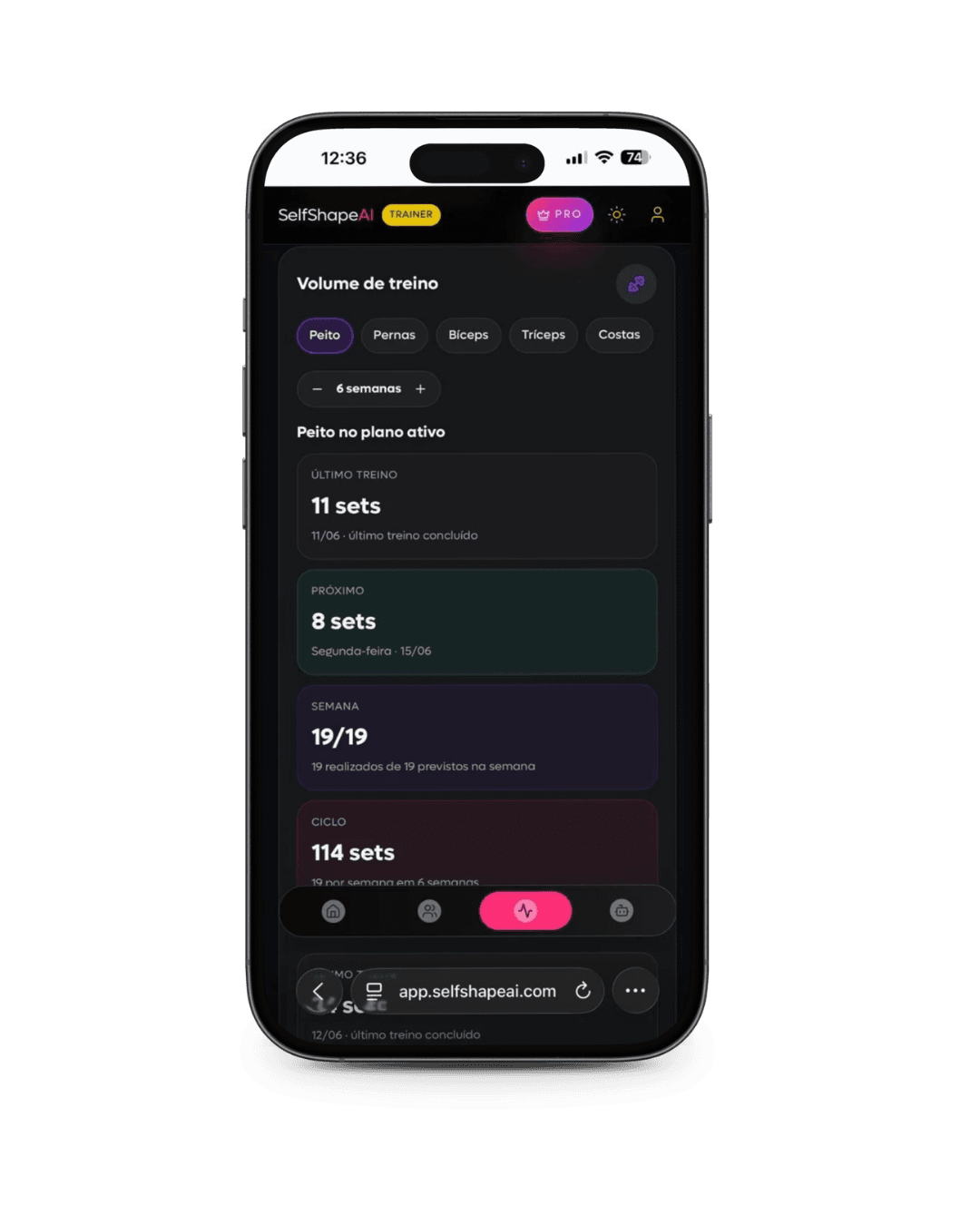
Do not increase load, reps, drop count and frequency together. Keep the method stable for several weeks and apply the criteria for increasing load. If execution worsens or every following session declines, the technique may cost more than it delivers.
How SelfShapeAI helps remove improvisation
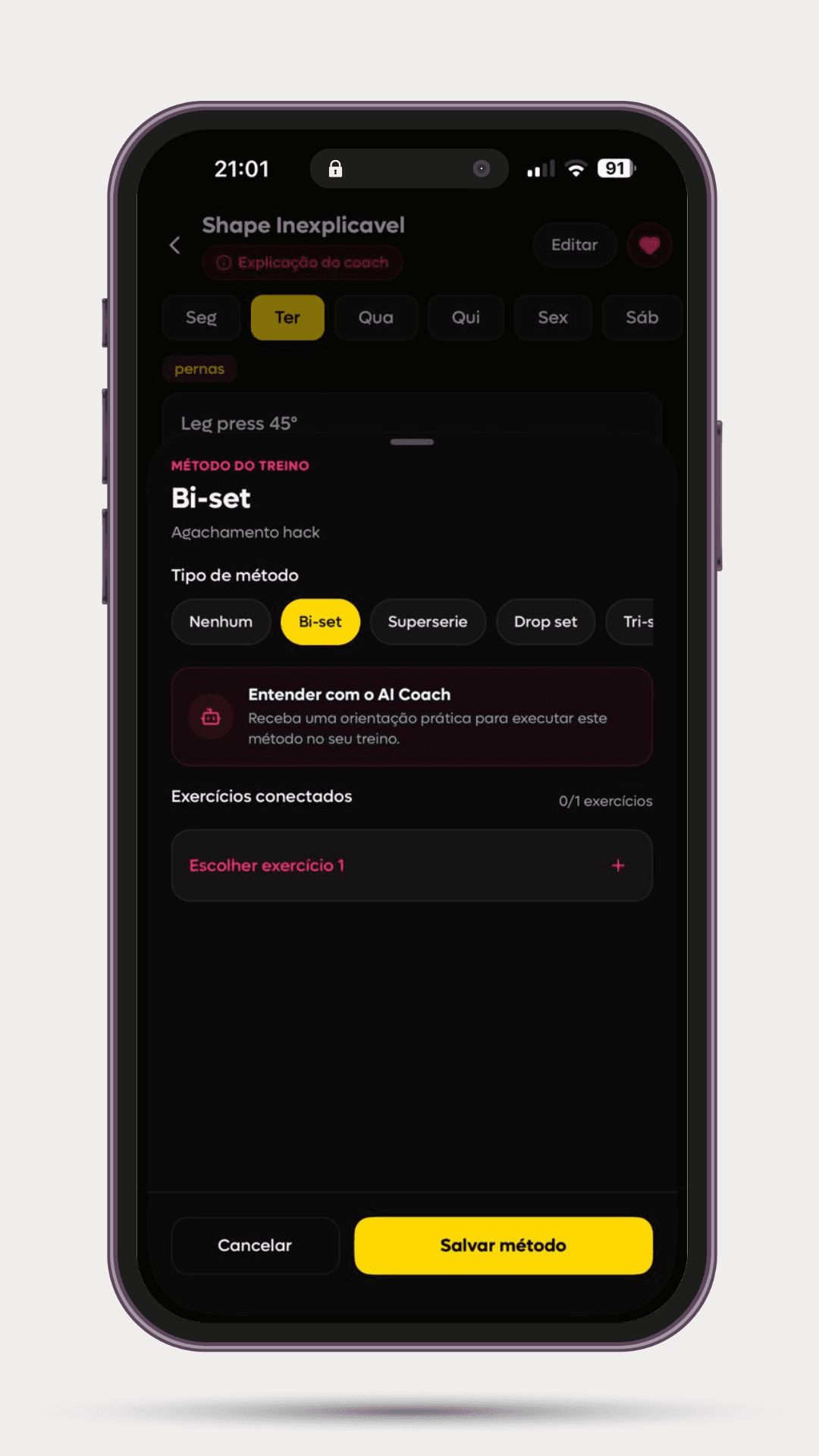
In SelfShapeAI, methods such as drop sets can sit beside an exercise with guidance and notes, while load, repetitions and progress stay connected to the plan. Avoid reaching the middle of a set without knowing how much to reduce, when to stop or how to compare performance later.
Explore AI workout creation, tracking features or how to use SelfShapeAI. Add the method when it solves a real time or organization problem, rather than merely making training more dramatic.
Common drop-set mistakes
- Reducing too little and turning subsequent repetitions into partial movements.
- Reducing too much and extending until breathing or burning is the only limit.
- Performing several drops without logging loads and repetitions.
- Using the technique early and losing performance throughout the rest of the session.
- Using movements with no safe stopping setup or unstable technique.
- Adding it to every exercise without adjusting weekly volume.
Drop sets complement the fundamentals rather than replace them. Technique, effort, volume, progression and recovery still govern hypertrophy. The muscle-building guide connects these variables before intensification.
Frequently asked questions
- How much weight should I reduce in a drop set?About 20% to 30% is a common starting point. Adjust for the exercise and available loads so you can perform several more reps with consistent technique.
- Are drop sets better than normal sets for hypertrophy?Not consistently. Meta-analyses found similar hypertrophy. The clearest advantage is completing comparable work in less time.
- How many drops should I perform?One reduction is enough to use the technique and makes fatigue easier to control. Multiple drops add effort and duration without guaranteeing better results.
- Must drop sets reach failure?Studied protocols often reach or approach failure, but technical failure can be your limit. Define the criterion beforehand and preserve execution.
- Can I use drop sets in every workout?They can appear regularly if the dose is small and recovery remains good, but need not appear in every session or exercise. Treat them as part of total volume.
Sources and scientific reading
Studies used in this review
- Source: Acute and Chronic Effects of Drop-Set Training: A Meta-Analysis and Systematic Review — Sports Medicine - Open
- Source: Effects of Drop Sets on Skeletal Muscle Hypertrophy: A Systematic Review and Meta-analysis — Sports Medicine - Open
- Source: Effects of Advanced Resistance Training Systems on Muscle Hypertrophy and Strength in Recreationally Trained Adults — Journal of Functional Morphology and Kinesiology
- Source: No Time to Lift? Designing Time-Efficient Training Programs for Strength and Hypertrophy — Sports Medicine
Editorial review by the SelfShapeAI team
Intensity that fits the plan
Drop sets are useful when they turn limited time into organized work. They lose value when they merely accumulate fatigue, hide stalled progression or make every session impossible to compare.
In SelfShapeAI, the method comes with context, clear execution and follow-up on what happened. Download SelfShapeAI for free.
Take this method to the app

Create your plan with AI, log check-ins and use the AI Coach to adjust training with context.
Share
SelfShapeAI Team
SelfShapeAI technical and editorial team.
Keep learning

Recommended next article
Myo-reps: how to do them, when to use them and whether they save time
Learn how to perform myo-reps, how long to rest, when to stop and which exercises suit this time-saving technique.
Continue →