Myo-reps: how to do them, when to use them and whether they save time
A hard set, short rests and small blocks of repetitions can compress your workout without treating fatigue as proof of superiority.


Myo-reps extend a set's work without resting two or three minutes before starting another. Perform a hard main set, pause for several seconds, then complete small blocks of repetitions with the same load. The result is a short, dense sequence close to failure.
The technique may save time, but is no magic shortcut to hypertrophy. The first longitudinal study specifically dedicated to myo-reps, published in 2026, found similar muscle and strength gains to traditional sets. The observed advantage was completing the work faster with about 30% less volume-load.
Contents
- 1. Short answer: myo-reps compress your workout
- 2. How to perform myo-reps step by step
- 3. A practical cable-curl example
- 4. Must the activation set reach failure?
- 5. How long to rest between mini-sets
- 6. Which exercises suit myo-reps?
- 7. Are myo-reps, rest-pause and drop sets the same?
- 8. What research shows about myo-reps
- 9. Do “effective repetitions” explain the method?
- 10. Count volume without inflating the workout
- 11. How to progress with myo-reps
- 12. When to use them, and when to avoid them
- 13. Tracking myo-reps in SelfShapeAI
- 14. Common myo-rep mistakes
- 15. Frequently asked questions
- 16. Sources and scientific reading
- 17. Less time, the same clarity
Short answer: myo-reps compress your workout
Myo-reps are a structured form of rest-pause. The initial set brings the muscle close to its limit; short rests restore enough capacity for a few more repetitions without returning you to a fully rested state.
This concentrates difficult repetitions into a short time. Still, difficult does not automatically mean better. Current evidence supports myo-reps as an efficient option, especially for people who know the exercise and need a shorter session. It does not suggest abandoning conventional sets everywhere.
| Method | What happens | Main use |
|---|---|---|
| Myo-reps | A hard set followed by mini-sets with the same load | Concentrate work into less time |
| Traditional sets | Full sets separated by longer rests | Preserve performance and simplify comparisons |
| Drop set | Load decreases after the main set | Continue after you can no longer sustain the initial weight |
| Cluster set | Rests occur before getting close to failure | Preserve repetition speed and quality |
Turn understanding into a workout you can follow
SelfShapeAI uses your routine and goal to build an explained plan, log every session and guide the next adjustment.




Download for free. Annual: R$ 299,90/year, equivalent to about R$ 25/month; monthly: R$ 39,90/month. See how AI training works.
How to perform myo-reps step by step
There is no single protocol accepted across studies and programs. The handbook uses a set to failure, about five seconds of rest and blocks of three or four reps. The specific 2026 study used a six-to-12-rep set to failure, 40 seconds before the first block and 20 seconds between mini-sets, with a five-block limit.
Start with a conservative version to keep the process simple. Learn the technique before adding blocks or reducing rest.
- Choose a stable, familiar exercise that you can safely stop.
- Perform an activation set ending at approximately 0 to 1 RIR.
- Rest for 15 to 30 seconds.
- Perform a mini-set of three to five repetitions with the same load.
- Rest again for 15 to 30 seconds.
- Repeat for another one or two blocks while you can meet the target with good technique.
- Stop when you fall one repetition short of the target or technique changes.
These numbers are a starting point, not a universal definition. Initial-set length, rest and block targets change the protocol's demands. Shorter rests and more mini-sets generally make the sequence more aggressive.
A practical cable-curl example
| Stage | Execution | Decision |
|---|---|---|
| Activation | 12 repetitions, finishing at 1 RIR | Keep the load |
| Rest | 20 seconds | Breathe and maintain position |
| Mini-set 1 | 4 repetitions | Target reached |
| Rest | 20 seconds | Keep the load |
| Mini-set 2 | 4 repetitions | Target reached |
| Rest | 20 seconds | Keep the load |
| Mini-set 3 | 3 valid repetitions | Stop because you did not reach four |
The method does not require a distorted fourth rep to prove failure. The rule was already set: when you cannot complete four reps with the agreed technique, stop. This reduces improvisation and makes your history easier to interpret.
Must the activation set reach failure?
Research protocols often take the activation set to concentric failure. In practice, ending at 0 or 1 RIR may preserve the method's purpose without requiring absolute failure every time. The aim is to start the blocks close to your limit, rather than make each repetition a contest.
If activation ends with three or four reps left, the mini-sets no longer concentrate near-failure work. If it ends with broken technique, the blocks start from a poor reference. Review training to muscular failure, muscular failure and the RPE and RIR guide before using the method.
How long to rest between mini-sets
Rests of 10 to 30 seconds appear in different rest-pause and myo-rep versions. Very short rests accelerate repetition loss; longer ones allow more work. The right rest keeps the sequence compact without turning the next block into another traditional set.
- Five to ten seconds: an aggressive version with a rapid performance decline.
- Fifteen to twenty seconds: a practical reference for many isolation exercises.
- Twenty to thirty seconds: may help with heavier loads or more demanding exercises.
- Beyond that: depending on context, the approach starts resembling separate sets.
Do not confuse the method's micro-rest with ordinary between-set recovery. Full intervals help preserve load and repetitions in traditional sets. Myo-reps deliberately shorten recovery, accepting more fatigue to save time.
Which exercises suit myo-reps?
The best exercise lets you pause, resume and stop without losing position. Machines, cables and isolation movements are often straightforward choices because they need less repositioning during the few seconds of rest.
| Simpler fit | Needs more care | Reason |
|---|---|---|
| Machine or cable lateral raise | Heavy free-weight overhead press | Lower stabilization demands and an easy stopping point |
| Cable curls and triceps extensions | Barbell bench press without safeties | Quick resumption without repositioning a barbell |
| Leg extensions and leg curls | Barbell squat | Lower technical cost as fatigue rises |
| Machine calf raise | RDL or deadlift | Lower systemic and trunk-control demands |
| Chest press or guided row | An unfamiliar movement | Stable path and more predictable failure |
This relates to the comparison of machines and free weights. Both build muscle; machines may simplify a technique requiring repeated restarts under fatigue. In either case, preserve range of motion and planned tempo.
Are myo-reps, rest-pause and drop sets the same?
No. Myo-reps belong to the rest-pause family but follow an activation, repetition-target and stopping-rule structure. Rest-pause is a broader name for methods using short rests to continue with the same load. In a drop set, load decreases to allow more repetitions.
The drop-set guide shows the difference in practice. Supersets instead connect two exercises, rather than extending one movement. All three can save time but create different demands.
What research shows about myo-reps
In the specific 2026 trial, 22 trained men performed flat bench press, incline bench press and cable flyes twice weekly for eight weeks. Myo-reps and traditional sets increased strength and muscle size with no between-group difference. Myo-reps required less time and approximately 30% less volume-load.
The result is promising but narrow: a small sample, only trained men, a few chest exercises and a short duration. It does not prove superiority across muscles or populations. It shows similar adaptations were possible in a more compact session in that context.
Earlier rest-pause studies also generally found similar hypertrophy to traditional sets when volume was matched. A 2026 review observed a possible modest advantage for rest-pause among advanced methods, but concluded that overall superiority of these systems for hypertrophy is not supported.
Do “effective repetitions” explain the method?
A popular idea says only the final repetitions before failure are effective. Myo-reps would concentrate more of them by keeping blocks close to the limit. This is intuitive, but should not be treated as an exact biological count.
Muscle recruitment and stimulus do not switch on only in the last five reps, and each rep does not carry a productive-or-useless label. Proximity to failure helps interpret effort, but load, range, technique and recoverable volume still matter. Use RIR as an estimate, not a cellular stopwatch.
Count volume without inflating the workout
One activation set plus three mini-sets does not automatically equal four traditional sets. Their length, rest and accumulated fatigue differ. Adding myo-reps to the entire plan and pretending weekly dosage is unchanged is also unwise.
- Use the sequence in place of some conventional sets.
- Start with one exercise and just two mini-blocks.
- Record activation and blocks separately in your notes.
- Watch performance and recovery in the following session.
- Add blocks only if technique and recovery remain stable.
Training volume must remain recoverable. Before intensifying, review how many sets to build muscle. More blocks do not automatically mean more stimulus; beyond a point, they may only add fatigue.
How to progress with myo-reps
Choose one variable at a time. Increase activation reps, complete another block within your defined limit or increase load after mastering the top of the range. Advancing everything at once removes your reference point.
A simple progression is to keep the load until you reach the top of the activation range and finish every planned block. Then apply the criteria for increasing load, return to the bottom of the rep range and build back up. This applies progressive overload to the protocol.
When to use them, and when to avoid them
| May make sense | Better to simplify |
|---|---|
| A short session with accessory exercises left | You are still learning the movement |
| A machine or cable you can safely stop | Technique breaks down under fatigue |
| A planned block lasting a few weeks | The plan already contains lots of failure and intensive techniques |
| You can log load, blocks and repetitions | Pain or joint discomfort rises during the sequence |
| Recovery stays predictable | Performance persistently declines in the next workout |
Myo-reps do not replace warm-up sets. Warm-ups prepare movement without substantial fatigue; myo-reps are hard work. For beginners, traditional sets usually teach technique, rest and effort with fewer variables.
Tracking myo-reps in SelfShapeAI
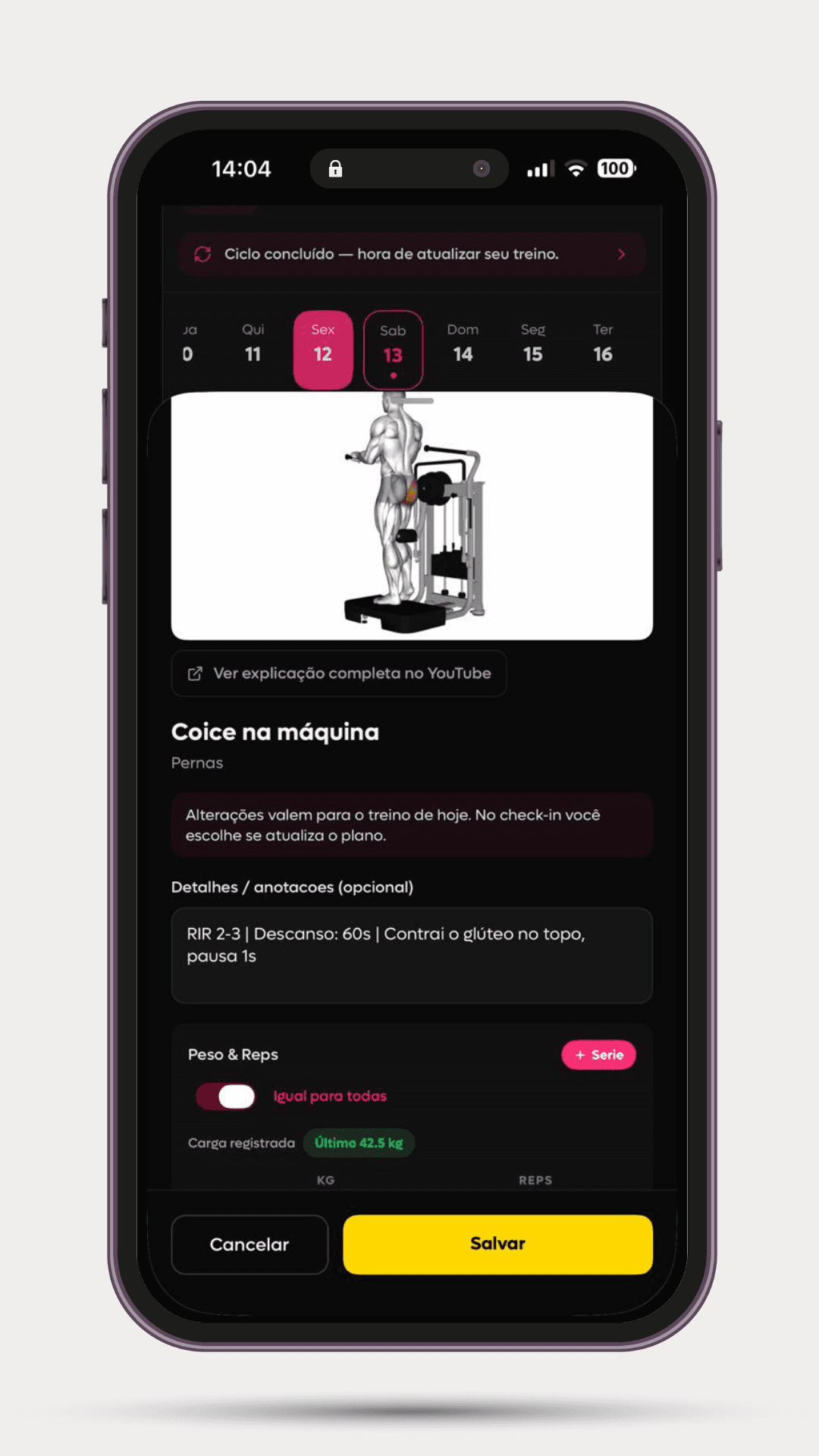
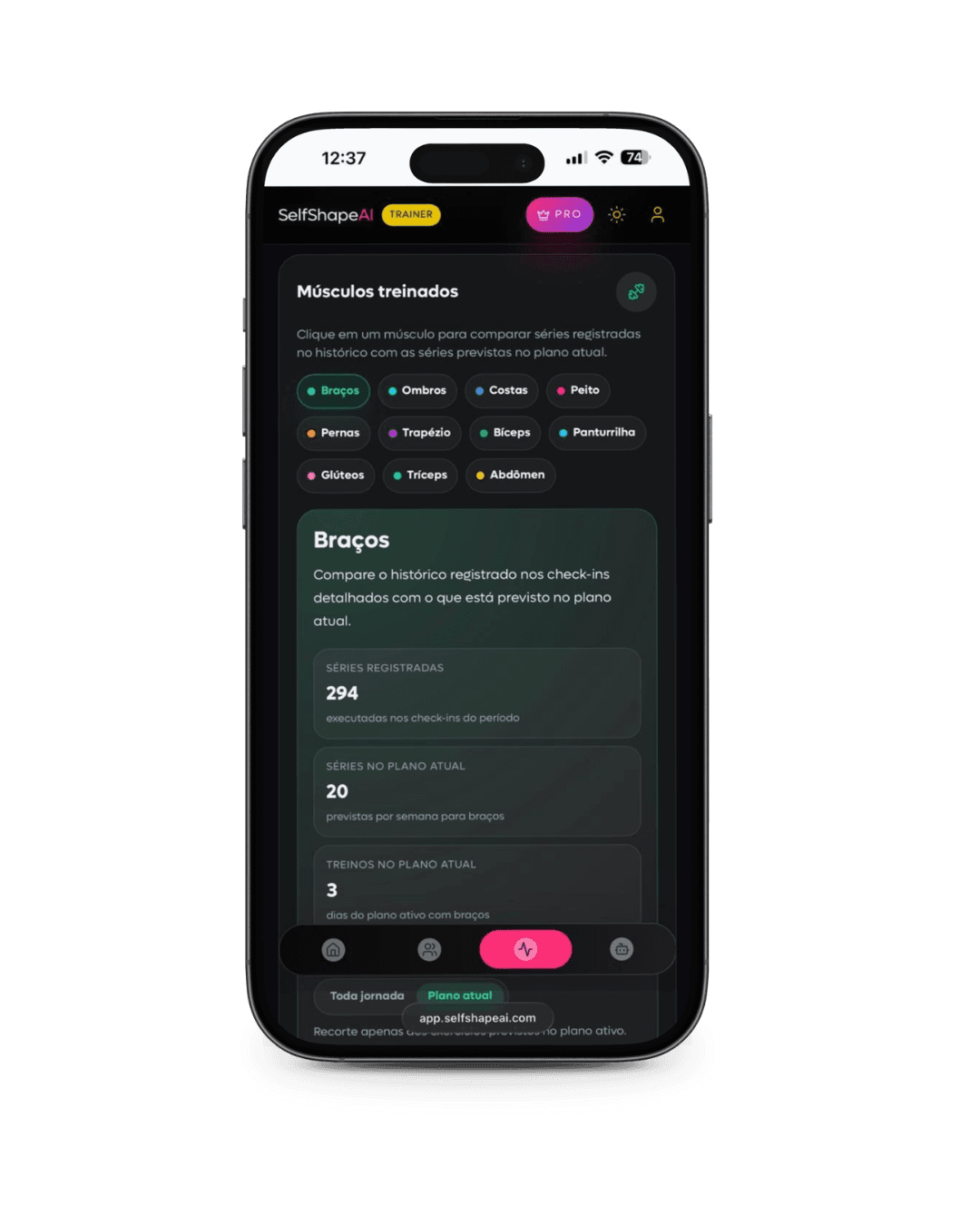
SelfShapeAI does not need an automatic method label for you to track it. Put the protocol in exercise notes: load, activation range, rest duration, target and block limit. Completed repetitions and session effort then become part of your history.
This keeps the method connected to your plan without confusing three mini-sets with three full sets. Explore tracking features, learn about AI workout creation and read how to use SelfShapeAI.
Common myo-rep mistakes
- Starting mini-blocks after an activation set that was too easy.
- Resting without tracking time and turning each block into a separate set.
- Continuing after losing the repetition target or technique.
- Using the method in free-weight compounds without a safe stopping setup.
- Using myo-reps everywhere while keeping all previous volume.
- Confusing burning and breathlessness with a superior muscular stimulus.
- Changing load, repetitions, rest and block count in the same week.
Myo-reps are a density tool, not an entire training foundation. The muscle-building guide organizes technique, effort, volume and recovery before advanced methods enter the plan.
Frequently asked questions
- How many seconds should I rest during myo-reps?Protocols vary. Fifteen to thirty seconds is a practical starting reference. Shorter rests make the technique more aggressive; longer ones support more repetitions.
- How many mini-sets should I do?Start with two or three. Stop earlier if you miss the repetition target or technique changes. More blocks add fatigue without guaranteeing more hypertrophy.
- Do myo-reps require failure?Studies often use failure for activation and the final stopping criterion. In practice, 0 to 1 RIR during activation may preserve the purpose, provided the blocks really start close to the limit.
- Are myo-reps better than normal sets?Not demonstrably for hypertrophy. The specific study found similar growth and strength, with a shorter session and lower volume-load.
- Can I use myo-reps for every exercise?There is no need. Use them selectively in stable, safe movements. Traditional sets remain a better reference when technique, strength or rested performance is the priority.
Sources and scientific reading
Studies used in this review
- Source: Similar Strength and Hypertrophic Adaptations in Less Time? Myo-Reps vs. Traditional Straight-Sets in Resistance-Trained Men — Journal of Strength and Conditioning Research
- Source: Rest-pause and Drop-set Training Elicit Similar Strength and Hypertrophy Adaptations Compared with Traditional Sets — Applied Physiology, Nutrition, and Metabolism
- Source: Strength and Muscular Adaptations After 6 Weeks of Rest-Pause vs. Traditional Multiple-Sets Resistance Training — Journal of Strength and Conditioning Research
- Source: Effects of Advanced Resistance Training Systems on Muscle Hypertrophy and Strength in Recreationally Trained Adults — Journal of Functional Morphology and Kinesiology
Editorial review by the SelfShapeAI team
Less time, the same clarity
Myo-reps make sense when training needs to be shorter without becoming random. Define load, rest, targets and a stopping rule before activation. Intensity then stays measurable, rather than merely tiring.
In SelfShapeAI, method, execution and tracking remain in the same plan. Download SelfShapeAI for free.
Take this method to the app

Create your plan with AI, log check-ins and use the AI Coach to adjust training with context.
Share
SelfShapeAI Team
SelfShapeAI technical and editorial team.
Keep learning

Recommended next article
Drop sets: how to do them, when to use them and their role in hypertrophy
Learn to perform drop sets, choose safe exercises and use the technique without compromising volume, progression and recovery.
Continue →